This article is published in Air Transport World part of Aviation Week Intelligence Network (AWIN), and is complimentary through Dec 18, 2025. For information on becoming an AWIN Member to access more content like this, click here.

Riyadh Air Is Ready For Takeoff

Boeing 787-9

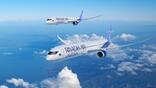
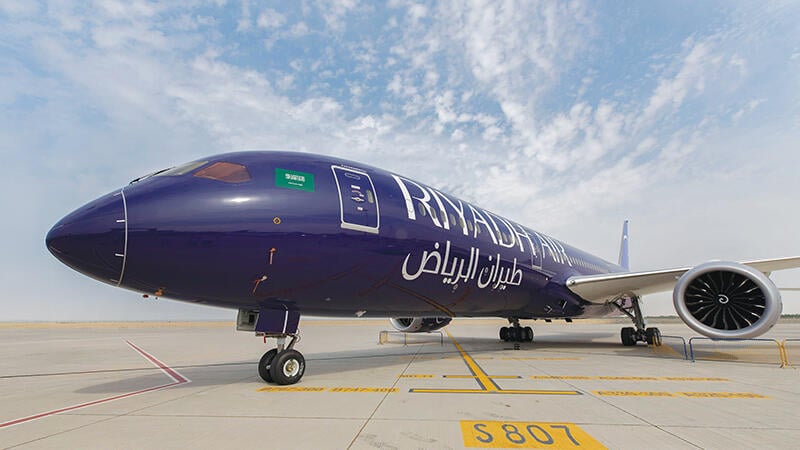
Riyadh Air has been using a Boeing 787-9 as a training aircraft in advance of imminent operations.

Credit: Ivan Batinic/Alamy

After three years, Riyadh Air has taken to the air, at least technically. Riyadh Air has had access to a Boeing 787-9 acquired from Oman Air earlier this year, which has been used as a training aircraft, to familiarize technical staff and onboard crews with the type.

The 787, which Riyadh Air changed to a lease agreement with AviLease in late October,  is being used for what the hotel industry would term a “soft launch” of the airline, with seats on the first few weeks’ flights between Riyadh King Khalid International (RUH) and London Heathrow (LHR) being occupied by staff from Riyadh Air or its parent organization, Saudi Arabia’s Public Investment Fund (PIF) and their family members.

These early travelers will be extensively surveyed on every aspect of their journeys, from baggage-handling to onboard service, with the aim of fine-tuning procedures before reservations are opened to the general public.

That will happen once the second new-build 787-9 is received, for which the precise date is unknown, but certainly before year-end. The initial new-build 787-9 will take over the Heathrow run, while the training aircraft will start services to Riyadh Air’s second destination, Dubai. Once the second new 787-9 is received, the training aircraft will be relegated to use as a technical spare in the event of unserviceability of one of the new aircraft.

The training aircraft is undergoing a modest cabin refresh. The seats will be retained, but new seat covers will be installed to align with the appearance of Riyadh Air’s new aircraft.

Aircraft
Credit: Alan Dron/ATW

Although the ex-Oman Air aircraft has approximately the same number of seats (around 290) as the incoming new-build aircraft, its interior configuration is very different, with only business- and economy-class cabins. The new aircraft, the first of which rolled out of Boeing’s Charleston, South Carolina, paint shop in September, will have a premium economy section as well as business and economy.

Riyadh Air will take delivery of one 787-9 per month (the airline has 39 on order, plus 33 options). It also has up to 50 Airbus A350-1000s on order, plus 60 A321neos. CEO Tony Douglas acknowledged to ATW the longstanding delay problems with Airbus and Boeing deliveries but has taken a conciliatory tone.

“I think you’ve got more chance by being collaborative than critical. I understand many of the challenges they’re facing. Over the past 12 months, they’ve been getting better at getting better. And the fact that we now have finished [787s] going into production test-flight schedules, with a drumbeat of one a month behind it, is a sight for sore eyes,” he said.

However, the OEMs’ delivery difficulties have made the creation of a new airline—a task that would be challenging enough at the best of times—considerably harder, he admitted. He remains cautious over deliveries.

“You don’t know until the day before, or sometimes the day after, that [a new aircraft] will be there,” he said.

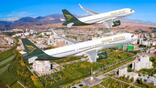
The A350-1000s will be used on denser or longer routes, such as RUH to LHR. Given the scarcity of slots at the UK hub, being able to carry 360 passengers rather than the 787-9’s 290 is an advantage. Additionally, the A350 has a range advantage over the 787, especially when operating from Riyadh, which experiences extreme heat in summer and is 2,000 ft above sea level.

“The A350-1000 gives us the range to the US west coast, when the 787 would be load constricted,” Douglas said.

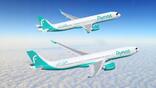
On the narrowbody side, the Airbus A321neos will be divided into two groups. The 30 “standard” A321neos will be deployed largely on regional services among the six Gulf nations, the Indian sub-continent and “up to and around four-hour sectors, give or take.” The second batch of 30 will be A321LRs, which will have a higher-specification cabin—closer to that of the 787s. They will be used to build markets to secondary cities and have sufficient range to cover all of Europe.

Apart from potential delivery problems, the other big unknown in scaling up the company is the availability of slots at destinations.

“I would almost triage this into one-third, one-third, one-third. One-third of the destinations are relatively straightforward to get access to. At the other end, there are one-third that are extremely difficult. And there’s one-third in the middle that, with appropriate knowledge and stakeholder management can be accessed,” Douglas said.

“Where we’ve been extremely fortunate is that we carry the brand of the capital city of Saudi Arabia,” he added, explaining that is a location to which many foreign airlines want access, which can be used to help move some of the “difficult” locations into the middle category.

Also operating in Riyadh Air’s favor is the airline’s status as a new entrant; airports often have a policy of encouraging new arrivals, rather than giving existing operators additional slots.

“Being a new entrant helps because there are remedial processes in some jurisdictions and slot allocations or access rights that encourage new entrants,” Douglas said.

Riyadh Air’s Heathrow slots, for example, are available to entrants as remedial slots that date back to British Airways’ 2012 takeover of British Midland International.

Riyadh Air was conceived as a major plank in Saudi Arabia’s Vision 2030 platform, which seeks to diversify the nation’s economy away from hydrocarbons. More specifically, “The need was always there for a second long-haul carrier for the Kingdom, given its economic growth and poor connectivity,” Douglas said.

At present, almost 90% of RUH’s flights are point-to-point services. Riyadh Air’s initial task will be to greatly expand the list of international destinations available from the country’s capital—100 by 2030 is the target—and it will then evolve into a super-connector, linking those destinations through its hub. The company aims to reach that 100-destination target much faster than regional rivals like Emirates Airline and Qatar Airways have done in the past.

To help reach that target, aircraft will be delivered at a rapid clip. From January, one 787 will arrive every month. When the Airbus aircraft start to arrive, that tempo will increase to two, and eventually three, per month.

The airline has been the subject of a carefully unfolding public relations campaign over the past three years. The next couple of years will be about turning that brand into a real, operational airline.

Alan Dron

Based in London, Alan is Europe & Middle East correspondent at Air Transport World.