This article is published in Air Transport World part of Aviation Week Intelligence Network (AWIN), and is complimentary through Oct 24, 2026. For information on becoming an AWIN Member to access more content like this, click here.
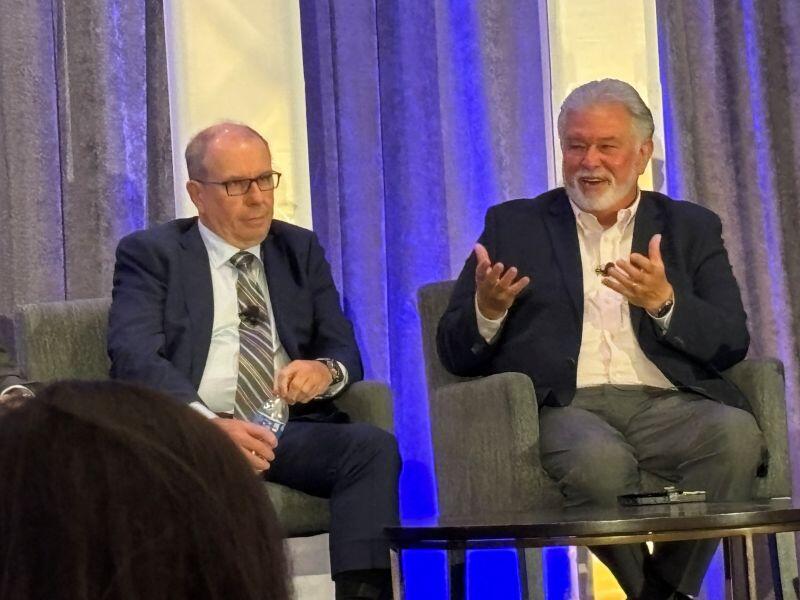
CommuteAir CEO Rick Hoefling (left) and GoJet CEO Rick Leach at the RAA Leaders Conference.
WASHINGTON—U.S. regional airlines must be technology-focused to transition through a challenging environment and into the opportunities ahead, the CEO of United Express partner CommuteAir believes.
As larger mainline carriers up-gauge their fleets away from regional jets, “connecting small cities and those small cities to bigger major hubs is going to be a big challenge,” CommuteAir CEO Rick Hoefling said as a panelist at the Regional Airline Association’s (RAA) Leaders Conference in Washington, D.C., on Sept. 23. “I think that’s where we need to really focus, and there’s really exciting emerging technology that’s coming on the scene with aircraft.”
Working closely with airframers early in new aircraft concept and design processes will be key, Bridgeton, Missouri-based GoJet CEO Rick Leach stressed during the panel discussion. Collaboration on solutions early in the development process ensures an aircraft’s viability for real-world operations.
“A lot of the OEMs see that value,” Leach said. “But they need to bring [the airlines] in at the beginning so we can talk about those solutions as to what works best and when they bring those great solutions back to the table, we can see if they’re going to work.”
The comments were made on the same day that Heart Aerospace announced an order from U.S. public charter carrier JSX for up to 100 Heart 36-seat electric regional aircraft. JSX is also trialing ATR 42-600s and has a letter of intent for up to 82 Electra.aero EL9s, a nine-passenger ultra-short-takeoff-and-landing hybrid-electric aircraft. JSX’s goal is to reach underserved markets that are not accessible via conventional airliners.
Hoefling emphasized the importance of using technology to adapt and fill the growing and significant connectivity gaps in underserved communities.
“At the end of the day, we really have to focus on being able to deliver those technologies, working with FAA to make sure those technologies are coming on board in the right manner, in the right timeframes and with the right safety enhancements,” Hoefling said. “At the end of the day, we’re going to be faced with significant growing pressure on small communities, and I think that’s the biggest challenge.”

Related Content