This article is published in Aviation Daily part of Aviation Week Intelligence Network (AWIN), and is complimentary through Feb 10, 2026. For information on becoming an AWIN Member to access more content like this, click here.

Mongolia's Hunnu Air Aims To Further Boost Its Embraer Jet Fleet

Hunnu Air Embraer 190

A Hunnu Air E190.

Credit: Trevisan Aviation Images/Alamy Stock Photo

SINGAPORE—Mongolia’s Hunnu Air is building up its Embraer jet fleet as it looks to add capacity and expand its network.

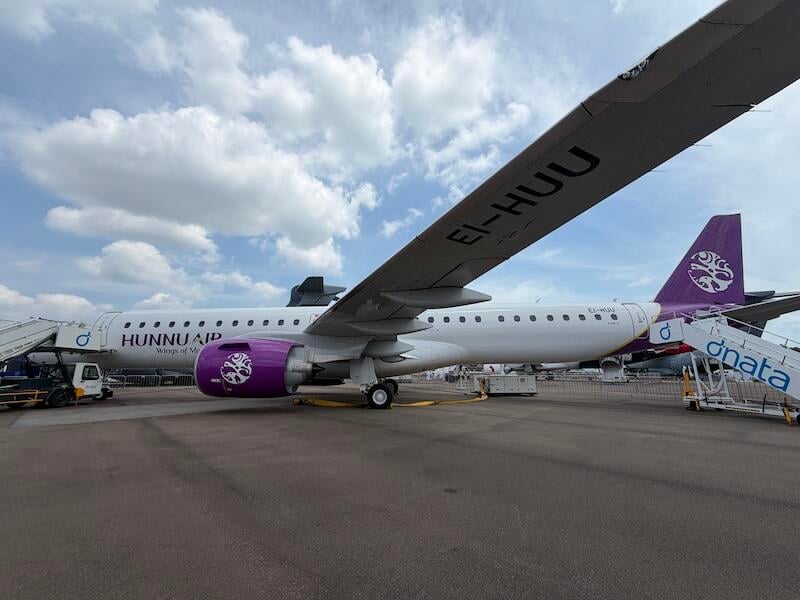
The carrier now operates two Embraer 195-E2s, which were delivered in April and December last year. It also has two E190s in its jet fleet. One of the E2s is on display here at the Singapore Airshow.

Hunnu Air is looking to lease another Embraer jet, airline Vice President Turbold Tserenkhuu told Aviation Week on the sidelines of the airshow. It is currently talking to potential lessors and wants to secure an aircraft later this year.

The airline operates flights to Beijing and Almaty, Kazakhstan, in addition to domestic and shorter-haul routes. It also offers charter flights to markets including South Korea, Japan and the Philippines.

One of its charter flights is to Phu Quoc, Vietnam. At 6.5 hr., this is believed to be the longest flight operated by an E2 jet.

Hunnu Air wants to add scheduled flights to Tashkent, Uzbekistan, and New Delhi in 2026, Turbold said. The carrier already operates some charter flights to New Delhi. Starting with charter flights on some routes allows the airline to build up demand before committing to scheduled service, he said.

The carrier has expanded its share of Mongolia’s international market from 5% in 2022 to 12% now, Turbold said. However, the Mongolian market is dominated by overseas airlines.

Before the COVID-19 pandemic there were seven airlines serving Mongolia, but now there are more than 20, Turbold said. Only three of these are Mongolian.

In addition to its jet fleet, Hunnu Air is adding four Cessna aircraft this year: two 208Bs and two SkyCourier 408s. It also has an ATR turboprop, but it is grounded due to lack of spares and will be phased out, Turbold said.

Adrian Schofield

Adrian is a senior air transport editor for Aviation Week, based in New Zealand. He covers commercial aviation in the Asia-Pacific region.