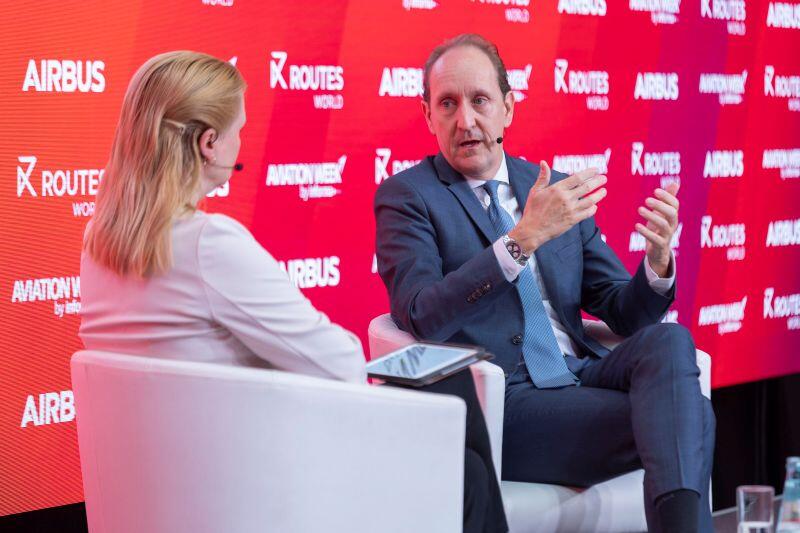
Lufthansa Group Member of the Executive Board and Chief Commercial Officer Dieter Vranckx at Routes World 2026.
FRANKFURT—Lufthansa Group aims to integrate TAP Air Portugal within 12-18 months of completing its proposed investment, drawing on its recent experience of bringing ITA Airways into the group.
The German airline group was selected by Portugal’s government on Oct. 14 to acquire a 44.9% stake in TAP for €1.025 billion ($1.15 billion), beating a rival offer from Air France-KLM Group. The transaction remains subject to regulatory approval, a process that could take a further 12-18 months.
“We follow the process as it has been laid out by the European Commission, so it is difficult to say [exact timelines],” Lufthansa Group Member of the Executive Board and Chief Commercial Officer Dieter Vranckx said during an interview at Routes World 2026 in Frankfurt. “But I would say it is probably in line with the ITA timeline—between one year and one and a half years.”
Once approval is secured, Lufthansa plans to begin realizing commercial synergies, incorporate TAP into its wider network planning and eventually bring the airline into its joint ventures. TAP’s existing Star Alliance membership should make the process easier.
“One big advantage is that they are in Star Alliance, so we don’t need to move them out of an alliance like we had to do with ITA,” Vranckx said.
More News And Analysis From Routes World 2026
Lufthansa expects to follow the integration model developed for ITA, which joined the group in 2025. Vranckx said the process has become more straightforward with each acquisition because common platforms covering revenue management, pricing and network planning are already in place.
“The next one, TAP, should be similar to ITA,” he noted. “Ideally, since we are an ambitious airline group, it should go faster than ITA. I think if we manage it within one year to one and a half years, we should be very proud.”
TAP would fill an important gap in Lufthansa’s network, significantly strengthening its presence on South Atlantic routes, particularly to Brazil. The group estimates that adding TAP would increase its share of Europe-South America capacity to about 20%, broadly level with International Airlines Group and Air France-KLM.
“We were missing some strength on the South Atlantic,” Vranckx said. “Geographically, it fits really well into our multihub strategy.”
The group increasingly plans capacity across its airlines and hubs as a single system, reducing duplication and routing passengers through the hubs best suited to individual markets.
“TAP will have a strong position on the South Atlantic, specifically Brazil,” Vranckx said. “At the same time, they also serve the North Atlantic, which will strengthen our strongholds there, as well as parts of Africa, which we will consolidate into the bigger picture.”
Lisbon is already Europe’s largest gateway to Brazil, accounting for 1.54 million two-way seats during winter 2026-27 and 31.4% of the market, according to OAG Schedules Analyser data. TAP is scheduled to offer about 8.49 million seats across its network during the season, up 5.3% year over year.
The regulatory review is expected to examine potential overlaps between Lufthansa Group and TAP. However, Vranckx anticipates fewer competition concerns than Lufthansa encountered during the ITA transaction. He argued that adding TAP would bring the group’s South American presence into line with those of its main European rivals rather than give it a dominant position.

Related Content