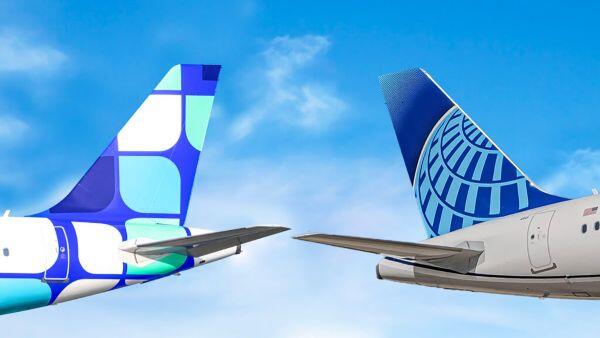
Blue Sky partners JetBlue Airways and United Airlines are firing back at Spirit’s criticism of the partnership, arguing the ULCC’s complaints are “based solely on speculation and calculated misconstruction.”
JetBlue and United unveiled the agreement, which includes interlining and linking the carriers’ loyalty programs, in May. United also gains slots at New York’s John F. Kennedy International Airport, allowing the airline to operate up to seven daily round-trip flights beginning as early as 2027.
Spirit subsequently filed a complaint with the U.S. Transportation Department (DOT) arguing that JetBlue “will become a vassal of United,” noting that the New York-based airline’s network decisions on overlap and non-overlap routes “will certainly be affected by United’s wishes and a ‘combined’ approach to capacity management.”
Additionally, Spirit believes that JetBlue will need to purchase more expensive United miles to offer connectivity to its loyal program members, and “that incremental cost must necessarily be covered by higher JetBlue fares.”
JetBlue and United described that assertion as “wholly unsupported,” arguing, “Blue Sky will maintain JetBlue’s independence, and enhance its competitiveness.” The partners stated that just two weeks after they unveiled Blue Sky, JetBlue launched new nonstop service between United’s Newark hub and Las Vegas and expanded service between Newark and Los Angeles “in direct competition with United’s existing service on these routes.”
Spirit suggested that “at a high level,” the arrangement creates the same anticompetitive incentives found to be present in the now-defunct JetBlue-American Airlines Northeast Alliance (NEA), which a 2023 antitrust ruling shuttered. But JetBlue and United stress, “Contrary to Spirit’s flawed assertions and speculation, the collaboration was specifically designed to fully preserve competition between United and JetBlue, while avoiding the competitive concerns raise by the former Northeast Alliance between American and JetBlue.”
Unlike the NEA, under Blue Sky there is no revenue sharing, no joint network planning and no schedule optimization, JetBlue and United explain.
Spirit also concludes the DOT needs to “investigate how closely the unprecedented selling of both airlines’ tickets on each other’s website, coupled with an interline agreement, is effectively a codeshare.” The Blue Sky partners argue: “Spirit erroneously conflates interlining and codesharing, despite these being distinct legal and operational terms.”
Both JetBlue and United interline with dozens of carriers, including other U.S. airlines. “Spirit’s attempts to misuse the distinct terminologies and mischaracterize the collaboration between United and JetBlue should be ignored,” they conclude.
JetBlue agrees with Spirit’s assertion that the “decision by the prior (Biden) administration to do everything in its power to block the JetBlue-Spirit merger was a serious blow to industry competition and set back both JetBlue and Spirit in their quest for profitability.”
JFK-based JetBlue incurred $3 billion in losses since the COVID-19 pandemic and resulting inflation fundamentally altered the aviation landscape, the partners say, adding JetBlue has not produced an annual profit since 2019.
Blue Sky is an important component of JetBlue’s strategy going forward, “and fully complies with antitrust laws ... and recent judicial precedent,” the partners say.
Spirit also requested a 60-day extension of the federal Blue Sky review. “JetBlue and United respectfully urge DOT to dismiss or disregard Spirit’s complaint and close the docket without further action,” the partners say.

Related Content