This article is published in Air Transport World part of Aviation Week Intelligence Network (AWIN), and is complimentary through Aug 27, 2026. For information on becoming an AWIN Member to access more content like this, click here.
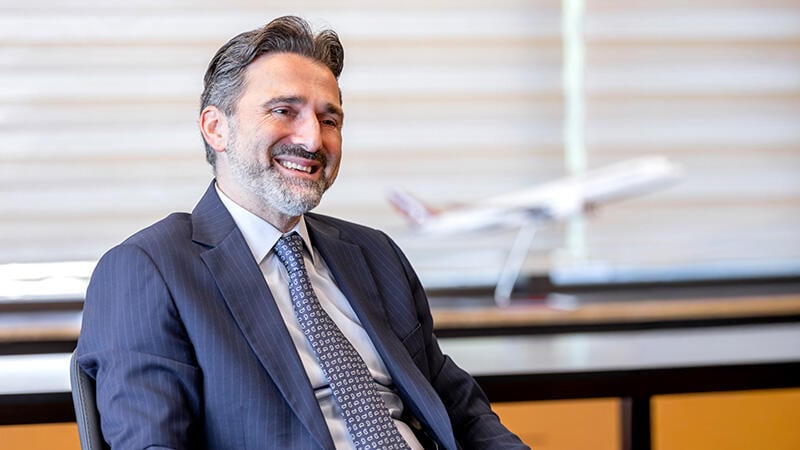
Murat Şeker, a longtime CFO at Turkish Airlines, was appointed to the board in April. He succeeded Ahmet Bolat, who has been chair since early 2022. Şeker gave one of his first exclusive interviews to ATW on the sidelines of this year’s IATA AGM in Rio de Janeiro in June, with the conversation focused on fleet and network plans.
As we are talking in Rio de Janeiro, how important is Latin America for Turkish Airlines? Definitely important. We keep proudly saying that we fly to more countries than any other airline, which brings a lot of diversity, connectivity and success. It also brings quite a few challenges because around the world there are regional crises, different economic developments and so on. But having said that, Latin America is the least covered region within Turkish Airlines’ big network. And part of the reason for that is that as we go through stages of growth, we have to increase our widebody operations. Some of those widebodies have long delivery schedule delays. We have been having meetings with [Airbus and Boeing] on at least stabilizing the delivery schedules of the widebody fleet. Unfortunately, however, we will not get many widebodies in 2026. But looking to the next three years: in 2027 we will receive about 10, the year after about 10 to 12 aircraft and the same in 2029, so by the end of 2029, we should have received an additional 30 widebodies. Most will be Airbus A350-900s and A350-1000s, along with some [Boeing] 787s. With this additional capacity, we will have more ability to grow in Latin America. This region is important. In the Americas, we have about 25 or 26 destinations, 14 of which are in the US. We want to grow and are looking at alternatives. Plus, our relationship with Air Europa is also important when thinking about growth in this part of the world.
Would you shift some capacity from other regions, such as the Gulf, to Latin America? Our Latin America growth strategy plan was established long before the Gulf crisis. And we have been tested by such phenomena for a long time. Whenever there is a crisis, be it financial, economic or geopolitical, we must be able to redirect the network. The Gulf crisis demonstrated that very clearly. Having good regional coverage is important considering our size. We have carried out our strategy to grow in Latin America. The capacity we pulled out of the Middle East region, from those countries where we suspended operations temporarily, was quickly put into the Far East, some parts of Africa, the [Commonwealth of Independent Sates] and some parts of Europe.
What are you hearing from Airbus and Boeing about delivery schedules going forward, and what is Turkish Airlines’ stance on the Boeing 777X? We are evaluating the 777X. That’s an aircraft type we looked closely at as we negotiated for the 787, for which we placed an order with Boeing in September last year. That order did not include 777Xs, but we have options that can be converted to some 777X-9s. The 777X earliest delivery for us would be in 2034. That is too far in the future. But definitely, this is an aircraft, like the A350-1000, that we would like to have in the fleet. We will look at how many 787s we would like to convert into 777Xs.
We have been informed by Airbus that [in 2026], we will receive only three A350s. Airbus doesn’t expect further delays after that unless a new crisis comes along. We will see. We are working on it. Also, we have around 30 Airbus A320neos grounded because of the Pratt & Whitney GTF engine issues, and this number might go up by the end of the year. Pratt & Whitney is improving, but we still have quite a sizable number of [GTF-powered] aircraft and those groundings are definitely not going to go to zero in the next two years.
For an airline the size of Turkish Airlines, what is the right mix of leased and owned aircraft? In the past, we have always favored financing; we want to own our aircraft. But leasing has always been a nice, albeit small, portion that provides flexibility. Today, roughly 150 of our 540 aircraft are owned and fully paid off, about 250 aircraft are financed and 120 are under operating lease; the remaining aircraft are owned. We want to keep it that way. It provides flexibility.
What about regional jets, such as the Airbus A220 or Embraer E2, on routes such as Istanbul to London City Airport? We studied those two options for a while and could not get anything reasonable in terms of price, and the timeframe did not fit well with our needs. At that time there were much bigger concerns about the Pratt & Whitney engines, so we paused our analysis. We are going back to considering regional jets again and have started to talk to [Airbus and Embraer]. We have not come to a decision or clear preference yet, but we feel there might, if the math adds up, be scope for regional aircraft in our large network. We operate to 127 destinations across Europe. There are secondary and tertiary cities. In those cities, having a smaller-capacity aircraft feeding our huge Istanbul hub network could be beneficial.
What configurations are you using on those A350-1000s designated for Australia routes? That kind of aircraft can be utilized for Santiago de Chile and Buenos Aires, for example, as well as Australia. We have a special dual-class configuration for the A350-1000: 66 business-class seats and 229 economy-class seats for a total of 295 seats. But we are also considering premium economy class. We have studied premium economy for some time now and will make a decision soon. We will introduce that from early 2028 and then use it on the ultra-long-range aircraft particularly. The first A350-1000 should enter operations by the end of 2027.
You’ve invested in Air Europa. Would Turkish Airlines be interested in also investing in an airline in Central Asia, where you are strong? We are always looking for strong partners and collaborations regardless of the region. But definitely, that region is particularly important. There are some Asian countries where we have an appetite for growth, organically or nonorganically. In Central Asia, there might be opportunities in passenger, cargo or MRO markets. With Air Europa, we are still in the approval process. That’s why we are not saying much about that investment. We got approval from the Spanish government, and the European Commission’s approval process is ongoing and will probably take [until end of July or August]. But things are moving according to plan.