This article is published in Aviation Daily part of Aviation Week Intelligence Network (AWIN), and is complimentary through Jun 14, 2026. For information on becoming an AWIN Member to access more content like this, click here.
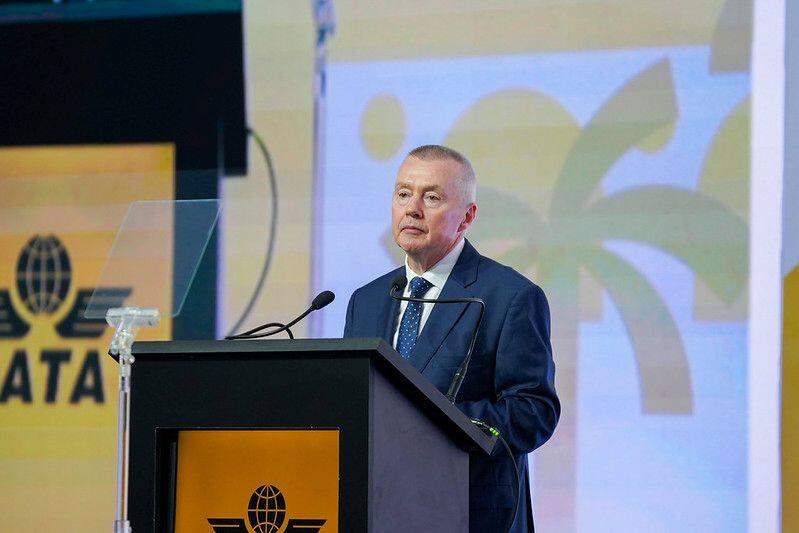
RIO DE JANEIRO—When Geraldo Alckmin, the Vice President of Brazil, gave his opening remarks at the IATA annual general assembly in Rio de Janeiro, he sounded like someone from a different age.
He was speaking of aviation as being the force for democratization of opportunities and a driver of global integration. And as for sustainability, Alckmin portrayed his country as being in a “privileged position to be a leader,” given its potential for sustainable aviation fuels (SAF) production.
But when IATA leaders presented their latest forecast for the financial performance of aviation and the state of the industry, attendees or the global airline event were quickly brought back into the harsh reality of the world as it is today and the consequences for airlines. “We see costs increasing everywhere,” IATA’s Chief Economist Marie Owens Thomsen said. “We are living through this crisis, an oil crisis compounded by a refining crisis.
“Once again, we meet in challenging and unpredictable times,” IATA’s outgoing Director General Willie Walsh said. The industry is facing the fallout of the Iran war and a “tectonic shift in trade,” he said.
The numbers: IATA halved its profit forecast for the industry from $45 billion to just $23 billion, with the net margin shrinking from 4.2% to 2%. Airlines will have to digest $100 billion in additional fuel costs this year, as jet fuel will be 70% more expensive on average than the industry group expected in January.
Airlines in all but one major region will remain in profit territory with Europe leading in terms of absolute numbers ($9.6 billion) followed by North America and Asia-Pacific. Airlines in the Middle East, most severely impacted by the war, will post a $4.5 billion loss in 2026.
However, Walsh does not believe that there will be a structural change for the Gulf carriers. “They will regain their position once we see stability; the model is not damaged by the short-term impact,” he predicted. Obviously, that assumes an end to military action in the region.
In the first four months of the year, traffic in the Middle East was down 24%, but IATA is only predicting an 11% decline for the full year, therefore expecting gradual recovery. Walsh praised the carriers in the Gulf, saying they were doing “everything they possibly can to operate as many flights as they can.” Also, customers were “strongly appreciative” of the efforts by the airlines to accommodate them under difficult circumstances.
Walsh also sees “no way” that Gulf carrier capacity can be replaced in the Europe-Asia Pacific market.
The year 2026 has been “tough ... for all airlines, particularly those whose balance sheets have not recovered,” Walsh said. “The good news is that demand is holding up,” even though airlines globally have raised fares and many expect to be able to pass through up to 100% of the increased costs over time. Walsh also dismissed the notion that there would be a shortage of jet fuel. “The fuel situation has been addressed,” he said. “I don’t believe there are concerns about a shortage of supply.”
IATA predicts an average jet fuel price of $152 per barrel through 2026 with Brent at $95 and therefore a $57 crack spread. “This is eyewatering stuff,” Owens Thomsen said. “It will affect absolutely everyone in the global economy.” She pointed out that typically a $10 increase in the price of crude oil ,Passenger traffic will still grow by 2.1% in 2026, and cargo demand will be up 0.7%.
Walsh pointed out that the industry is also facing $11 billion in higher costs because of delayed deliveries of engines and aircraft. “We are missing 5,000 replacement aircraft,” he said, leading to missed efficiency gains, higher lease rates and other unwelcome effects. “The supply chain continues its failure to deliver aircraft and engines,” he stressed.
Walsh criticized engine manufacturers for making high profits when their customers were suffering and accused them of “gouging” the airlines. “They have disappointed us with the new technology engines they have developed. It used to be taken for granted that the engine was going to work and that it was going to stay on wing for years.” Walsh demanded: “stop gouging us and get back to making great engines that work and last. Allowing these failures to continue into the next decade is completely unacceptable.”
Given slow progress in SAF production, Walsh made clear that “there is still hope for net zero 2050, but it is fading fast.” Last year, only 0.8% of fuel needs were covered by SAF with 2.1 million tons of fuel having been produced. Production needs to rise to 500 million tons by 2050, according to IATA estimates, to reach the targeted volume of 65%.