This article is published in Air Transport World part of Aviation Week Intelligence Network (AWIN), and is complimentary through Jul 10, 2026. For information on becoming an AWIN Member to access more content like this, click here.

How Robotics Are Changing Airport Operations

Airstar Robot

The Airstar Robot at Seoul Inchoen Airport is a multi-functional “guide/patrol/docent” machine.

Credit: Delta Air Lines

For several years, there have been forecasts of major changes coming in the way airports operate, for both passengers and operators. Robots are being increasingly used and may be the key to fast-tracking those changes.

From the passenger perspective, biometric identification makes it likely that in a few years, people will walk through airports from curb to gate without once presenting paper documents such as boarding passes or passports, with their progress being tracked electronically through the terminal.

For such a system to operate, passengers will be required to hand over increasingly large amounts of personal data. However, every indication is that most people are prepared to do so in exchange for increased convenience.

That convenience means greatly extending the data incorporated into the electronic documents required for flight. While electronic boarding passes are common today, their utility will be greatly expanded, including passport information and ancillary information.

Robot
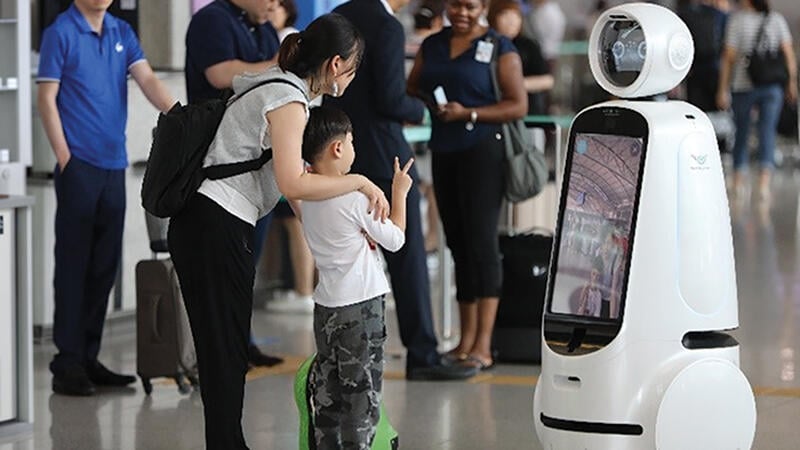
Robots like this one are being employed for passenger check-in at Seoul Incheon Airport. Credit: Alan Dron/ATW

In April, IATA published the results of several digital identity Proofs of Concept (PoCs) completed with the support of airlines, airports, technology providers and governments across Europe and Asia-Pacific. The successful PoCs demonstrated that contactless, biometric-enabled international travel is already achievable with digital identity replacing paper documentation. They also showed that interoperability of systems is sufficiently advanced to support contactless journeys involving multiple carriers and different digital identity wallets (including Digital ID in Apple Wallet for US passport holders and Google ID Pass for UK and US passport holders) as well as national digital identity programs such as India’s Digi Yatra.

For airlines, moving from a simple boarding pass to a “journey pass” that can incorporate details of not only a flight but also hotel bookings or entertainment at a destination is the vision, according to Amadeus’ head of product marketing Valerie Viale.

A few airlines are already taking steps towards developing such a journey pass and she anticipates it will become commonplace in the next five to 10 years.

Amadeus is also seeing the early stages of AI being introduced to airports. Initially, AI is being used to help airport personnel make smarter decisions through offering automated recommendations to personnel, the company says. Assistance can take the form of briefing staff at the start of their shifts on events that occurred before they came on duty, as well as indicating which areas of work will require their focus in the next few hours. (see also AI Transformation on pg. 28)

Amadeus is already seeing requirements start to come in from airports. However, it emphasizes that it is not looking at full automation of functions but rather having a human in the loop. “We’re trying to accelerate and enable workers to take smarter decisions,” an Amadeus spokesperson said.

Within terminals, robotics are starting to make their presence known in the form of self-guided devices that can assist passengers. Among the locations using these are Seoul Incheon Airport, which has recently introduced two types of multi-function robots—a “guide/patrol/docent” machine known as Airstar and a self-check-in variant, Airchecky.

Around 30 of the machines have been in use since early this year, with Airstar able to dispense information on flights and airport facilities, as well as offer the best route to reach terminal locations. Passengers can use voice or touch commands to elicit the information in several languages. Reactions from users so far have been “very positive,” according to airport authorities.

The use of passenger assistance robots expands in the new Incheon Terminal 2, which features the Airporter robot that supports wayfinding with baggage transport, as well as an autonomous people mover called Air Ride that can ferry a group of people between gates.

“A key challenge identified during operations was the need to manage different robot types through separate control systems,” an Incheon airport spokesperson told ATW. “To address this, we have established an integrated robot platform this year to support more efficient and scalable operations.”

The airport is looking to invest in a robotics-based airport operating system supported by private 5G infrastructure, digital twin technologies, and integrated control platforms, allowing robotics investment to be viewed as part of the airport’s broader digital transformation and automation strategy

In the world’s largest market for industrial robots, China’s robot presence represents more than half of the world’s installations. Chongqing Jiangbei International Airport has started operationalizing eight “porter” robots in the new Terminal 3. Called “Yu Feifei,” these robots use facial recognition technology to guide passengers to their desired location in the terminal and also can carry up to 8 kg of carry-on baggage. Designed by Chongqing Airport Group and Xiamen Ruiview Information Technology, feedback for Yu Feifei has been positive, with passengers generally finding it easy to operate, responsive and well-suited to travel-related service scenarios.

BAGGAGE HANDLING

More importantly, Chongqing is the first airport in China to use robotic arms to handle and sort check-in luggage. Using visual and tag-based recognition, two robots load bags into carts at a rate of 180 pieces an hour. Chongqing airport says the grabbing technology also reduces baggage damage. Developed by a subsidiary of the Second Research Institute of the Civil Aviation Administration of China—Chengdu Civil Aviation Logistics Technology Co.—and Chongqing Airport, these arms are paired with 13 autonomous baggage robots to transport oversized or transfer baggage and, in all, can handle 357 bags an hour, with a 65% improvement in efficiency compared to manual operation.

Porter Robots
Chongqing Jiangbei International Airport debuted “porter” robots in the new Terminal 3 that use facial recognition technology to guide passengers and also can carry up to 8 kg of baggage. Credit: Chongqing Jiangbei International Airport

The airport told ATW that to date the robotic arm system has processed more than 5,000 pieces of baggage in both live operations and testing, although the grasping success rate has not yet reached expectations because of the wide variation in bag material, shape, size and weight,

“Further improvements will require accumulating real-world baggage data for deep learning and optimization to enhance handling efficiency,” the spokesperson said.

In Singapore, the International Center of Aviation Innovation (ICAI) is expanding its focus beyond passenger experience to develop airside robotics solutions aimed at reducing manpower requirements as airport capacity grows.

Paul Tan, ICAI head of program management and airport program director, told ATW the center is working with industry partners—including aircraft manufacturers, airports, ground handlers, ground support equipment providers and academia—to rethink operational processes and accelerate adoption of automation technologies.

Low-hanging fruit include deployment of autonomous tractors and cargo dollies, which are already widely used at airports like those in Hong Kong and Singapore. The next challenge is the interaction with aircraft on the ramp, such as opening of cargo doors and plugging of fuel lines.

A longer-term objective is the deployment of robotics inside aircraft for baggage and cargo loading, an area that remains technically challenging. A key barrier is the current lack of industry-wide standardization in data and communication protocols, which is necessary for different robotic systems to operate as a unified network and deliver productivity gains.

The main thrust therefore revolves around autonomous and semi-autonomous airside operations, robotics for physically demanding tasks and developing a digital coordination layer to integrate these systems. ICAI is also seeking an airport partner to serve as a test bed for these applications. Tan said real-world deployment, coupled with transparent data-sharing and validation of standards, will be critical to gaining acceptance from industry stakeholders and regulators.

The center is developing a robotic arm for ramp-side baggage handling, designed to transfer bags from tractors into aircraft cargo holds.

Variability of operations is identified as an issue for introducing robotics into airports.

“Airport operations rarely involve neat, standardized inputs. Bags vary in shape, weight, stiffness and placement. Equipment positioning differs from one turnaround to another, and work practices can vary across operators and shifts,” Tan said.

One location where robotics will be used extensively is Poland’s planned multimodal transport hub, Centralny Port Komunikacyjny (CPK), around 40 km west of Warsaw. The largest airport in Central and Eastern Europe, it is planned to open in 2032 with an initial annual capacity of 34 million air passengers.

The hub’s backers are looking at robotics, notably in the baggage-handling system where a contract has already been awarded but make the point that it is difficult to estimate the extent to which robotics and AI will be employed because the technology is developing so quickly.

“We’re setting the scene as opposed to [naming] specific systems,” a CPK representative told ATW at the Passenger Terminal Expo and Conference in London in March. Maintenance, such as snow removal in winter, is another area that is a candidate for robotics.

SNOW REMOVAL

Automated snow removal is a field that has already been trialed in several Nordic nations. At Ivalo Airport, northern Finland, as long ago as 2019, a worker pressing a single button at the small regional airport could trigger the deployment of multiple snow-plow-equipped tractors, which lined up in perfect echelon formation and proceeded to clear the 2,499-meter single runway, without a single human at their controls.

Operating along predefined waylines loaded into an onboard computer, the vehicles were programmed to clear runways, taxiways and aprons more efficiently than humans, with no risk of accidents through tiredness or momentary inattention.


Øveraasen Driverless Snowplows
Stockholm Arlanda Airport uses Øveraasen driverless snowplows. Credit: Avinor

Finavia, which operates the Nordic nation’s airports, told ATW that “We still see autonomous vehicles as a viable solution, but we have not launched new pilots or moved to using fully automated machinery.”

However, the technology has been taken forward in both Sweden and Norway. At Stockholm Arlanda Airport, airport operator Swedavia uses six autonomous snowplows to keep the airport’s runways clear in wintry conditions.

The system uses Norwegian company Yeti Move’s autonomous system, enabling Øveraasen driverless snowplows to clear runways to tolerances of as little as 1 cm. “By leveraging advanced positioning and coordination, the technology allows multiple vehicles to operate in formation, ensuring continuous and reliable snow removal,” Yeti Move says. “Arlanda’s adoption of this autonomous solution is part of Swedavia’s broader strategy to enhance operational efficiency and sustainability.”

Arlanda’s move to full autonomy is an advance from just a few years ago, when several Nordic airport authorities said that they foresaw semi-autonomous systems as being the way forward, at least in the short term, with a human riding in one vehicle of a group to supervise their performance.

Similarly, Oslo Gardermoen has six Yeti Move-enabled autonomous Mercedes snowplows working in formation to clear airside areas of snow. Operations in the Norwegian capital demonstrate preplanned missions, real-time predictive capabilities, and coordination with air traffic control.

Robotics, often linked with AI, are starting to make inroads in a wide range of activities, according to the Airports Council International—Europe’s recent report Regional Airports and Innovation.

“The concept of autonomous airport systems is gaining traction as regional airports seek to optimize efficiency while managing limited human resources,” the report notes. “These systems include automated airside vehicles, AI-driven scheduling tools, and remote-operated control towers—all designed to reduce operational costs and enhance reliability.”

Inside terminal technologies such as intelligent lighting, HVAC automation, and predictive analytics for passenger flow management are helping small airports operate more sustainably and responsively.

Ground operations are also seeing efficiency gains from autonomous systems. “Automated baggage handling systems—once the domain of large hubs—are increasingly scalable and affordable, offering mid-sized facilities faster processing times and fewer manual errors,” the report says.

“On the airfield, robotic solutions for maintenance tasks such as runway inspection, vegetation control and pavement cleaning improve safety and free up staff for higher-value activities. Additionally, robotic ground support equipment, including autonomous tugs and cargo loaders, is being explored as a way to increase turnaround speed and reduce emissions,” the report says.

Spanish airports operator AENA, for example, has undertaken a project with autonomous jet bridges at Seville, Vigo and Menorca airports, with the aim of validating remote, automatic control for passenger bridges, “reducing on-site staff, boosting efficiency, cutting costs, and enhancing safety.”

At Seville, “the project focused on remote guidance system validation, digitizing control stations and enabling remote operation via cameras and alerts.

“Vigo implemented multi-phase solutions, including remote control, automatic docking with AI, obstacle detection using LiDAR and video analytics and a dispatcher interface.

“Menorca piloted autonomous operation without onboard operators, relying on radar sensors and video analytics for safety. Technologies include AI, computer vision, LiDAR, radar, and real-time processing, addressing automation needs to improve reliability, reduce turnaround times, and lower safety risks,” the report says.

KPIs for the project include an increase in turnaround efficiency per person, a reduction in time between docking connections, reduction in disconnection time and improved detection of people and objects around sensitive zones using AI analytics.

ICAI’s Tan noted that adoption of robotics will be gradual, with incremental progress needed to build confidence across the sector. He expects the full cycle—from technology development and demand aggregation to industry acceptance—to take 10-20 years

“[Adoption of industry standards] will require strong program management, coordination with relevant stakeholders and third-party certification to build trust,” he said. “This is a long-term effort. The more trust you build, the more adoption you will see.”

He called for the industry to imagine the ‘future state’ where all aspects of life will adopt automation, adding that airports risk falling behind broader societal trends if they fail to adopt automation, potentially remaining among the most labor-intensive sectors.

Chen Chuanren

Chen Chuanren is the Southeast Asia and China Editor for Aviation Week's Air Transport World magazine and the Asia-Pacific Defense Correspondent for Aviation Week.

Alan Dron

Based in London, Alan is Europe & Middle East correspondent at Air Transport World.