This article is published in Aviation Daily part of Aviation Week Intelligence Network (AWIN), and is complimentary through Jul 09, 2026. For information on becoming an AWIN Member to access more content like this, click here.
Breeze Airways founder and CEO David Neeleman.
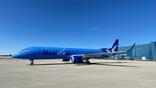
MIAMI—Five years after launching Breeze Airways in the middle of a pandemic, founder and CEO David Neeleman believes the startup has found its footing and profitability by doing something much of the US airline industry abandoned years ago: connecting underserved midsize cities with nonstop flights.
Speaking on a panel discussion and on the sidelines of the Aviation Festival Americas conference in Miami, Neeleman described Breeze as “a transportation system where there isn’t transportation” versus a traditional airline.
The model appears to be working. Breeze operates or has announced 335 routes across 90 cities, with approximately 85% of those routes facing no nonstop competition. The airline recently became profitable despite much higher fuel prices. “Budget didn’t show us being profitable in the first quarter [of 2026],” he said, but “even with the elevated oil costs, we made money in the first quarter for the first time.”
Much of Breeze’s strategy centers on avoiding direct competition for spill traffic with larger airlines while stimulating entirely new traffic flows. Neeleman pointed to Charleston, South Carolina, from where Breeze will soon serve nearly 30 nonstop destinations.
Before Breeze entered those markets, approximately 710 passengers traveled between Charleston and those cities per day, mostly via hubs, Neeleman said. Today, Breeze alone carries nearly 1,000 passengers daily in those markets while competing airlines have also grown traffic. “None of our competitors lost a thing,” he said.
Passenger awareness of this relatively new player, rather than demand, remains Breeze’s biggest challenge. Neeleman says the carrier’s unusually high net promoter scores and customer loyalty demonstrate the concept resonated once travelers have experienced the airline. “All we need to do is let people know about us, because once they do, they’re going to come back and fly us again,” Neeleman said.
Operational reliability has become another cornerstone. Neeleman described an almost obsessive focus on avoiding cancellations and maintaining on-time performance, including operating private Lear 45 jets specifically to move replacement crews, mechanics or parts around the network when disruptions occurred. “We flew 50,000 flights without a cancellation,” Neeleman said of an eight-month stretch in 2025. “We’re on this quest to be the number one on-time airline.”
The airline’s simplified operating structure helped. All aircraft return to base nightly for maintenance and cleaning, while Breeze maintains five spare aircraft to support operations. “Our degree of difficulty is lower than anybody else,” the CEO said.
Breeze also continues refining the premium model it introduced with its Airbus A220 fleet. Neeleman conceded the airline underestimated premium demand and wants to expand first class seating from 12 seats to as many as 20 on some aircraft configurations. “We sell our 12th first class seat much faster than we do our 137th seat,” he said.
Neeleman downplayed speculation about Breeze pursuing ETOPS certification for trans-oceanic flights or Hawaii service using the A220s. While he acknowledged opportunities such as Ireland or the UK could eventually make sense seasonally, he stressed such expansion was “not an imminent thing” because Breeze is focused on building out its US point-to-point network coupled with some close-in international routes.