This article is published in Air Transport World part of Aviation Week Intelligence Network (AWIN), and is complimentary through Oct 14, 2026. For information on becoming an AWIN Member to access more content like this, click here.

Airlink CEO On Delivering Humanitarian Aid Worldwide

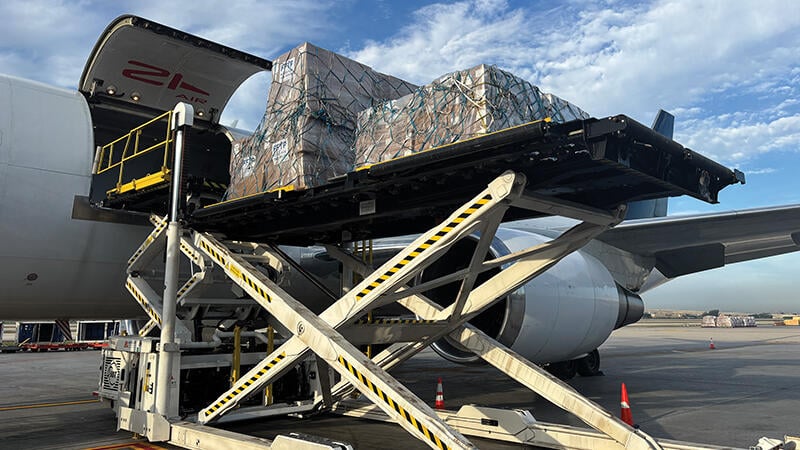
A freighter being loaded

A freighter being loaded with supplies at Miami Airport bound for Venezuela.

Credit: Karen Walker

Devastating twin earthquakes struck northern Venezuela on June 24, leaving entire neighborhoods in rubble. More than 6,500 people died and some 230,00 were injured or hospitalized. Tens of thousands were displaced or left homeless.

It was, of course, a human tragedy. But it was also a trigger for an unusual collaboration between the US government, the private sector and nonprofits that ensured critical supplies were delivered as fast as possible to where they were needed. The key to that speed was aircraft flying into Venezuela loaded with food, hygiene products, medical supplies and tents.

Washington DC-based nonprofit Airlink was central to the airbridge mission. Airlink is a global humanitarian organization that connects the aviation and humanitarian sectors. Its many airline partners include Air Canada, American Airlines, Qatar Airways, Southwest Airlines and United Airlines as well as cargo specialists like DHL and UPS. Airlink’s overall network includes over 250 aid organizations and more than 50 commercial and charter airlines. The organization has flown about 14,000 relief workers and transported approximately  18 million pounds of humanitarian cargo, helping more than 63 million people impacted by disasters like earthquakes, epidemics, floods and hurricanes.

Paloma Adams-Allen
Airlink president and CEO Paloma Adams-Allen. Credit: Airlink

In October 2025, Paloma Adams-Allen succeeded Steve Smith as the organization’s president and CEO. She previously served in senior roles at the US Agency for International Development (USAID).

For all the expertise built up at Airlink and Adams-Allen’s own experience at USAID, the Venezuela earthquake was a unique challenge.

“Airlink had never actually responded to an emergency in Venezuela per se, but we came out of and were tested in the fires and the rubble of the massive Haiti earthquake [in 2010], which was the first major response that really made us into an organization and tested this idea of using underutilized [air transport] capacity,” Adams-Allen told ATW.

Adams-Allen explained the well-tested procedure when the alarm sounds. “First, we activate our nonprofit community.  We tell them our projected need. In this case, we asked who has operated in Venezuela or is operating and is prepared to mobilize urban search and rescue teams ASAP, emergency responders, and then the kinds of critical needs that have to get there within the first 72 or so hours. And we start doing the needs assessment and capacity assessment with our nonprofits. We also activate our airlines, many of whom are in-kind donors in terms of capacity, space, plane tickets, et cetera, to say, ‘Please expect this is what we are going to need. Who is able to get into any of these airports?’”

An immediate problem with Venezuela was that Caracas Airport had been damaged by the earthquake, but it was quickly established that Valencia Airport, about two-and-a-half hours’ drive away, was open. However, it was small compared with Caracas. Airlink brought in airlines like Avianca and COPA Airlines that had smaller aircraft and familiarity with flying into Venezuela that could operate from within the Latin American region.

“Our biggest partners airline partners don’t necessarily fly into Venezuela or would not be able to, but our Latin American partners were able to do so. And so, because we’ve had years of trust and of testing lots of approaches together, when we really needed it and everyone was looking for a way to help, we were able to tap into those trusted sources,” Adams-Allen said.

AIRBRIDGE

The next major step was to launch an airbridge to get supplies into Venezuela via flights from the US over seven weeks, the critical window for those displaced and in need of basic food, shelter and medical provisions.  This was where the US State Department and Amazon stepped in. They joined forces with Airlink and the United Nations’ World Food Programme (WFP). From July 9 through Aug. 27, Amazon provided cargo aircraft and pilots to fly about 250 tons of supplies out of Miami Airport (MIA) to Venezuela. Crews would conduct the flights in and out within the same day.

Amazon director global aviation operations Ali Faddis led the air operations’ mission. “Amazon is very invested in humanitarian work. We have a whole disaster relief team with 12 tons of supplies prepositioned globally with what is typically most needed first in a disaster and when something occurs, those hubs activate and the disaster relief team will coordinate the movement of those supplies as needed. Sometimes it may only need to be by truck. Sometimes it needs to be by air,” Faddis explained to ATW on the tarmac at MIA beside the Boeing 757 freighter that was about to deliver one of the final missions to Venezuela with pilots Jose Qmis and Tate Page in the cockpit. This particular flight was going to Maiquetía in central Venezuela.

Pilots Jose Qmis (left) and Tate Page
Pilots Jose Qmis (left) and Tate Page ahead of an Amazon flight to Venezuela to deliver supplies to earthquake victims. Credit: Karen Walker

On the ground, the WFP led the distribution mission. WFP director private-sector partnerships Paul Skoczylas was also on the tarmac to see the Amazon aircraft off.

“WFP has a network of 80 organizations we work with in Venezuela. We have provided more than 250,000 people with assistance and 600,000 hot meals. Remember, there are still 24,000 people who are in camps or displaced by this earthquake, so hot meals are really important.  It’s not just food—it’s medical supplies, shelter supplies, hygiene supplies and things like that. Our job is to make sure that we reach the people who are most in need,” Skoczylas said.

Paloma Adams-Allen acknowledged it had been a complex mission, but Airlink leaned into two core tenets: strong, long-term partnerships and trust between those partners.

“In this case, because we trusted our nonprofit partners about their knowledge of the ground and their access and their ability to navigate, we were able to breathe and say, ‘Okay, we don’t know this context that well. We will handle the first mile, and you all will handle the last mile.’ We have had numerous other donors who support us throughout the years, but when there are major types of events like this, they’ll step up and say, ‘How can I help, or can I help a little bit more?’ And all of that is an investment over almost two decades in trusted relationships with our ecosystem of support.”

Humanitarian disasters—and a growing workload for Airlink—seem to be coming faster. By mid-August, Indonesia had been struck by a deadly earthquake and by end of August, a glacier-triggered debris flow and flash flood had blasted through the Nepal-China border region, leaving thousands dead, missing or displaced.

A different type of disaster hit West Africa earlier this year—another breakout of the Ebola virus. Airlink was involved in getting aid to the Dominion Republic of Congo and was again faced with huge logistics challenges.

Airlink Responders
Airlink responded to the Ebola crisis in the DRC. Credit: Action Medeor courtesy of Airlink

“We responded to Ebola in 2014. So again, we were dealing with a disaster type that we know well, a health emergency that we know well. We understand how it functions, but the context is complicated because this is in the DR Congo and in a region that is also in conflict, so is very difficult to access. There is a lack of trust in that region as well of the communities generally for nonprofits, partly because there was so much rollback in USAID and other funding,” Adams-Allen said.

“Again, our approach was to work with trusted partners, activate the network. The International Federation of the Red Cross has local workers and volunteers all across our country and in that region. And they were the first to say to us, even before it broke in the news, ‘It feels like something is percolating. People are getting sick. We need to get organized for this.’ And so, they have been our major partner. And what we started doing with them was with support from Qatar Airways getting us into Entebbe and then on into Bunia.”

On the ground, the scenes and needs were distressing and heartbreaking.

“Because of the nature of Ebola and people are dying, burials and handling of bodies have to be done very carefully. So, our first round was about getting safe and dignified burial kits because people wanted to bury their loved ones, but touching your sick loved one will make you sick. And the caregivers are the ones who end up dying. We had to make sure that we provided them with the kinds of resources they needed to handle that first wave. Next were testing kits,” Adams-Allen explained.

In early August, Cali in Colombia was struck by an earthquake, killing more than 300 people and injuring and displacing thousands more. Airlink is involved in that first-response mission.

PRIORITIES

Adams-Allen is clear about her priorities as the need grows worldwide. “Airlink embodies what I believe is a really effective model of development and humanitarian assistance. And that is a model that has successfully brought together the private sector heavily in the form of aviation, but not exclusively, and the nonprofit and humanitarian sector to solve major issues in the ecosystem of humanitarian assistance.

Amazon
Amazon joined Airlink, the US State Department and the World Food Progamme to fly about 250 tons of supplies to Venezuela from MIA. Credit: Amazon

“The second thing is that Airlink is small, nimble and incredibly efficient. Airlink’s reason for being and the reason it was really created was to take advantage of underutilized capacity and airline assets and to put those to good use, to put those to humanitarian causes. That means that planes that we’re taking on our vacations and taking to work and for all these other great reasons are also many times mobilizing critical humanitarian aid that’s needed and transporting first responders.  If Airlink wasn’t providing this resource through commercial airlines, the humanitarian sector would be figuring out alternate ways to get that aid there in a much more expensive and much less efficient way.

“I really believe that the airlines’ moment is now; the need, just to give you a number in terms of the envelope of humanitarian need in the world, is 300 million people projected to need critical urgent aid. That is a massive number. And it’s in the face of declining public funding for aid and skepticism potentially about foreign aid.

“Airlink has an opportunity to give back with the assets that they have, whether it’s their people’s time, volunteerism, in-kind resources, business funding or foundation funding. Our model is so flexible that it allows the private sector to give back in a way that we need them to. So, my priority is that we are the organization that is scaled sufficiently to respond to the need that has the talent, the expertise, the technologies and the network we need.”

ATW and Aviation Week are media partners with Airlink. Find out more at airlinkflight.org and listen to the full interview with Paloma Adams-Allen on the ATW Window Seat podcast at https://aviationweek.com/podcasts/window-seat-podcast/podcast-
airlink-rescue

Karen Walker

Karen Walker is Air Transport World Editor-in-Chief and Aviation Week Group Air Transport Editor-in-Chief. She joined ATW in 2011 and oversees the editorial content and direction of ATW, Routes and Aviation Week Group air transport content.