This article is published in Aviation Week & Space Technology and is free to read until Jul 09, 2026. If you want to read more articles from this publication, please click the link to subscribe.

Airlines Grapple With Consequences Of Iran War’s Fuel Price Spike
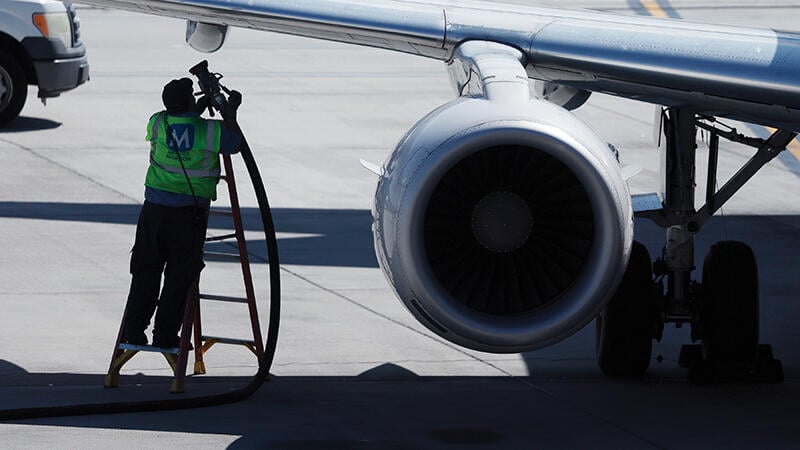
worker carrying refueling tube by aircraft

Consequences of the jet fuel price spike may go beyond short-term operational issues.

Credit: Justin Sullivan/Getty Images

Airline executives gathering in Rio de Janeiro for the International Air Transport Association’s annual general meeting on June 6-8 have one major topic on their minds: the fuel crisis—both the immediate pricing and supply challenges and its potential longer-term impact on industry.

When the war with Iran erupted just weeks into 2026, airlines scrambled to manage the initial disruption, reallocating capacity and—for those not hedged—dealing with the short-term spike in operational costs from the sharp rise in fuel prices.

  • Jet fuel price is 77.5% higher year over year
  • Airline CEOs gather in Rio de Janeiro for IATA AGM

As the conflict drags on—and with it, the blockade of the Strait of Hormuz, crucial for the transport of jet fuel from the region—there has been no let-up in the fuel price pressure. The International Air Transport Association’s Jet Fuel Price Monitor showed the price was up 77.5% year over year at $159.85 per barrel, as of May 22.

Carriers could be in for a tough second half of the year, with no clarity yet on when the Strait of Hormuz will reopen.

High fuel prices have claimed a high-profile casualty: Spirit Airlines. While the current environment has prompted questions on possible resulting changes in the U.S., including further industry consolidation, chatter around merger and acquisition (M&A) activity largely petered out after Spirit’s early May shutdown (AW&ST May 18-31, p. 16-19).

Whether any new airline merger proposals would receive support from the current U.S. administration is unclear. Three mergers have closed within the last 20 months. President Donald Trump “loves to see big deals happen,” U.S. Transportation Secretary Sean Duffy noted in early April. A few weeks later, as he voiced interest in helping Spirit, Trump mused that he liked “having a lot of airlines so it’s competitive.”

Ultimately, a bailout for Spirit failed, despite advanced negotiations as the carrier neared an exit from a repeat restructuring—one that followed failed merger attempts with Frontier Airlines and JetBlue Airways. On May 2, Spirit said no additional funding was available and that it had “no choice but to begin this wind-down,” as high fuel costs proved too much for its remaining liquidity.

A little over one week later, Allegiant closed its acquisition of Sun Country Airlines, combining two budget industry outliers with like-minded niche models. The Las Vegas-based carrier had announced the cash and stock transaction in January.

“By joining forces, we aim to improve our ability to reshape and lead the leisure travel market throughout North America, a timely move given the recent post-pandemic shifts that have exposed vulnerabilities in other low-fare carriers, which are struggling to adapt,” Allegiant CEO Greg Anderson said when the deal was announced.

Regional carrier Republic Airways closed its own acquisition of Mesa Air Group in late 2025.

As fuel prices began to spike in early March, speculation around other potential combinations rose alongside costs—including United Airlines and JetBlue, a pair that had announced their interline and loyalty-linking Blue Sky partnership in the spring of 2025. The latter declined to comment on market rumors, instead citing “meaningful progress” achieved by its multiyear go-forward plan and expressing confidence that “JetForward is the right strategy to restore profitability.” Meanwhile, Blue Sky is still in its early days. 2026 is “going to be a big year” for the partnership, JetBlue CEO Joanna Geraghty said at a mid-March investors conference.

JetBlue was one of the carriers to take advantage of Spirit’s network pullback during its second restructuring and recent exit, aggressively moving into markets its one-time merger partner had served. That has included capitalizing on a “generational” opportunity at Fort Lauderdale-Hollywood International Airport (FLL), Florida, Spirit’s former home base. But a challenging high-cost environment is supporting continued scrutiny.

“The question remains if this move to build a hub at FLL, along with other JetBlue initiatives, including the Blue Sky partnership with United, can meaningfully strengthen profitability to overcome the highly-leveraged balance sheet,” Raymond James analyst Savanthi Syth stated in a May 18 industry brief. “Restructuring is also possible if the debt load proves too burdensome, but JetBlue’s asset base should remain valuable even in that scenario.”

M&A remains another potential outcome, Syth added. A combination with American or Southwest would give either of the larger carriers greater relevance in New York and Boston, she said, and Southwest would also gain access to a transatlantic-capable fleet, “although the product mismatch is meaningful.” A matchup with Alaska Airlines—which closed its own merger with Hawaiian Airlines in late 2024—could strengthen loyalty in East Coast markets, but would do little outside of East and West Coast regions.

As for United, the carrier “already benefits from Blue Sky without taking on JetBlue’s debt, although a South Florida hub, Boston relevance, and JFK presence would still be strategically attractive if the divestiture math worked,” she wrote.

Whether high and volatile costs will prompt additional consolidation in the U.S. remains to be seen. The headwind has spurred at least six industrywide fare increases since March 1, as carriers work to offset added expenses with adjustments to fees and fares.

U.S. airlines are also adopting capacity reductions. United is planning the largest cut at 5% and, similar to other operators, targeting marginal capacity. Alaska Air Group is shedding one point of planned capacity growth in the second quarter and instead expects an increase of 1%. Southwest’s 2026 planned capacity growth of 2% is at the lower end of its previous guidance. American Airlines also trimmed its second-quarter capacity growth by a percentage point and now expects an expansion of 4-6% during that time period, a higher level than some of its peers.

Despite optimism about resilient demand, the second half of the year looms large. How long will the conflict last? Will fares continue to escalate? A busy summer season approaches, with American and United forecasting record travel volumes.

“Further reductions in the very near term don’t make economic sense, given the current demand environment as we enter our summer peak,” American Airlines Chief Financial Officer Devon May said in April. As American moves beyond that peak, “we will be sharp with capacity in light of the current fuel environment,” he stated.

As all airlines move past the peak travel period, further capacity reductions could ensue, particularly if price elasticity emerges. “It’s anybody’s guess where fuel is going to be for the remainder of the year into next year, so we’re trying to be flexible,” Geraghty said in April, when JetBlue stated it was cutting capacity 2-3 points in the second half of the year.

TD Cowen analyst Tom Fitzgerald has pointed to lower U.S. Transportation Security Administration (TSA) passenger volumes. “Data for TSA was revised higher for March, but lower for April,” he wrote in a recent report. “May thus far has also been down year over year.”

The timing of Easter in early April is like causing some noise, Fitzgerald said, and it is “possible we see a bounce back as we head into peak season.” However, he noted, “it seems like some bookings were pulled forward, followed by more demand elasticity as consumers push back against higher prices.”

In Europe, authorities have taken steps such as allowing use of Jet A fuel in the region and clarifying slot rules in the event of fuel-shortage-linked flight cancellations in a bid to help airlines weather the crisis. Carriers have taken their own steps to manage the situation, acknowledging the pressure from price spikes but insisting there are no shortages for now.

In April, Lufthansa Group canceled 20,000 departures, or 1% of system capacity through October, as it shut down regional subsidiary CityLine, in part to save fuel and cut the worst-performing routes, accelerating plans that preceded the war. However, CEO Carsten Spohr said May 5 that he does not expect a shortage of fuel in Europe until at least the end of June, and sees imports from other countries compensating for missing deliveries from the Gulf countries over time.

While disruption to Gulf airline networks is lifting Air France-KLM’s Asia yields, the group said in presenting first-quarter results April 30 that higher fuel costs were likely to erode much of that short-term benefit.

The Franco-Dutch group noted that reduced long-haul capacity from Gulf carriers in March pushed passengers back onto nonstop services to Asia, India and East Africa, allowing Air France and KLM to raise fares, upgauge aircraft and add limited frequencies to capture displaced demand. However, the group is cutting planned 2026 capacity growth to 2-4%, down from previous guidance of 3-5%, as a projected rise in fuel costs offsets the short-term benefits.

Air France-KLM expects its 2026 fuel bill to rise $2.4 billion year over year to about $9.3 billion, including a $1.1 billion increase in the second quarter alone.

KLM Cityhopper and Lufthansa aircraft
KLM said in April that it would operate 80 fewer European flights over the next month because of high fuel prices. Credit: DPA Picture Alliance Archive/Alamy Stock Photo

“Like everybody else, we don’t know when the Strait of Hormuz will reopen, but Europe remains very well supplied with jet fuel,” Ryanair CEO Michael O’Leary said on a May 18 analyst call, stressing that most of Europe’s jet fuel needs come from West Africa, the Americas and Norway.

The low-cost carrier’s own fuel needs for the year to come are about 80% hedged. O’Leary struck an optimistic note about the conflict, saying he did not believe it would drag on into the longer term.

Industry players are closely watching developments in the Middle East for signs of the war being resolved and access to fuel supplies from the region being restored. Without that, further capacity cuts and price hikes in the year’s second half look more likely, as airlines seek a balance between raising ticket fares to offset higher costs without putting off wary consumers.

Julie Palmer, managing partner at financial and real estate advisory group BTG, warns that rising ticket fares could put off financially stretched consumers. “A number of airlines have been left with no choice but to start passing some of the burden of soaring jet fuel costs onto customers by increasing fares,” she tells Aviation Week. However, if shortages continue or worsen, many would-be travelers will be priced out of their vacation, particularly given rising energy, food and borrowing costs elsewhere, she explains.

“Should swaths of people choose to stay home this summer as a result, this would be bad news for operators who have been banking on a busy summer to pay for a difficult start of the year,” Palmer says.

O’Leary predicted structural consequences for the region’s airline industry if the crisis drags on. “If it does continue over those 12 months, there will be significant airline failures in Europe this winter, mainly from some competitor airlines that offer low fares but don’t have low costs, have very stressed gearing on their balance sheet and are not as well hedged as Ryanair,” he said. “You see already many of those airlines are cutting capacity.”

“If shortages of jet fuel deepen, these airlines already teetering on the edge of financial distress, along with the more resilient larger operators, could be looking at more serious conditions,” Palmer says. “Reducing capacity at the same time as demand is falling could be all that is needed to tip some airlines over the edge into permanent closure. Those with the measures in place to hedge costs and supply issues and keep tight control over costs will be the ones that can survive in the environment. If they make it through, they will get the lion’s share of the market, routes and demand, should it return.”

While no Asia-Pacific airlines have shut down due to the fuel cost spike, most have been cutting capacity. This has mainly been through frequency reductions, but routes have also been halted. Flights to Gulf destinations have been suspended in many cases, with the duration extended to gauge how quickly demand will return.

Some Asian carriers are taking the opportunity to advance maintenance checks for aircraft while capacity is lower. However, this trend is limited by heavy maintenance slot scarcity.

Asia-Pacific airlines have been raising fares and fuel surcharges, but this has generally not been enough to offset the cost increase, leading to revised earnings estimates. The fuel price volatility has prompted some carriers in the region to adjust their formulas for calculating fuel surcharges.

As with Air France-KLM, there have nonetheless been positive aspects to the Middle East crisis for Asia-Pacific airlines. Demand for flights to Europe from Asian hubs has surged due to reduced capacity out of the Middle East, with airlines able to shift capacity from elsewhere in their networks to European routes. Cathay Pacific, Malaysia Airlines and Qantas are among those that have added frequencies to their Western European flights. Singapore Airlines has announced further increases on UK routes from July, and from October plans to boost frequencies on a broader range of European routes as well as adding a new service to Madrid via Barcelona.

Effects of the fuel cost crisis and responses vary widely between airlines in the region, Association of Asia-Pacific Airlines (AAPA) Director General Wong Hong says. Some have decided to cut capacity in the range of 5-10%, while others are able to absorb the cost increase and maintain their networks. He notes that LCCs have typically been more affected by the fuel cost spike, leading to larger capacity cuts.

Current fuel costs will not be sustainable in the long term and will cause more serious problems if they persist beyond the summer period, Wong says. Airlines with solid hedging positions will obviously be less affected.

Governments should communicate with airlines to see how they can offer support and alleviate the cost burden, Wong says. Authorities should recognize that airlines are “economic multipliers” for their countries and vital to their financial health, he notes.

Wong cites the example of the Malaysian government, which announced a range of support measures for airlines on May 16. These include the deferral and waiver of certain government fees and charges as well as a domestic fare rebate program.

Asia-Pacific governments need to pay close attention to airlines to ensure soaring fuel costs do not threaten their survival, stresses the AAPA, which is urging authorities to engage with carriers to get a clear picture of their situation—the earlier, the better—so more effective solutions can be developed.

Helen Massy-Beresford

Based in Paris, Helen Massy-Beresford covers European and Middle Eastern airlines, the European Commission’s air transport policy and the air cargo industry for Aviation Week & Space Technology and Aviation Daily.

Lori Ranson

Lori covers North American and Latin airlines for Aviation Week and is also a Senior Analyst for CAPA - Centre for Aviation.

Christine Boynton

Christine Boynton is a Senior Editor covering air transport in the Americas for Aviation Week Network.

Adrian Schofield

Adrian is a senior air transport editor for Aviation Week, based in New Zealand. He covers commercial aviation in the Asia-Pacific region.