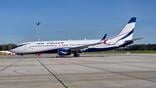
African Airlines Turn To Secondary Market, Aircraft Backlog Tops 17,000

Raphael Haddad, President of Jetcraft.
The secondary aircraft market has become an increasingly vital growth lever for regional aviation, particularly in Africa, even as a persistent global supply backlog complicates carriers’ access to aircraft, according to Raphael Haddad, President of Jetcraft Commercial.
Speaking to Aviation Week, Haddad laid out several challenges that have tightened the used aircraft market worldwide.
“Restarting production lines after the pandemic proved far more difficult than anticipated while a severe shortage of components—including new engines, APUs and landing gears—has left supply barely sufficient to meet new-build demand, let alone the secondary market,” he said.
New aircraft production is now effectively saturated, he added, with the combined OEM backlog exceeding 17,000 aircraft, driven by engine and landing gear delays as well as production issues Boeing has faced in recent years.
“Compounding the problem is a shrinking pool of used aircraft. During and immediately after the pandemic, part-out companies aggressively harvested older aircraft—generally those built in 2000 or earlier—both to meet OEM demand and to capitalize on the components’ shortage,” he said.
At one point, Haddad said, the number of available narrow-body aircraft on the market could be counted “on one hand.”
These constraints have collided with a resurgence in global travel demand that has now surpassed pre-pandemic levels. Global passenger traffic stood at roughly 4.9 billion before COVID-19. Despite ongoing conflicts, 2026 is expected to close at around 5.3 billion.
For African carriers, Haddad said, access to new aircraft remains uneven.
“In Africa alone, air travel is forecasted to grow by 6% in 2026, but supply constraints mean capacity is struggling to keep up,” Haddad added. “Major operators such as Ethiopian Airlines, EgyptAir and Royal Air Maroc, along with a handful of well-run private carriers, can secure new-build aircraft relatively easily, but many others lack the financial strength and supportive economic conditions to do so—pushing them toward the used market instead.”
He also pointed to a fleet-planning imbalance, adding that “regional aircraft make up roughly 50% of Europe’s fleet segment versus just 20-22% in Africa, despite the cost benefits of right-sizing capacity to demand.”
Nigeria’s Momentum, Uganda’s Potential
Haddad expressed optimism about Nigeria’s growth trajectory, noting that as Africa’s most populous nation, Nigeria needs larger aircraft to serve surging travel demand to North America, Europe, the Middle East and China—where there is a large trade route.
“At the same time, Nigerian carriers have embraced right-sizing, with several regionally focused airlines making effective use of narrowbody and regional aircraft—if the demand is there, and it is,” he said.
Haddad also credited the Nigerian government for creating a dedicated aviation ministry, easing hard-currency flow, reducing foreign billing backlogs and lowering airline taxation and operating costs. He also pointed to a broader Economic Community of West African States initiative aimed at cutting aviation costs by 15-20% across the bloc—progress he described as “overdue but welcome.”
Haddad praised the appointment of Girma Wake, acting CEO at Uganda Airlines, as a “smart move” for the carrier, noting his instrumental role in building Ethiopian Airlines into its current form. Haddad noted the CRJ900 fleet suits Uganda Airlines’ market but questioned its widebody strategy, suggesting a need for balance, adding, “Girma will ensure the airline gets on track.” Haddad also offered an example on how fast the used aircraft market moves.
“A customer seeking two aircraft in a specific configuration took four weeks to secure financing after Jetcraft identified suitable options—only for them to find the aircraft had already sold two weeks earlier,” he said. “Funding and financing structures must be in place before an aircraft is identified, not after.”
Roughly 40% of Jetcraft’s activity over the past eight to 10 years has involved African customers, Haddad said, alongside significant business in North America, Central Asia and Europe.
Looking ahead the next five years, he said his top priority for African aviation would be to see “full liberalization through an open skies environment across the continent, which would accelerate economic development broadly.” He also called for greater use of regional aviation, more hubs and a larger role for private and independently operated carriers.
“I am very positive about Africa,” Haddad said. “It has made leaps and bounds over the last 20 years.”

Related Content