FRANKFURT—After a very strong first half for Leap engine deliveries, Safran signals that the times of engine shortages are over.
“We are going to meet both Airbus and Boeing expectations, as well as deliver enough spare engines to the airlines in order to ensure that there is not going to be any aircraft on ground,” Safran CEO Olivier Andriès said in an analyst call July 28.
Andriès specifically referred to the expected demand for narrowbody engines in 2026. But he added: “We are confident also in 2027 to meet both Airbus and Boeing expectations. Do we have enough to offset some of the other guy’s lack of deliveries? If we can help in that respect we would obviously, but again, our first priority and our first commitment is to deliver on our promises ... to Airbus and Boeing and the airlines.”
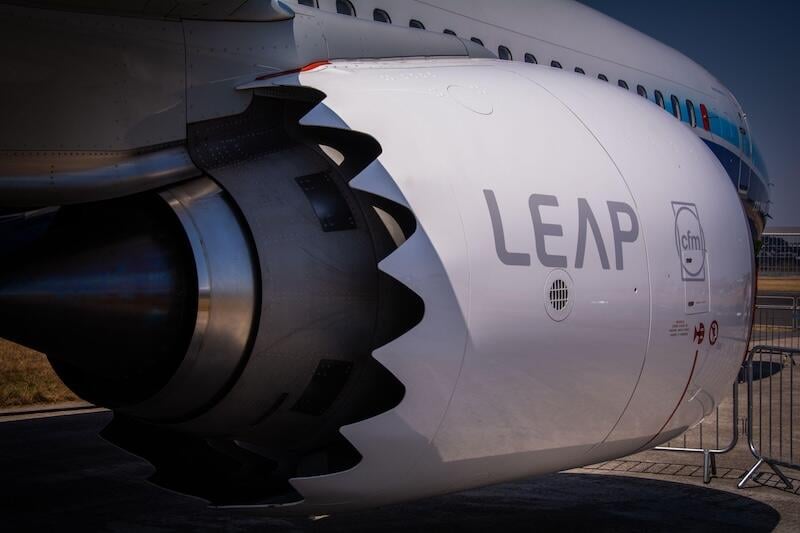
CFM International, Safran’s engine joint venture with GE Aerospace, delivered 1,030 Leap engines to Airbus and Boeing in the first half of 2026, an increase of 41% over the same period last year. This marked the fourth consecutive quarter with Leap deliveries in excess of 500 units.
Deliveries of Airbus A320neo-family aircraft continue to be below Airbus’ own targets because of a shortage of engines, particularly from Pratt & Whitney, but CFM International has also recently been struggling to keep up with demand, though it now appears to have overcome the bottlenecks.
Safran recorded much improved financial performance in the first half, including a 19% revenue growth to €17.5 billion ($19.8 billion) across all divisions and €3.2 billion operating profit, which translates into an 18.5% margin, up from 17% a year earlier. The company raised its guidance for the full-year revenues and now expects an operating profit of €6.4-6.5 billion, up from €6.1-6.2 billion.
Leap deliveries for the full year are set to be up in the high teens, which is more than the 15% growth in units that Safran had previously expected. The company also expects much stronger growth in spare parts and services revenues.
As for spare parts, the CFM-56 is driving performance as the manufacturer is also benefitting from a low level of retirements. But the Leap is also seeing a “fast growing number of shop visits, significant work scope increase and more shop visits being performed by third-party maintenance, repair and overhaul shops,” Andriès pointed out.
The Iran war “barely impacted our performance,” he said.
Widebody ramp-up plans at Boeing and Airbus are “very good news for our equipment division.” Among others, Safran builds landing gears for the 787 and the A350.
In interiors, the company continues to see improved pricing for seats. However, Andriès admitted that Safran and the industry at large “have not yet turned the corner” for seat deliveries. He demanded an “objective discussion” between seat manufacturers, aircraft-makers and certification authorities to reach an improved situation by the end of the year.
Andriès said he has listened to Airbus’ comments about a potentially different business model for the next-generation single-aisle. Lars Wagner, CEO of the commercial aircraft business, told investors at the Farnborough Airshow business update that Airbus sees the introduction of an A320neo replacement aircraft as a “once-in-a-lifetime opportunity” for Airbus to participate more in services revenues in a new program, among other things.
“Any potential discussion on the business model has to be holistic, taking into account the [manufacturing] side and the aftermarket side,” Andriès warned. “When we invest in a brand-new engine development, we have to be quite patient to get our return because not only do we spend a lot of money for the development of the engine, the industrialization, the ramp up, getting into service and all that. On top of that, for years and years, when we deliver engines to the airframers, we do that at a loss, and we only make a profit at the time when shop visits come up.”
The discussion “is not going to be the same” if CFM were in a single-source arrangement with Airbus or another airframer. “Then topics could be on the table that would not be on the table if we are in a typical dual-source situation,” Andriès indicated. For Safran, the ambition would be to reach the same internal rate of return as in the current business model.

Related Content