This article is published in Aviation Week & Space Technology and is free to read until Jul 29, 2026. If you want to read more articles from this publication, please click the link to subscribe.

The Road To Redemption For Honeywell Aerospace Starts In Phoenix
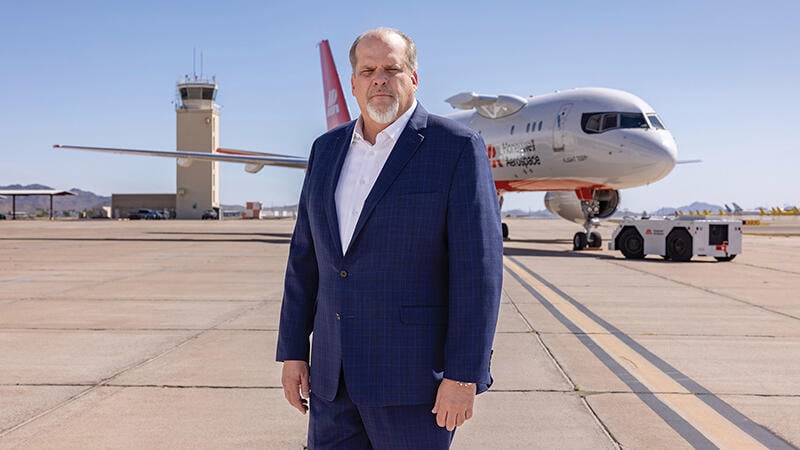
Jim Currier standing in front of Honeywell Aerospace Boeing 757

Jim Currier took over Honeywell’s aerospace operations in August 2023 and is now CEO of the independent company. 

Credit: Honeywell Aerospace

Morale among employees at what is now Honeywell Aerospace was at times so bad that, to commiserate, they made their own T-shirts about Honeywell being “hell.”

They were not the only frustrated stakeholders. In recent years, OEM customers publicly shamed the company as a supply chain problem—a rarity in the otherwise clubby world of aerospace and defense manufacturing. At industry conferences, speakers called out Honeywell as an example of how shareholder-first strategies can go too far, akin to what happened at Boeing and General Electric (GE) before their own turnarounds.

  • The company has underinvested and must spend more to keep growing
  • Supply chain performance remains a concern and M&A an opportunity

Still, unlike Boeing and GE, Honeywell’s aerospace and defense division has remained a profitable business in recent decades—indeed, its traditional operating margins of almost 30% were the envy of corporate rivals. While those margins might have been too good, considering the frustrations voiced, they were also why Honeywell International CEOs repeatedly declined to divest the division even as other multi-industrial conglomerates broke up.

But by 2024, a major Wall Street activist investor forced the creation of what is now a key $18 billion stand-alone Tier 1 aerospace supplier and large defense prime. On June 29, Honeywell Aerospace will spin out of Honeywell International and stand alone as a publicly traded company. While its finances appear solid to analysts, the question remains: Can Honeywell Aerospace rebuild its once-vaunted reputation and outperform in this new era of aerospace and defense?

Honeywell Aerospace CEO Jim Currier, who sat down with Aviation Week editors at the company’s headquarters here, also vowed to be responsive and collaborative with customers, employees and suppliers, acknowledging that Honeywell’s reputation has suffered in recent decades.

“Coming into the role in August of 2023, I fully recognized a significant issue we had in terms of customer perception—without a doubt,” he said. Currier reached out to customers and instructed his management team to do the same. “Part of that is being exceptionally transparent with customers.”

As a division of multi-industrial conglomerate Honeywell International, the Honeywell aerospace and defense unit was subject to the corporation’s playbook—a supply chain management strategy and business operating system that maximized productivity, efficiency, rooftop consolidation, single sourcing and outsourcing across the board. To their credit, leaders of the aerospace and defense division “ran it well,” Currier said. But the playbook has changed since the COVID-19 pandemic.

Honeywell’s aerospace and defense division was led by Rob Gillette from 2005 to 2009 and by Tim Mahoney from 2009 to 2019. Both were handpicked by then-Honeywell International CEO and Chairman David Cote. Mike Madsen, who led the division from 2019 until Currier took over in August 2023, was picked by then-CEO and Chairman Darius Adamczyk.

“One thing that I have found within Honeywell Aerospace is that if it’s within our four walls and it’s a crisis, we can mobilize whatever we need to do to get it resolved,” Currier said. “If it’s in someone else’s four walls to get it resolved, that’s a little bit more difficult to do—and particularly if you were sole source with a particular supplier. So part of what we’re doing to address the customer perception issue is I am exceptionally transparent about investments, exceptionally transparent about where we are dual-sourcing and multisourcing and insourcing where we continue to have pain points. And again, going into this in a very humble manner, you know, with the major OEMs and with the airlines.

“Are we perfect? No, we’re not,” he continued. “And part of that is I’m trying to unravel a supply chain strategy that had been in place for over a decade, and we’re only three years into this journey.”

Honeywell Aerospace aircraft
Honeywell Aerospace’s new brand and livery are an homage to Phoenix, the new company’s headquarters. Credit: Honeywell Aerospace

Currier said when he took the top job, he had a watch list of “hundreds” of troubled suppliers, while today it counts roughly 10. Generally, smaller, family-owned mechanical suppliers, or those that provide parts and systems, tend to be more problematic than electronic suppliers because the mechanical suppliers still deeply depend on skilled labor that has become a premium across industry since COVID-19. He did not identify any suppliers.

Still, Currier said he wants to take a holistic approach to customers, suppliers and employees—moving away from a transactional modus operandi. “It’s an emotional journey for sure,” he said. “The way I look at the business is: There’s no such thing as just a customer ecosystem, an internal ecosystem and a supply ecosystem. It’s one ecosystem, and it all has to work together.”

Currier said his spending priorities begin with driving organic growth of commercial, defense and space, business aviation and aftermarket business lines. Honeywell Aerospace also aims to ensure it makes returns to shareholders—“somewhere in the 30% range of dividends, which will be competitive,” he said—then look for bolt-on and tuck-in acquisitions, as well as partnerships with other companies. Finally, the company will repurchase outstanding shares.

Honeywell Aerospace hosted public investor briefings and demonstrations here June 2 and 3, and by all accounts, the event was well executed. Currier and his team showed off a deep bench of leaders and products, according to analyst reactions afterward.

The company forecasts it will achieve a compound annual growth rate (CAGR) of 6-8% in organic sales by 2030, starting from the $17.7 billion reached in 2025, as well as adjusted pretax earnings of more than $6.5 billion compared with $4.3 billion last year. Free cash flow is projected to swell to more than $4 billion from the 2025 pro forma amount of $2.5 billion.

Among its business groups, Honeywell Aerospace expects robust demand. It projects commercial OEM deliveries to climb at 10% CAGR and business aviation deliveries to increase 3% through 2030. Executives foresee sustained momentum in the commercial aftermarket, and in defense, they forecast 5% growth as direct sales boost the company’s international military contracts 7%.

But growth might not be linear, since the company will have to make investments after the spinoff. Honeywell has acknowledged outsourcing too much in the past. For instance, it spent $100 million to open a new circuit card assembly production line, work it used to do in-house. Over the last three years, the company has spent $1 billion on insourcing some work, increasing vertical integration, dual-sourcing some parts for reliability and making improvements within its own factories. During the investor days, managers said they would spend more on those initiatives after the spinoff.

The forecasts struck most analysts at the investor days as respectable but disappointing—and more back-end-loaded than generally liked. Honeywell Aerospace managers outlined overall operating margins that appeared to come in around 26%, just below the historical level, according to JP Morgan analysts. Also, the organic sales CAGR forecast fell below the bullish expectations of some investors that hope to tap into explosive defense budgets in Washington and elsewhere.

“Honeywell Aerospace’s guided end-market growth levels are generally below the consensus average for its peers,” analysts at BNP Paribas said. While the company forecasts growth of mid-to-high single digits in commercial OEM and aftermarket sectors, peers forecast growth closer to 10%. In response, Honeywell Aerospace says it is projecting mid-single-digit growth and its peers 6%.

“Today, the ‘narrative’ on Honeywell Aerospace is that its above-peer mid-20s pretax margins are the result of underinvestment over the past several decades, which contributed to share losses on current-gen large commercial aircraft programs ([Boeing] 737 MAX, 787, [Airbus] A320neo and A350),” analyst Scott Mikus of Melius Research said. “Like any narrative, there is some truth to it, and it shows up in the numbers, as evidenced by Honeywell Aerospace’s commercial aero OE sales remaining roughly flat since 2012.”

Mikus said that within avionics, Honeywell Aerospace lost market share to Rockwell Collins (now a part of RTX) and Thales in the large commercial transport market and to Garmin in the low-end business jet and general aviation market. In aircraft wheels and brakes, Honeywell Aerospace was reluctant to cannibalize its steel Cerametalix brakes product line, which held strong positions on the Boeing 717, 737NG and 777 as well as the Airbus A330ceo and many other legacy platforms, while Safran, Collins Aerospace and Parker-Hannifin’s Meggitt invested in lighter-weight carbon brakes. Within aeroengines, Woodward nearly tripled its revenue content on the 737 MAX relative to the 737NG by winning content on the CFM International Leap-1B engine that Honeywell Aerospace provided on the CFM56-7B powerplant.

“It also didn’t help that Honeywell largely sat out the aerospace mergers and acquisitions cycle in the 2010s when high-quality aerospace assets were less expensive,” Mikus said. “Acquisitions of businesses that had secured content gains on newer platforms could have mitigated some of the share losses Honeywell Aerospace experienced in the large commercial transport market.”

Meanwhile, concerns linger about Honeywell Aerospace’s supply chain capability. Analysts at Jefferies have toured 23 facilities across leading aerospace and defense companies over the past six months. “During these site tours, there has been mention of supplier issues, and Honeywell Aerospace has come up,” they noted.

“There are investors concerned that Honeywell Aerospace could be deprioritized by critical suppliers, such as the forgings and castings houses, which we expect management could seek to quell fears with a detailed supply chain strategy [building off] $1 billion-plus invested in aero supply chain over three years,” the analysts stated. Along those lines, Honeywell Aerospace’s backlog of work to be delivered has ballooned to $19 billion, up 20% year over year, and past-due obligations run through 2027.

For his part, Currier promises he and his management team will provide “100% focus” to make amends and outperform end-market growth in the company’s various target sectors. The upshot remains to be seen, but at least the company will no longer be in service to a larger corporate parent. Observers see the potential to succeed, but they are waiting on results.

“Honeywell Aerospace has a 100-plus-year heritage as a Tier 1 aerospace and defense supplier of mission-critical systems and components,” Mikus of Melius said. “As a stand-alone business, we think [Honeywell Aerospace] will be a formidable competitor on future commercial aerospace and defense programs if it continues investing for the future.”

Asked what he wants Honeywell Aerospace’s reputation to be by 2030, Currier said: “Recognition as being a premier Tier 1 provider of the most innovative technological systems solutions that provide enhancements of safety and reliability and efficiency and truly enables the future of flight . . . on the commercial side, and then also recognition of what Honeywell Aerospace does for national security and defense as well.”

Michael Bruno

Based in Washington, Michael Bruno is Aviation Week Network’s Executive Editor for Business. He oversees coverage of aviation, aerospace and defense businesses, supply chains and related issues.

Guy Norris

Guy is a Senior Editor for Aviation Week, covering technology and propulsion. He is based in Colorado Springs.