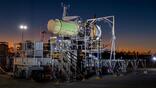
German-funded GENtwoPRO is developing next-generation components for Airbus’ conceptaul ZEROe hydrogen-electric airliner.
Germany has launched a research program to develop the next generation of hydrogen fuel cell propulsion system components for eventual application in a zero-emission commercial aircraft.
Funded by the German government’s LuFo VII-1 national aviation research program, the GENtwoPRO project is a follow-on to the Airbus-led FAME (Fuel Cell Propulsion System for Aircraft Megawatt Engines) project, funded by the EU’s Clean Aviation public-private research program.
A three-year project that aims to develop a scalable fuel cell system for use in a 100-seat short-haul airliner, GENtwoPRO involves Airbus, the Aerostack joint venture between Airbus and fuel cell producer ElringKlinger, and thermodynamic simulation specialist TLK-Thermo. German aerospace center DLR, the Technical University of Braunschweig, and RWTH Aachen University are also involved.
Although funded by different sources, the objectives of FAME and GENtwoPRO “are connected to secure hydrogen propulsion for commercial aviation,” said Johannes Hartmann, air and thermal systems research and technology portfolio manager at Airbus.
Launched in December 2023, the three-year, €52.4 million ($60.5 million) FAME project plans to bench-test by year-end an integrated 1-megawatt-class hydrogen-electric propulsion demonstrator using liquid-hydrogen energy storage and low-temperature proton exchange membrane fuel-cell power generation.
“The project covers the propulsion system from end-to-end, meaning the full chain of components and subsystems from the liquid hydrogen tank to the propeller, for example, the hydrogen line, air system line, fuel cell stack subsystem, colling and power lines,” Hartmann said.
FAME is testing a first-generation hydrogen aircraft powertrain with the main goal of demonstrating proper functional integration and that safety requirements are met. Leveraging the learning gained, GENtwoPRO “focuses on developing a second generation of components that could be integrated into the engine of a hydrogen aircraft, including fuel cell systems, power line and air supply,” he said.
In February 2025, Airbus delayed plans to field a zero-emission 100-seat aircraft by up to 10 years, to the 2040s, after determining the technology was not ready. Airbus and Clean Aviation then shifted the focus of their research to developing improved second-generation hydrogen-electric systems with better weight, power and thrust performance.
In a related development, the Technical University of Dresden, Germany, has commissioned a research aircraft to be used as a flying laboratory for fossil-free propulsion systems. The Diamond DA62 MPP is based at Kamenz airfield in the Lusatia region of eastern Germany.
The aircraft has been acquired under the three-year, €4.6 million FoFlu project, which is funded primarily by the EU’s Just Transition Fund, which is intended to support regions expected to be the most negatively impacted by the EU’s transition toward climate neutrality.
Powered by turbodiesel aeroengines, the DA62 has a flight endurance of up to 10 hr. on jet fuel. The aircraft will be used to flight-demonstrate the integration of new propulsion and structural technologies, including lightweight-hydrogen tanks.

Related Content