This article is published in Aviation Daily part of Aviation Week Intelligence Network (AWIN), and is complimentary through Aug 24, 2026. For information on becoming an AWIN Member to access more content like this, click here.
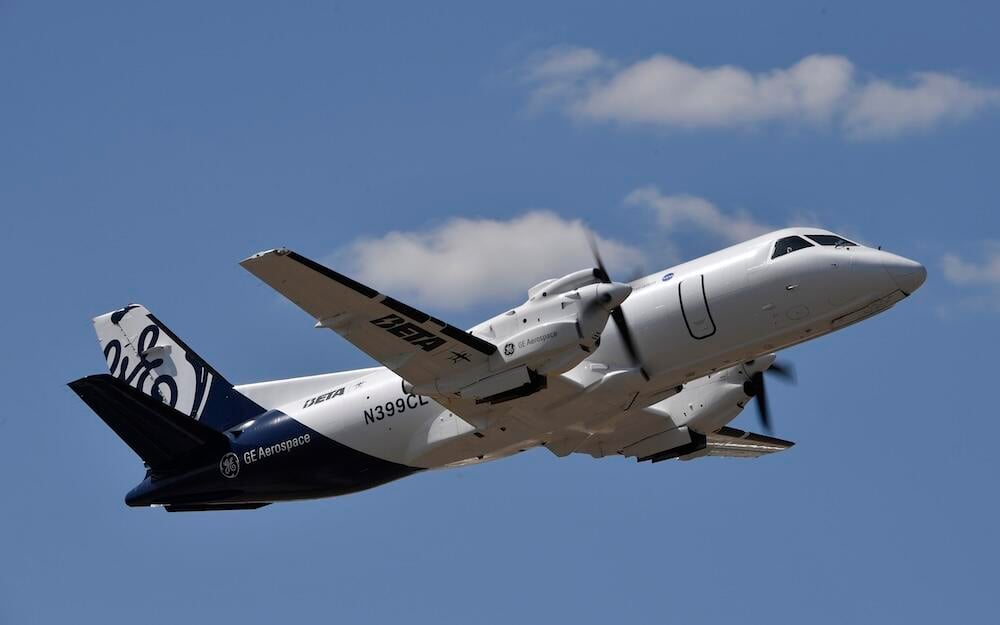
GE Aerospace's Saab 340B testbed, nicknamed “Gertrude,” is in the flying display at the Farnborough Airshow equipped with a hybrid-electric engine on the starboard side.
FARNBOROUGH, England—GE Aerospace has flown its modified Saab 340B megawatt-class hybrid-electric testbed at 30,000 ft., representing a milestone for an electric propulsion system operating at standard commercial airline altitudes.
The aircraft, which is on show at the Farnborough Airshow after being flown across the Atlantic from the U.S., incorporates a fully integrated megawatt-class hybrid-electric propulsion system in a modified nacelle in the No.2 right engine position, and retains the standard GE CT7 turboprop in the left position.
Developed through the NASA Electrified Powertrain Flight Demonstration (EPFD) project in collaboration with Boeing and Vermont-based electric vertical-takeoff-and-landing aircraft developer Beta Technologies, the first hybrid-electric flight above 30,000 ft. was completed on May 20.
Commenting at Farnborough on NASA’s contribution, agency administrator Jared Isaacman said: “For nearly seven decades, NASA has taken on the near impossible, solved very hard technical problems, and helped move new capabilities into the hands of American industry. We're doing it again today with a new generation of hybrid-electric propulsion systems that can improve efficiency, expand capability, and potentially contribute to an exciting new future in air travel.”
“When NASA began exploring this technology nearly 15 years ago, many questioned whether it could ever become practical at scale,” Isaacman said. “We spent years working through the hardest technical problems: electrical components, batteries, size, weight, thermal management, and the power systems needed for megawatt class performance and make it a reality. Now, alongside GE Aerospace, we made those systems lighter, more efficient, and ready for the demands of flight.”
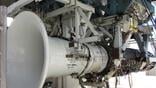
Ground tests of the integrated propulsion system in 2022 at NASA's electric aircraft test bed at the Neil Armstrong test facility in Ohio, simulated operations at 45,000 ft. “But now we're moving out of the lab and into practical application,” Isaacman said. “The engine GE Aerospace is demonstrating integrated electric motors, a gas turbine, and energy storage capabilities into megawatt-class hybrid-electric propulsion powertrain for the kinds of aircraft millions of Americans rely upon every single day,” he added.
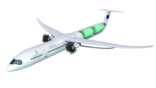
Lessons learned from the EPFD program Hybrid-electric technology will also inform the design of the Open Fan under development by GE with CFM International joint venture partner Safran.
The hybrid-electric system incorporates GE Aerospace-developed motor/generators, power converters and inverters, controllers and Avio Aero gearboxes. Fitted with Dowty propellers, Unison heat exchangers and torque sensing, the aircraft includes batteries provided by BAE Systems.
Beta Technologies served as the systems integrator and pilots from the eVTOL developer ferried the aircraft to the airshow, operating in hybrid-electric mode during each leg of the journey. Originating at Beta’s flight test site in Plattsburgh, New York, the transatlantic journey began with stops at Goose Bay, Canada; Nuuk, Greenland; Keflavik, Iceland and Wick, Scotland, before terminating in Bournemouth, England.
“The very first time we turned on the hybrid system, it worked exactly as planned on the aircraft,” said Christine Andrews, hybrid-electric leader at GE Aerospace. The flight test campaign, which began on May 3, “was wildly successful,” she added. By May 20 “we were able to operate the hybrid system in flight on the Saab 340 at over 30,000 feet altitude, both motored and generated at full power,” said Andrews. “We used the hybrid system to get to a higher altitude than what the Saab is rated for or can go to on its own CT7 power and sustain that for two hours.”
“We were so confident in the system that we did ferry the Saab 340 over here, and we used the hybrid system on every leg of the ferry flights,” she said.
“Our minimum viable was 30,000 ft. continuous operation. We've hit every technical milestone that we wanted to, but when you are able to be this successful this quickly, you want to see how much further you can push it. We have got a few more things we want to do when we get back, and then we have a few events that we want to take the aircraft to yet this year before we determine its end fate,” Andrews said.
GE said lessons continue to be learned which will be critical for future hybrid propulsion systems. “We understand the system—GE did the battery system management, the thermal management system associated with it, all the controls that come along with it,” Andrews said.
“Understanding how that worked across the flight envelope, where we may want to use batteries, where they would buy their way onto the cycle for the foreseeable future, and what we would deem is required in the way of advancements in either batteries or fuel cells is all useful. But just being able to know we can operate the system as designed, whether it's battery or fuel cell, from lab to flight, is a key hallmark of the program,” she added.
The experience will pave the way for hybrid-electric application on RISE added Arjan Hegeman, vice president of future flight engineering at GE Aerospace. “The really high voltage, massive wattage power in that motor generator at altitude is really a first. These power and voltage levels are unlikely to be the first step in a narrowbody platform, but demonstrating this aircraft with effectively the equivalent of three CT7 engines instead of just two gives an idea of the amount of power that we're talking about here.”
“Now making that work at altitude, downscaling it to lower levels, is the easy part,” Hegeman said. “We now have this massive understanding from an operational perspective, but also from an overall electronic system perspective at those levels at that commercial flight altitude. That sets us up really well for the future and how to deploy this in RISE,” he added.