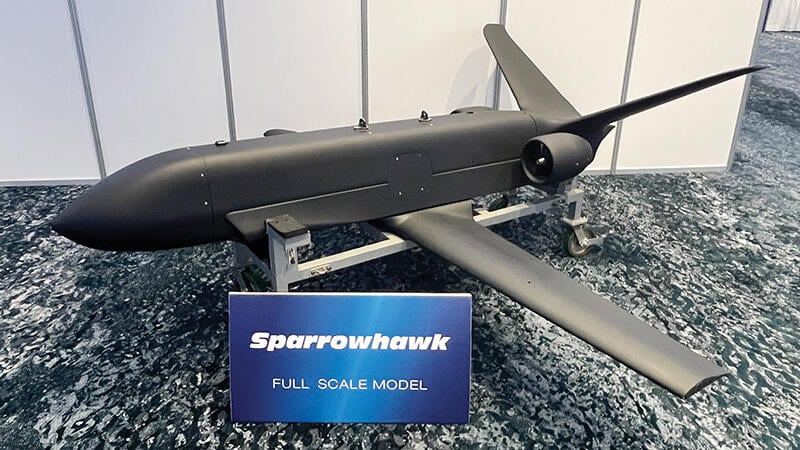
GA-ASI selected the Sparrowhawk’s ducted fans for low noise but remains open to other propulsion designs.
After several unsuccessful attempts, DARPA’s Gremlins project demonstrated the air recovery of an uncrewed aircraft in October 2021. Almost five years later, the capability has yet to be deployed operationally, but work continues to mature the technology.
General Atomics Aeronautical Systems Inc. (GA-ASI)—which lost the Gremlins flight demonstrationin competition in 2018 to Dynetics and the Kratos-developed X-61A—is continuing work to add an air-recoverable small drone capability to its MQ-9.
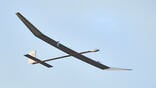
The Sparrowhawk is a Group 3 uncrewed aircraft system (UAS) purpose-designed for air launch from and recovery to a pylon under the MQ-9’s wing. Weighing 500 lb. and with hybrid-electric ducted-fan propulsion providing more than 5 hr. of flight time at 25,000 ft. and up to 150 kt., the aircraft is one of a series of air-launched effects that GA-ASI is developing to extend the reach of its medium-altitude, long-endurance uncrewed aircraft.
The manufacturer’s work on air-launched effects is focused on endurance, using some of the same payloads carried by its MQ-9 Reaper, MQ-1C Gray Eagle and their derivatives, Don Sauder, director of launched effects at GA-ASI, said at the American Institute of Aeronautics and Astronautics Aviation Forum on June 9 in San Diego.
While Dynetics’ X-61A Gremlins demonstrator was launched and recovered by a Lockheed Martin C-130 using a deployable probe that the UAS extended to engage a stabilized docking device towed by the aircraft, Sauder describes GA-ASI’s approach as simple.
The MQ-9 extends a towline with a weighted end from an underwing pylon. The Sparrowhawk flies “through” the line and executes a roll maneuver, with the aircraft forebody and wing leading edge guiding the line to a pair of fuselage doors that open like fingers to capture the end.
The Sparrowhawk then rotates and stows its wing in line with the fuselage; the drone is designed to be passively stable as it is winched up to the host aircraft. Installed inside the pylon, the winch is based on a helicopter rescue hoist and has the same safety features, Sauder said. Power can be run down the towline to a precision GPS tracker in the weighted end.
“You can think of inflight recovery as the Pandora’s box for small UAS,” he said. “So much about small UAS is focused on single-use aircraft. You send it out and, whether it does the mission or not, we’ve spent the money.
“Once we’re able to unlock aerial recovery, it gives us the opportunity to start reusing those aircraft,” he said. “That initial investment cost goes down so that we can start to put more expensive payloads on because we’re not afraid we’re going to lose them every mission.”
In developing the Sparrowhawk, Sauder said GA-ASI has tried to develop a more “mission-relevant” version of DARPA’s Gremlins, matched to the MQ-9’s flight envelope. The entire front end of the UAS is for payload, and the nose can be swapped among a sensor ball, electronic warfare system or a radar, he said.
So far, GA-ASI has conducted captive-carry testing of the Sparrowhawk, instrumented towline flight tests to validate dynamics, multiple air launches and tow-out and reel-in tests using different bodies. “We’ve flown and intercepted tow lines, but we haven’t closed the full loop yet,” Sauder said.
But does the defense customer want the capability that air launch and recovery brings? “There is a lot of interest in air recovery, but not a lot of financial interest, because people are timid to approach it,” he said. “We are continuing on our own internal investment as we can. It’s not something we are throwing heaps of money at year over year. We’re finding some couch-cushion dollars here and there to progress this, picking up projects to continue to mature this technology.”
In the absence of customer funding to bring the technology to fruition, Sauder said GA-ASI plans to continue burning down the risk and raising the technology readiness level of air-recovery capability piecewise. “It is our intent to bring this full circle,” he said.

Related Content