This article is published in Aviation Week & Space Technology and is free to read until Sep 18, 2026. If you want to read more articles from this publication, please click the link to subscribe.

Radia Updates C-242 As Outsize Cargo Market Looks For New Entrants
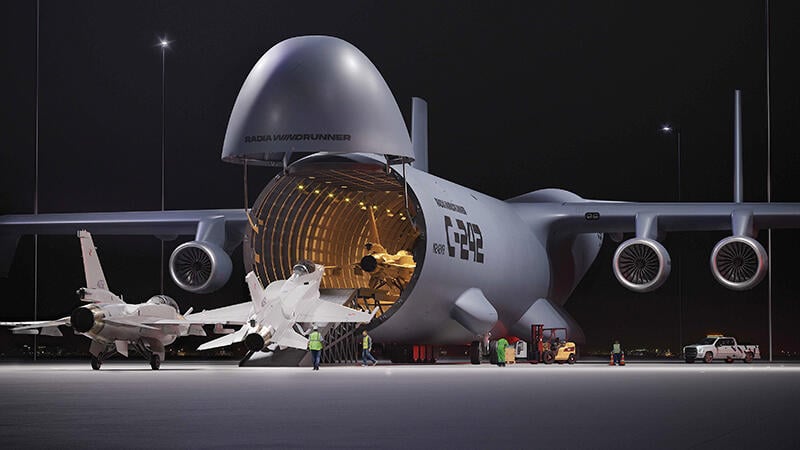
Radia WindRunner aircraft

Radia has maximized the internal volume of its WindRunner aircraft by mounting the landing gear externally, enabling it to accommodate a wide range of loads.

Credit: Radia

As rarities in aerospace go, the outsize cargo aircraft—or purpose-designed large airlifter—is among the most unique. Limited in number yet indispensable for key commercial and military roles, the outsize freighter fleet is rarely augmented or refreshed. Debuts of new options with tail or nose loading ramps are separated by decades, and relatively low flight hour accumulations mean that aging aircraft remain in service for years.

But today, even the stalwarts are dwindling. The Antonov An-124, long the backbone of the global civil outsize fleet, first flew 44 years ago; the final aircraft was built in 2004. Just 23 remain in service, and five of those are in storage, according to Aviation Week Fleet Discovery data.

  • WindRunner signs up 21 suppliers
  • Radia dubs its military airlifter the C-242

On top of aging, sanctions on Russia have further shrunk the commercially accessible fleet. The failed drone attack on an Antonov Airlines An-124 in early August at Leipzig-Halle Airport in Germany—the Ukrainian cargo carrier’s base since Russian attacks on Ukraine in 2022—again underlined the fleet’s vulnerability.

Lockheed Martin’s C-5, the nearest U.S. Air Force military equivalent to the An-124, first flew in 1968; the final delivery of the upgraded C-5M occurred in 2018. Although the service has 52 reengined C-5Ms in its inventory, mission capability reportedly remains a big challenge. Rates below 40% were recorded early this year.

Specialized outsize fleets of Airbus Beluga XL and Boeing 747-400 Large Cargo Freighters support their respective airframers’ production lines. The final 747 with a nose cargo door, a 747-8F, was delivered to freight airline Atlas Air in January 2023.

The next-largest military airlifter, the Boeing C-17, has been out of production since 2015. Although other military airlifters—like the Airbus A400M, Lockheed C-130 and Embraer C-390—remain in production, demand for a new generation of larger airlifters is growing.

Under the Next-Generation Airlift (NGAL) program, the U.S. Air Force is poised to begin an analysis of alternatives for a single future airlifter to replace the C-17 and C-5. In parallel, the Air Force Life Cycle Management Center’s Propulsion Directorate is working with engine-makers on studies of propulsion systems for a future aircraft.

The Air Force seeks an NGAL aircraft with a wingspan of less than 223 ft.—close to that of the C-5—and the capability to carry a minimum payload of 160,000 lb. over at least 2,500 nm without refueling. The Air Force, which issued a request for information (RFI) in June, aims for the NGAL aircraft to enter production as early as 2038 and achieve initial operational capability in 2041. The service expects to retire the C-5 in the late 2040s and to operate the C-17 through 2075.

Respondents to the RFI include California’s JetZero, which is developing its blended wing body as a commercial airliner as well as a potential military tanker-transport. The full-scale demonstrator with a 178-ft. wingspan and 260,000-lb. gross weight is designed to pave the way for a 200-ft.-wingspan production version. “We responded to the RFI in a way that gives the Air Force options,” JetZero President and CEO Dan da Silva says.

Another startup targeting military airlift is Colorado-based Radia, which is developing the enormous WindRunner. The 356-ft.-long, 261-ft.-wingspan aircraft is designed to carry payloads up to 160,000 lb. and 344 ft. long. With the capability to operate from a runway length of 6,000 ft., the WindRunner is planned to fly 1,200 nm at Mach 0.6 powered by four commercially available turbofans in the 55,000-lb.-thrust range.

Despite the emergence of an active Air Force RFI, Radia is proposing a nearer-term military WindRunner variant dubbed the C-242, founder and CEO Mark Lundstrom says. “The Pentagon is starting to turn the gears for the Next-Generation Airlift, and it is a process which would create a new capability sometime probably in the early 2040s,” he says. “Radia’s intent is to provide service in the early 2030s.”

By positioning itself for direct sales or as a fleet operator for lease to the Air Force and to commercial users, the company “can complement the existing fleet,” Lundstrom says. “We think there is a very interesting opportunity during the early 2030s to provide a powerful bridge to whatever comes next.

“The last C-5 was produced in 1989 and has a mission-capable rate, they recorded recently, of 37%,” Lundstrom notes. “We are interested in helping to provide some gap fill and to do other things.

“It’s not just about reliability; it is about capability as well,” he adds. Named for its 242,000-ft.3 internal capacity, the C-242 was originally designed to carry wind turbine blades. The aircraft has a maximum internal width of 33 ft. compared with 21 ft. on the An-124 or the 13 ft. of the A400M and C-17.

Antonov An-124
Antonov’s An-124 set the industry benchmark for outsize commercial cargo carriers, but it faces obsolescence and parts shortages. Credit: Mark Wagner/Aviation-Images

“It has seven times the volume of a C-5, but it carries a very similar mass to a C-17 and yet can land on dirt strips that have a similar surface capability requirement as a C-130,” Lundstrom says. “Of course, a C-130 has 2% of the volume of the WindRunner.”

The An-124 can carry up to 120 metric tons of cargo; the A400M can carry up to 37 metric tons. In comparison, the WindRunner is designed to transport 72.6 metric tons (160,000 lb.), but its larger size means it could deploy six Boeing CH-47 helicopters or four Lockheed Martin F-16 fighters up to 1,100 nm without the need for disassembly, Radia says.

Aircraft operated by the startup would also provide surge capacity for military customers under a model similar to the U.S. Air Force’s Civil Reserve Air Fleet (CRAF), which supplies capacity through aircraft operated by airlines.

“The larger countries would want some additional capacity that they could call upon if and when additional strategic airlift is needed,” Lundstrom says. “When you need strategic airlift, you need a lot quickly, so having your own fleet but then being able to surge with some additional fleet is something that makes a lot of economic sense.”

Lockheed Martin C-5M
Lockheed Martin’s upgraded C-5M, which is expected to serve the U.S. Air Force until a Next-Generation Airlift platform replaces it in the 2040s, has a low mission-capable rate. Credit: Lockheed Martin

In the commercial market, Radia plans to partner with established logistics providers. The startup announced a strategic marketing collaboration in June with Denmark-based Blue Water Shipping, a global provider of project logistics and freight forwarding. The agreement is focused on outsize and complex cargo.

Radia continues emphasizing European suppliers for the WindRunner as it targets NATO’s need for strategic military airlift. These include bringing on France’s Latecoere to develop the electrical wiring interconnection system and the UK’s Stirling Dynamics to support integration of flight controls.

Radia previously selected Italy’s Leonardo for the fuselage and Magnaghi Aerospace for landing gear, as well as Spain’s Aernnova for the wing and Aciturri the empennage. U.S. supplier Astronautics is to provide the avionics. Brazil’s Akaer, recently acquired by Edge Group, based in the United Arab Emirates, is to provide the cabin, which can be pressurized to an altitude of 8,000 ft. The cargo bay can be pressurized to 19,000-ft.-pressure altitude up to the aircraft’s maximum flight level.

Other suppliers include the UK’s Element Materials Technology, which will provide the fuel system; U.S.-based Ingenium Technologies, supplying the high-lift control system, and AFuzion, providing safety and certification consulting; and Italy’s Atitech, tasked with maintenance, repair and overhaul and engineering services as well as support for Radia’s planned final assembly line.

“We are entering the industrialization phase,” Lundstrom says. “We have built the supply chain and have a couple dozen suppliers on contract now. The type of suppliers that we’re signing up are the top aerospace companies in the world, and typically, we are not announcing memorandum of understandings—we are announcing contracts. To have credible suppliers contracting with you after years of diligence is a strong indication of the industry taking this very seriously as the next strategic airlifter.”

With many of the large aerostructures providers based in Italy and Spain, Lundstrom acknowledges that sites in Southern Europe are among the finalists for final assembly. “There is also the possibility of a U.S. production site as well,” he adds. Shortlisted candidate cities include those with existing aerospace talent, access to seaports and economic incentive support at a state or government level.

The selection of more European suppliers comes as NATO announces plans for a multinational fleet of A400Ms to address strategic airlift capability gaps among European allies. The initiative is supported by Belgium, Croatia, France, Poland, Spain, Turkey and the UK.

NATO has three initiatives aimed at providing participating countries with additional air transport capacity: the Strategic Airlift International Solution (SALIS), the Strategic Airlift Capability and the Multinational Multi-Role Tanker Transport Fleet.

SALIS gives nine partner countries assured access to up to five An-124-100s chartered under a five-year contract with Germany-based Antonov Logistics SALIS that runs to the end of this year.

Clinching a SALIS or CRAF deal in the future will likely be crucial to Radia’s chances of success, says Tom Crabtree, managing director at Seattle-based Transport Research Advisory. “Unless Radia lands Air Mobility Command or a similar coalition in Europe, they are going to be really challenged,” he says. “They don’t have a sister passenger [version] platform.”

Although outsize commercial cargo carriage commands an average yield of around $9/kg compared with around $3/kg for regular payloads, Crabtree is skeptical of Radia’s business case for developing a clean-sheet large freighter unless augmented by strong military interest. Without it, he says, the numbers rarely add up.

“Over the last 35-plus years since 1990, the number of cargo jets commercially flying, both conversions of old passenger aircraft or factory-built freighters, has never exceeded 11 or 12% of the total jet transport fleet in general,” Crabtree says.

Despite the skeptics, Radia says the program continues to gain momentum and remains on track to fly the WindRunner in 2030. “We’re getting there,” Lundstrom says.

Editor's note: This article was updated to clarify information about the Radia cabin.

Guy Norris

Guy is a Senior Editor for Aviation Week, covering technology and propulsion. He is based in Colorado Springs.

Graham Warwick

Graham leads Aviation Week's coverage of technology, focusing on engineering and technology across the aerospace industry, with a special focus on identifying technologies of strategic importance to aviation, aerospace and defense.

Comments

1 Comment
Does the aircraft will kneel like the AN-124 or C-5?