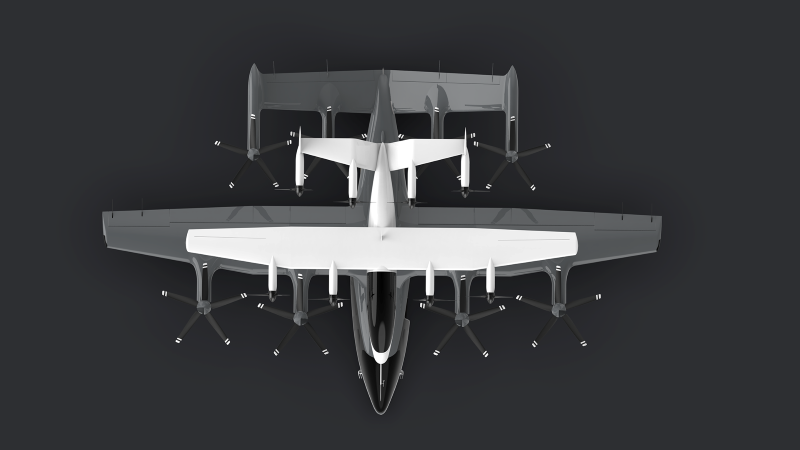
Zuri is developing a five-seat hybrid VTOL aircraft with a 700-km (434 mi.) range, 350-km/hr. cruise speed and 2,800-kg (6,172 lb.) maximum takeoff weight.
Prague-based hybrid-VTOL startup Zuri is advancing assembly and systems testing of its second-generation technology demonstrator, as the company works toward flying the unmanned tiltrotor aircraft by the end of the year or in early 2027.
The Zuri Technology Demonstrator 2.0 is a 690-kg-class, all-metal aircraft designed to validate the hybrid propulsion system, tiltrotor mechanisms and flight control laws planned for the company’s future five-seat regional aircraft. The demonstrator has a 10-meter wingspan and eight tilting propulsion units distributed across its wing and V-tail.
“One of the things that we’re working on right now and really pushing is our second technology demonstrator,” founder and CEO Michal Illich tells Aviation Week. “This year was really about accelerating that and putting together all of the pieces and components and tying in all of the work that we’ve done over the last eight years.”
Zuri displayed a two-seat mockup of the aircraft at AERO Friedrichshafen in Germany in April, giving attendees a first look at the demonstrator’s dimensions and layout. The aircraft will be flight-tested unmanned, but Illich says the two-seat configuration has prompted questions about whether Zuri could eventually pursue a smaller aircraft in addition to its planned five-seat regional model.
“That’s not the primary goal, but you never rule anything out,” says Robert Demmer, Zuri’s marketing lead.
For now, Illich says the focus is on completing the demonstrator and beginning full-system testing. Zuri has already tested the tilting mechanism and electric motors at reduced voltage in-house, using roughly 100 volts rather than the full 800-volt architecture. The next major step is a full-power propulsion test to verify that the motors, controllers, propeller blades and battery pack can operate together and provide the required thrust.
“What will happen later this month is taking the setup and running it full power,” Illich says. “That’s an important milestone for us.”
The aircraft is being assembled at Zuri’s Prague research and development center, where the company is also developing an iron bird ground test platform to validate hybrid-electric systems before flight. Zuri says the demonstrator will be used to test hybrid power management, transition performance, flight control laws, battery cooling and redundancy architecture.
Illich says the aircraft could be completed in December, although he acknowledges the schedule may slip into early next year.
Zuri’s longer-term goal remains a five-seat hybrid VTOL aircraft with a projected 700-km (434 mi.) range, 350-km/hr cruise speed and 2,800-kg (6,172 lb.) maximum takeoff weight. Unlike battery-electric air taxi developers focused on short urban routes, Zuri is targeting regional missions where Illich says hybrid propulsion offers a practical range advantage.
“We operate in a different range,” Illich says. “Companies like Joby and Archer are focused only on urban air mobility with less than 100 km range. Zuri is a different market. It’s regional air mobility.”
The company originally explored a lift-plus-cruise configuration before shifting to an all-tiltrotor design. Illich says the prior architecture was simpler but less efficient because the lift rotors became dead weight in cruise. For the second-generation demonstrator, all eight propulsion units tilt and remain active in cruise.
“During the cruise flight, which is around 95% of the time, you are just carrying that weight,” Illich says of lift-plus-cruise designs. “That’s why we moved to the Zuri 2.0 that’s fully tiltrotor.”
The company is preparing to launch a Series A funding round of up to €25-30 million ($29.1-34.9 million). If successful, Illich says Zuri could remain on track for certification of the larger aircraft around 2030.
The two-seat demonstrator also gives Zuri a possible path into the U.S. personal aircraft market under the FAA’s Mosaic rulemaking, although Illich says that remains exploratory.
“We don’t have any kind of official announcement or plans publicly for Mosaic,” Illich says. “But obviously, if you look at the current demonstrator that we are building, it has two seats, so the idea of introducing it to the U.S. market via Mosaic may make sense.”

Related Content