This article is published in Business Aviation & AAM Report part of Aviation Week Intelligence Network (AWIN), and is complimentary through Apr 03, 2026. For information on becoming an AWIN Member to access more content like this, click here.
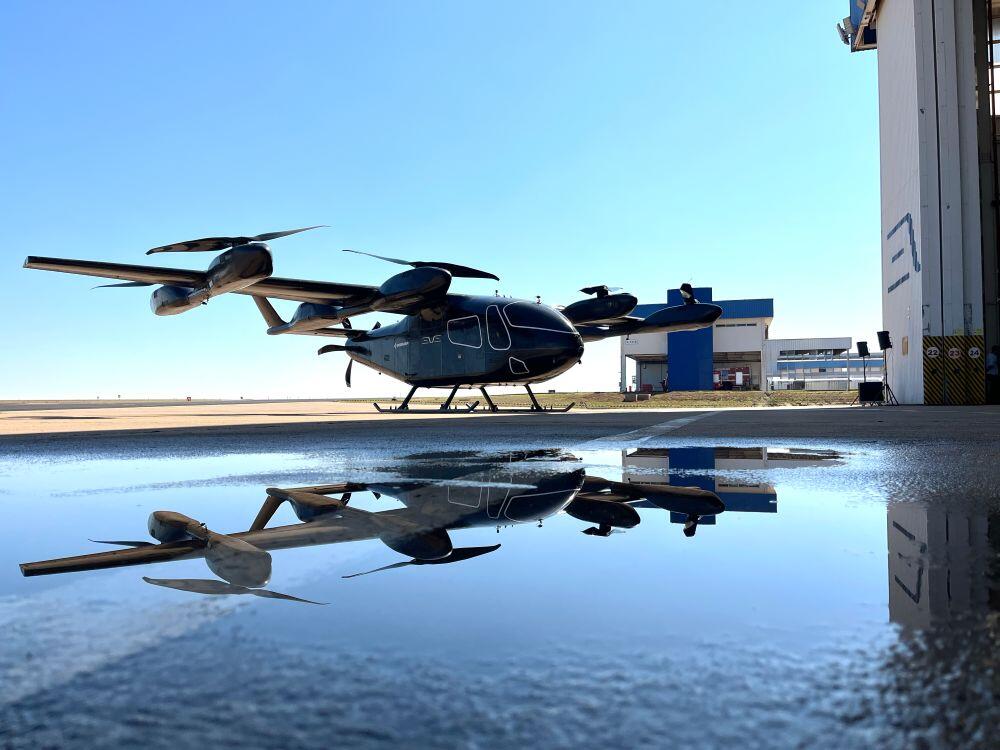
Eve’s TechCare service supports operators across maintenance, spare parts and training.
As eVTOL developers move closer to commercial service, much of the industry’s attention has focused on certification timelines and technical milestones.
But an important and at times overlooked challenge is coming into focus: building and training the maintenance workforce needed to keep these aircraft flying at scale.
The situation will be easier to manage in the early stages of commercial service, as initial operations will involve small fleets, limited routes and tightly controlled conditions. But those dynamics will change quickly as utilization increases.
“I think maintenance is the real risk point, especially early on before the industry reaches any kind of scale,” said Dean Rudolph, an analyst at Collinear Group. “The existing maintenance workforce is already constrained, and now you’re asking it to absorb an entirely new class of aircraft with different systems and requirements. If that infrastructure isn’t in place ahead of time, it can quickly become a limiting factor on growth.”
Unlike pilot training, which is being addressed through new regulatory frameworks and simulator-heavy programs, maintenance lacks a comparable road map. And while eVTOL developers often emphasize the simplicity of electric propulsion, that does not necessarily translate into easier maintenance.
Technicians working on eVTOL aircraft will need to understand high-voltage electrical systems, battery performance and software-driven diagnostics—areas that fall largely outside the experience base of today’s airframe and powerplant (A&P) workforce. Electric motors may have fewer moving parts than turbine engines, but they introduce new considerations around thermal management, power distribution and system-level monitoring.
“The skill set is different,” Rudolph said. “It’s less about mechanical troubleshooting in the traditional sense and more about understanding how systems behave and how to interpret what the data is telling you.”
That shift is already prompting comparisons with the automotive sector, where electric vehicles have driven a similar evolution in maintenance practices. In both cases, technicians are increasingly expected to diagnose issues through software tools, monitor system performance and identify faults before they result in hardware failures.
For eVTOL developers, that has implications not just for training, but for how maintenance is structured operationally.
Rather than relying solely on periodic inspections and reactive repairs, many companies are emphasizing predictive maintenance—using onboard data to anticipate issues and schedule interventions before they affect operations. The goal is to maximize aircraft availability while minimizing unscheduled downtime, a critical factor in business models that depend on high utilization rates.
“We’ll spend more time looking at data and understanding systems before they fail,” said Luiz Mauad, head of customer services at Eve Air Mobility. “That’s a different profile from traditional maintenance. Technicians will be diagnosing issues through software and sensors as much as they are working hands-on with the aircraft.”
Eve is building that approach into its broader service offering through TechCare, which is intended to provide operators with integrated support across maintenance, training and parts provisioning. The goal is to give operators clearer visibility into how aircraft will be supported over time, particularly in the early years of deployment.
“It’s not only about maintenance or spare parts or pilot training or technician training, but everything together,” Mauad said. “There’s no value if you don’t add everything in a comprehensive solution. We’ve been listening to operators and putting together what they need to fly the aircraft.”
Other developers are still refining their strategies, but the underlying challenge is consistent across the sector. Even if eVTOL aircraft prove more reliable or easier to maintain in certain respects, they will still require a workforce that does not yet exist at scale. That creates a potential bottleneck as fleets grow.
The issue is not simply headcount. It is also alignment between existing skill sets and the requirements of a new class of aircraft. While some technicians may transition from traditional aviation roles, others may come from adjacent industries as the overlap with electric vehicle maintenance becomes more apparent.
For operators, the implications are significant. Maintenance capacity directly affects aircraft availability, turnaround times and dispatch reliability—all of which feed into operating economics. Even small disruptions can cascade through tightly scheduled networks, particularly in early operations where spare aircraft may be limited.
That dynamic reinforces the importance of addressing maintenance early, rather than treating it as a secondary concern behind certification and pilot training.
“You can solve a lot of problems with a small number of aircraft,” Rudolph said. “Scaling is where the real test begins.”