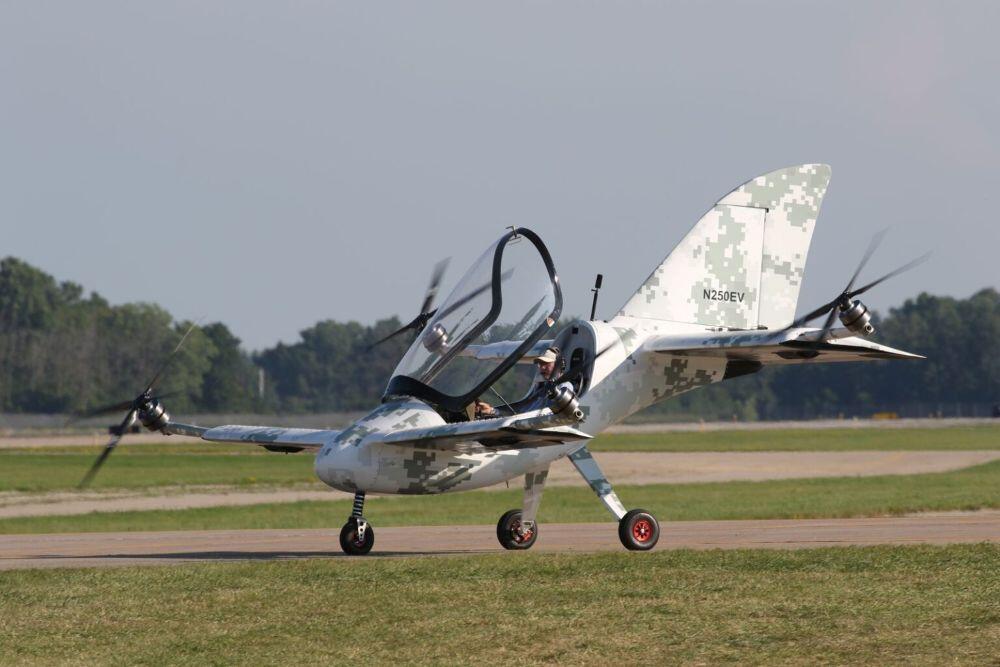
Skyfly is targeting a first piloted transition flight later this year.
Skyfly plans to begin transition flight testing of its Axe personal eVTOL later this year while targeting first flights of a second aircraft by year’s end and initial customer deliveries in 2027, founder and CEO Michael Thompson told Aviation Week.
The U.K.-based company is currently flight testing its first Axe prototype in the U.S. while developing a second aircraft in Britain that incorporates a new propulsion system, larger battery and updated cabin intended to reflect the configuration planned for customers.
“We’re planning to start looking at transitions this year,” Thompson said. The company plans to begin with transitions at altitude before gradually expanding toward the full flight envelope.
The first aircraft has been used primarily to build flight experience and identify areas for improvement. Thompson said the second aircraft will incorporate lessons learned during testing, including upgrades aimed at addressing thermal limitations encountered during hover operations.
“It’s got a larger battery and there are certain limitations with the first aircraft,” he said. “We’ve got a whole new propulsion package that we’re going to start testing at the end of the year.”
The company’s timeline remains closely tied to the FAA’s Mosaic rulemaking, which would significantly expand the capabilities allowed under the light sport aircraft (LSA) framework and create a pathway for personal eVTOLs such as the Axe.
Before Mosaic, Thompson said Skyfly expected it would need to pursue a more conventional certification program.
“Before Mosaic, there was no other option than to go for a type certification,” he said. “The special conditions for vertically capable aircraft are for transport-level aircraft, so it’s not tailored to light sport. It’s completely overkill.”
If Mosaic is delayed, Thompson said Skyfly could pursue a kit-built approach similar to the experimental aircraft market.
The company currently holds 57 customer orders for the Axe. Thompson said prospective buyers range from first-time pilots attracted to electric aviation to experienced aircraft owners looking for a short-range recreational or commuting aircraft.
While much of the eVTOL sector remains focused on developing air taxi networks, Thompson believes personal ownership represents a largely underserved market.
“I think people will be very surprised at the size of this market, because it’s going to be well ahead of the game regulation-wise,” he said. “An LSA-type aircraft takes a lot of the bureaucracy away from flying ... It’s a very affordable machine compared to a legacy aircraft with a piston or turbine engine. So, I think this new type of aircraft opens up an opportunity for loads more people to go flying.”
The company also sees pilot training as a potentially significant opportunity. Thompson argues the broader powered-lift sector will require affordable training aircraft if it is to expand beyond a relatively small pool of existing pilots.
“Training is so under talked about,” he said. “If the eVTOL market wants to scale as quickly as they’re saying, then they need training aircraft. They can’t just rely on simulators.”
“We see ourselves as probably the only aircraft that can do powered-lift training affordably—like the equivalent of a Cessna 152 for powered-lift training.”
In parallel with the piloted Axe program, Skyfly is developing an autonomous cargo variant equipped with a turbine generator that recharges the battery during flight. Thompson said the aircraft is aimed at military logistics and commercial cargo missions and has attracted interest from defense organizations in both the U.K. and U.S.
Skyfly is targeting delivery of its first 20 aircraft in 2027.

Related Content