This article is published in Advanced Air Mobility part of Aviation Week Intelligence Network (AWIN), and is complimentary through Aug 08, 2026. For information on becoming an AWIN Member to access more content like this, click here.

European eVTOL Researcher Seeks Co-Founders For Novel UAV

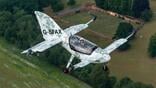
The DragonFire UAV takes off in a tailsitter configuration and tilts 90 deg. to cruise on its wing.

The DragonFire UAV takes off in a tailsitter configuration and tilts 90 deg. to cruise on its wing. 

Credit: John Lou

German aerospace researcher John Lou has made a name for himself as a thought leader in advanced air mobility circles, in large part owing to an influential report he self-published that exposed monumental flaws in the design and physics of defunct company Lilium’s eVTOL air taxi.

Now, Lou is setting out to leverage his burnished public profile and expertise in eVTOL flight physics to develop a battlefield drone that combines the performance in cruise of a fixed-wing aircraft with the affordability and mission flexibility of a quadcopter.

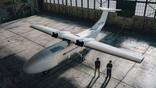
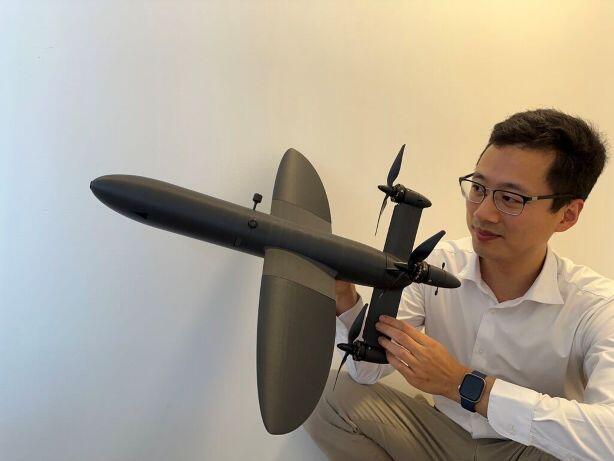
Called DragonFire, the uncrewed air vehicle (UAV) is a small quadcopter that takes off vertically in a tailsitter configuration and then tilts horizontally to cruise on its wing. Lou has built a demonstrator with 2 kg (4.4 lb.) empty weight and 0.7 m (2.3 ft.) wingspan which he displayed in June at the Paris Air Show and plans to fly for the first time in the coming months.

He says his inspiration for the DragonFire was the Russia-Ukraine war–specifically the Ukrainian military’s pioneering use of small, attritable and easily produced quadcopter drones.

“Quadcopters are great for a few reasons: They’re affordable, easy to build with existing components and highly adaptable for different missions,” Lou says. “But obviously, everybody knows they’re bad in cruise flight. So my idea was to return to first principles and say, ‘How can I rearrange major components so that it is more aerodynamically efficient?’

“So the idea here is you put the payload in the front, and you strap the battery in the middle, and then you sort of rotate the quadcopter 90 deg. so it looks like a tailsitter,” Lou continues. “Then you have a much smaller cross-sectional area. You have a lot less drag. You add some wings to it and boom, you have a lot more aerodynamic efficiency.”

While Lou has yet to fly the DragonFire, he predicts that the design is more efficient than tiltrotor or quadplane UAV architectures. “It’s a lot simpler than a tiltrotor concept, because you don’t need tilt mechanisms, or some kind of control system to actuate them,” he says. “And it’s better than a quadplane because this is going to have a much higher speed, and you don’t have the same issues with edgewise flow.”

Lou says he is currently seeking business partners to further develop and commercialize the DragonFire. “My bottleneck is partners, because I can make cool tech or get a prototype to fly, but I need the people who have all different talents, skills and networks,” he says.

As a master’s degree student at Cranfield University and an engineer with UK engineering services firm IET Limited, Lou says he has been closely following the eVTOL industry since the early days of Uber Elevate. For his award-winning master’s thesis, he analyzed the tradeoffs of popular eVTOL configurations from startups including Archer, Beta Technologies and Joby.

His curiosity in Lilium was piqued following the publication in January 2020 of a now-famous takedown of the Lilium Jet’s design and flight physics in German aerospace publication Aerokurier. After Lilium hit back with a technical blog authored by co-founder Patrick Nathen, Lou decided to wade into the fray. What he found next shocked him.

“I started going through the Lilium paper and even went into their references. The first reference cited a research paper—but when I looked at the source, I couldn’t find the reference. I thought that was strange,” Lou says. “I then took the effort to check each one, and very quickly the whole paper started to unravel. I could feel myself sweating and my heartbeat racing, because suddenly I understood the gravity of the situation. I knew this was going to be a huge discovery—and few others knew it at the time.”

He took his time crafting his technical analysis, which he published in video form in April 2023, during a time when concerns about Lilium’s financial health were already swirling. Clocking in at over two hours, it amounted to perhaps the most comprehensive—and damning—critique of the Lilium Jet’s design and flight physics that has ever been published.

“I knew I only had one shot, and it had to really stick,” Lou says. “The reaction was a bit slower than I expected—I thought it would blow up overnight—but people were reading it, digesting it and discussing it privately. It didn't convince everyone right away, but it made an impact, and that grew over time as word spread.”

As a longtime industry observer, Lou considers Joby to be the market leader and is also generally positive on Beta Technologies. He is less sold on Archer’s design, but adds that criticism of the company from certain corners may be overblown.

“Even though a lot of people expected Joby to take the lead and it’s not surprising they have, I still think it’s worth giving them a lot of praise,” he says. “With Archer, I’m less sold on the concept. It’s not like Lilium—it obviously flies. I just question whether it will be outperformed by other concepts like Beta’s or Joby’s.”
 

Ben Goldstein

Based in Boston, Ben covers advanced air mobility and is managing editor of Aviation Week Network’s AAM Report.

Comments

1 Comment
We should probably also mention the AV (AeroVironment) Wildcat UAS entry in the current DARPA EVADE program. It has a very similar tailsitter configuration, but with one additional prop on the nose, and hybrid propulsion.
https://www.avinc.com/resources/press-releases/view/avs-wildcat-reaches-key-milestones-in-darpas-ancillary-programs-evade-demonstration