Stan Little is the founder and former CEO of Southern Airways Express.
Former Southern Airways Express founder and CEO Stan Little, one of the earliest commercial backers of Regent Craft’s seaglider concept, has been named chairman of The Twenty-Five, a luxury mobility company that plans to launch operations using the Rhode Island startup’s all-electric vessels.
Little’s connection to Regent dates back to 2021, when Southern Airways became the first company to place a deposit-backed order for the startup’s wing-in-ground-effect vehicles. At the time, Southern was evaluating a range of emerging transportation concepts as advanced air mobility (AAM) startups sought airline partners and letters of intent.
“We had gotten a lot of interest from the eVTOLs, we had gotten interest from companies that were going to retrofit existing aircraft with electric propulsion,” Little said. “I elected at that time to take the position that we’re not going to sign on with everybody. Let’s truly look at the landscape, figure out which one or two, or maybe three, we think are going to make it.”
After meeting Regent co-founders Billy Thalheimer and Mike Klinker, Little concluded the company’s 12-passenger seaglider concept offered advantages that many competing concepts lacked.
“I walked away saying this is the one that’s going to have the clearest path to the fastest certification,” he said. “Number one, their ships are looking at captains, not pilots, and 2021 was the height of the pilot shortage. Number two, with battery technology the way it was then, and even still to this day, you needed something that wasn’t going to use the entire battery just getting up to altitude.”
The decision marked the beginning of a relationship that has now come full circle. Following Southern’s merger with Surf Air Mobility, Little stepped away from the company but remained interested in Regent’s progress.
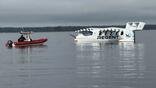
Little argued that seagliders may enjoy an easier path to public acceptance than some AAM concepts because they operate close to the water and incorporate significant redundancy. Regent’s Viceroy is designed to fly approximately 30-ft. above the surface while operating in ground effect.
“Let’s think about an eVTOL. There, you’re talking about being 2,000 or 3,000 ft. in the air on a vehicle that has not been around for very long,” he said. “I think I feel more comfortable gliding–literally, glide is in the name–back down to the water from 33 ft. than I do being 2,000 ft. above Midtown Manhattan.”
The Twenty-Five is positioning itself as a membership-based luxury mobility platform built around premium coastal travel experiences. Earlier this year, the company announced plans to acquire dozens of Viceroy seagliders and was named the manufacturer’s official launch partner.
Rather than operate as a traditional transportation provider, The Twenty-Five plans to combine seaglider service with private club amenities and waterfront terminals. The company is initially targeting routes such as New York-to-Hamptons, Boston-to-Nantucket and Miami-to-Palm Beach, markets where travelers today often rely on congested roads, ferries or helicopters.
Little said the membership model is intended both to create a high-end customer experience and to help manage what he expects will be significant demand for the seagliders during the early years of operation.
The company believes seagliders could provide a new transportation option for coastal markets by combining high-speed travel with the operating economics of an all-electric vehicle. Regent’s Viceroy is designed to travel up to 180 mi. at speeds approaching 180 mph while flying within ground effect over water.
Looking ahead, Little sees the seaglider as more than a niche transportation service.
“I think this is one of those moments where transportation changes fundamentally,” he said. “Once we start putting people on these ships, I think you look back and say, ‘Am I ever going to go back to helicoptering over there?’ If I can get on a seaglider and go faster, smoother, easier and cheaper? I don’t think so.”

Related Content