This article is published in Business Aviation & AAM Report part of Aviation Week Intelligence Network (AWIN), and is complimentary through Aug 24, 2026. For information on becoming an AWIN Member to access more content like this, click here.
FARNBOROUGH–Joby has “a finite amount of work” to complete before for-credit certification flight testing of its S4 air taxi can begin, and the company is “on track” to carry out its first commercial passenger-carrying flights before year’s end, the firm’s system engineering and certification lead says.
Ife Ogunleye, who joined Joby in 2019 after seven years at the FAA, says the company will be able to start for-credit flight testing with an FAA pilot once it has completed “several prerequisites” under Part 21.35, which specifies the flight tests required for type certification.
“The regulation has specific requirements of all the things you have to do,” he says, “and we have all those identified and we’re now working through them. We’ve been working with [the FAA] to have that scope defined and agreed to, and now we can start working through it.”
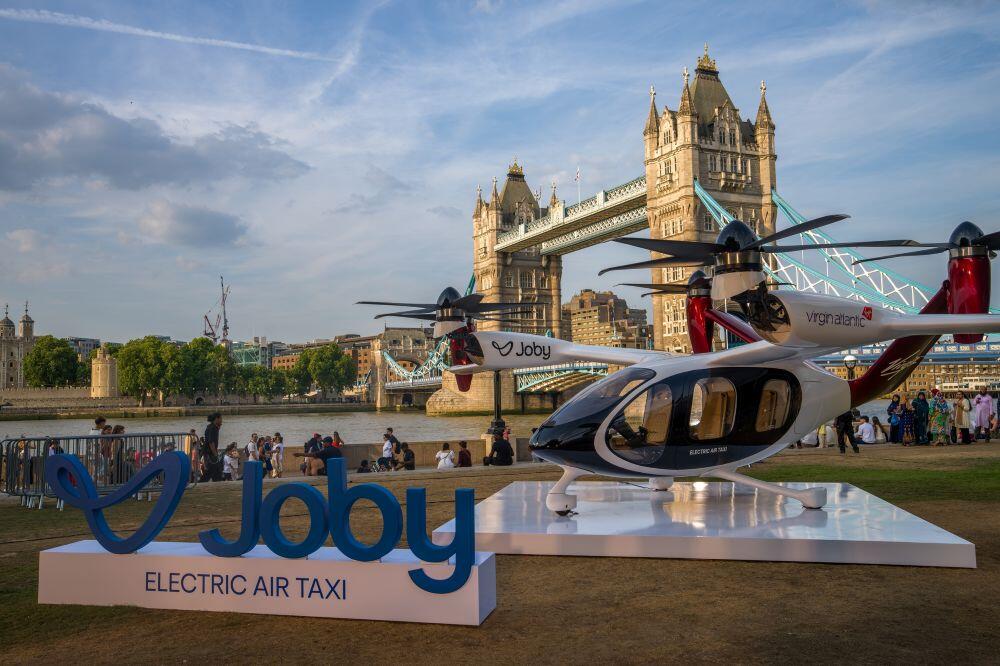
Joby will also be responsible for ensuring the S4 receives approval from the UK’s Civil Aviation Authority (CAA) ahead of its planned launch of service with Virgin Atlantic. The two companies announced a commercial agreement during the Farnborough Airshow here, which will initially see Joby operate air taxis between Virgin’s Manchester and London airport hubs and nearby city centers. The FAA “has done a fairly decent job at harmonizing a lot of the work that they’ve been doing” with international equivalents, Ogunleye says. He noted that the company is pursuing parallel validation with the CAA, the Japan Civil Aviation Bureau and Australia’s Civil Aviation Safety Authority.
The relationship between Joby and the FAA has been “probably one of the more positive relationships I’ve seen between an applicant and a regulator,” Ogunleye says. “The FAA is excited about the technology and the concept. At the end of the day, they’re engineers, so they’re excited about what we’re trying to do. There’s been some hesitation on some of the newness of it, which you would expect when they haven’t seen something before, and their policies aren’t in place already. It’s hard when there’s not a past precedent to lean on. That just takes time to develop, and the FAA has been willing to put in that time.”
That said, the questions an aircraft like the S4 asks of regulators are not always completely new ones.
“It’s a powered lift [aircraft] even though it spends the majority of its time on the wing—so it’s a mix between a helicopter and an airplane,” Ogunleye says. “So there’s some uniquenesses there, but overall it’s not something that’s completely out of this world from a regulatory perspective. Having already worked programs like the [Leonardo] AW609, which is a powered-lift project, and some other fly-by-wire projects that introduce novel technology, it’s definitely within the scope of those types of programs.”
The extensive amount of flying Joby has been able to carry out already—both with prototypes and its first conforming aircraft—may not directly count for credit, but will help speed up the certification process.
“Flight test is one of the most costly parts of any program, so you want to have a lot of maturity going into it. You want to have a lot of knowledge going into it, and you want to have a clear exit strategy out of it,” Ogunleye says. “That’s what we’ve been able to achieve with all the flying that we’ve been doing.”
Three more conforming aircraft are expected to join the test fleet by year’s end, and Ogunleye says the company’s planning for FAA type inspection authorization (TIA) will allow specific tests to be transferred across different airframes.
“We’re not going to be constrained into having only a certain number of airplanes that can do a certain number of tests,” he says. “So we do have the flexibility to allocate tests to the aircraft that we need.” Destructive tests, he adds, will be carried out on “the structural piece, but not on the full conforming aircraft.”
Another factor that increases the company’s confidence in being able to make rapid progress is the blend of different backgrounds and specialisms that it has amassed in its workforce.
“The focus is on leveraging the best of both worlds,” Ogunleye says. This means “getting that innovative, rapid prototyping out of the Silicon Valley, and also the rigor and the expertise and the knowledge that comes from folks that have worked through an entire certification program with the FAA before that know the pitfalls and the lessons learned and being able to apply that to our program. We’ve been fortunate to have good leadership to pull the team together and to understand how to get these two mindsets to work collaboratively. We’ve gone through the storming-norming phases and we’re to the point now where there’s just a mutual respect, dependency and appreciation for the skill sets that the two groups bring.”