This article is published in Aerospace Daily & Defense Report part of Aviation Week Intelligence Network (AWIN), and is complimentary through May 10, 2026. For information on becoming an AWIN Member to access more content like this, click here.

Orion Returns From Crewed Shakedown Flight Around The Moon

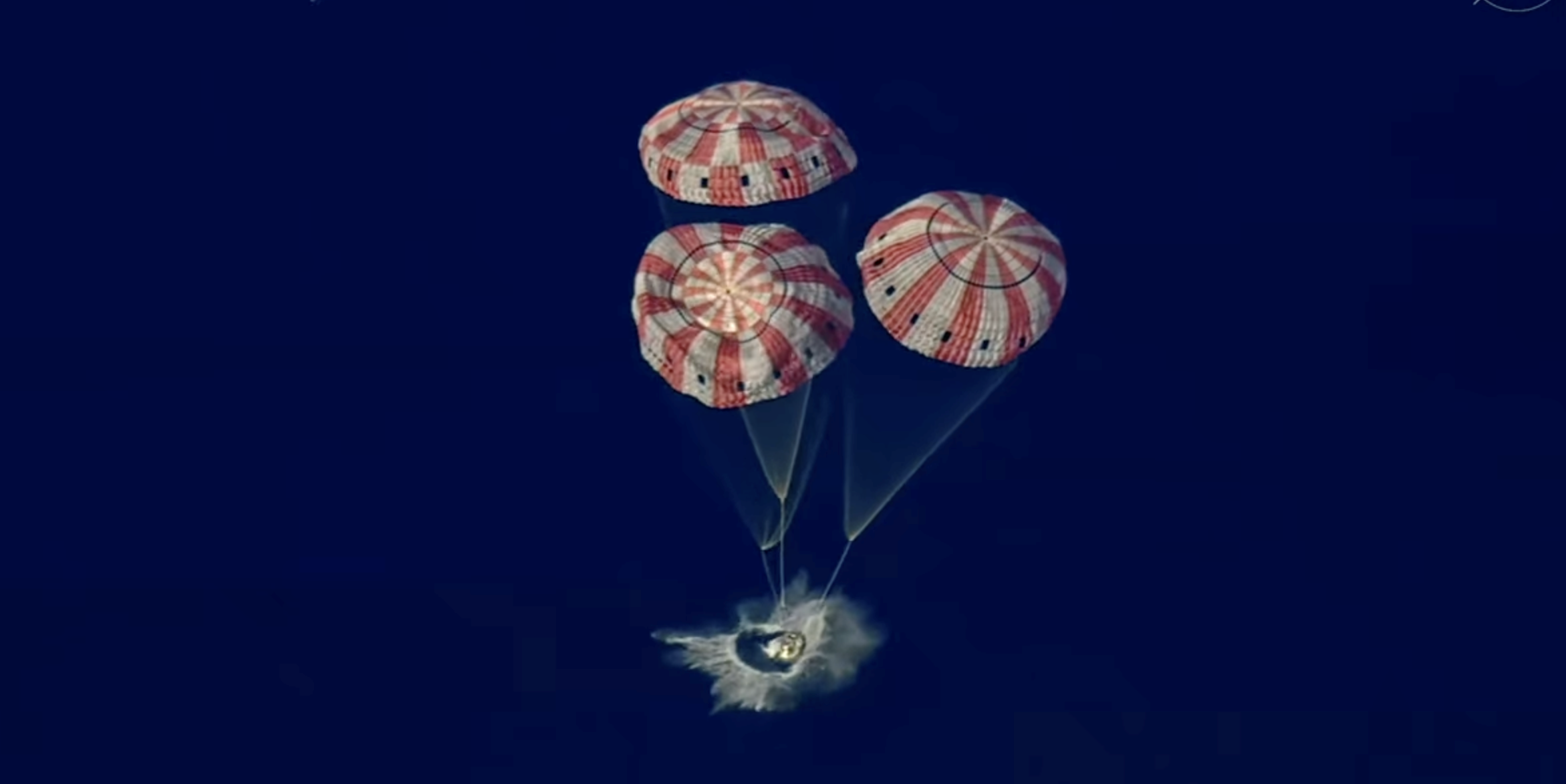
Artemis II splashdown
Credit: NASA

HOUSTON—The Artemis II astronauts returned from a nine-day flight test of NASA’s deep-space Orion capsule on April 10, marking the first crewed flight beyond Earth orbit in more than 50 years and setting the stage for a series of missions to establish a base on the Moon.

Strapped inside the Orion spaceship Integrity were commander Reid Wiseman, pilot Victor Glover and mission specialist Christina Koch, all with NASA, and Canadian Space Agency mission specialist Jeremy Hansen.

“From the pages of Jules Verne to a modern-day mission to the Moon, a new chapter of the exploration of our celestial neighbor is complete,” NASA Mission Control commentator Rob Navias said.

The astronauts lifted off aboard NASA’s Space Launch System (SLS) rocket  at 6:35 p.m. EDT April 1. After a day-long systems checkout, the Lockheed Martin-built Orion capsule fired its service module for 5 min. 50 sec. to set a course toward the Moon.

The translunar injection burn also set the stage for Integrity’s re-entry into Earth’s atmosphere at 7:53 p.m. EDT April 10 as the ship soared 400,000 ft. over Hawaii, traveling at a speed of 24,661 mph, or Mach 32.

Four min. later, Integrity’s crew module thrusters fired for 19 sec. to tilt the capsule up, fine-tuning its angle of attack as it headed for splashdown in the Pacific Ocean southeast of San Diego at 8:07 p.m. EDT. A  U.S. Navy ship was standing by to recover the crew and the Orion capsule. “Perfect bull’s eye splashdown for Integrity and its four astronauts,” Navias said.

NASA revised the Artemis II reentry profile following the uncrewed Artemis I mission, which returned from a  25-day flight test on Dec. 11, 2022, with unexpected wear on its heat shield. Ultimately NASA decided to rework the shield for future Orion flights, but for Artemis II the agency modified the capsule’s re-entry trajectory to minimize the amount of time the shield would experience peak heating of 4,000-5,000F.

For Artemis I, Orion dipped in and out of the atmosphere twice during re-entry, giving NASA 20 mi. and 3,657 mi. between entry interface and splashdown. That profile was designed to reduce  heat and thermal stress on the heat shield, improve landing accuracy, lower G-forces on the crew and provide more control and contingency options.

For Artemis II, the time between atmospheric entry and splashdown was cut to 13.5 min, and 1,956 mi., with the crew experiencing up to four times the force of gravity.

NASA’s nine-day Artemis II mission around the far side of the Moon was the third test flight of the capsule and its first with astronauts. The mission was designed to assess life support, propulsion, communications and re-entry  systems, as well as crew response to the deep-space environment in a spacecraft with a volume equal to two minivans.

Developed by NASA under a contract awarded to Lockheed Martin in 2006, Orion launched for the first time on Dec. 5, 2014, on a 4-hr, 24-min. Earth-orbit flight test. That was followed by the Nov. 16, 2022, launch of Artemis I with an Orion crew capsule aboard the SLS, which was making its debut flight. That uncrewed spacecraft was put into lunar orbit for a shakedown cruise in deep-space.

NASA named the Artemis II crew in April 2023 and launched the mission three years later on April 1. With Orion’s environmental and life support systems and other equipment operating as expected, the ship headed for a swing around the far side of the Moon, setting a new distance record for a human spaceflight and giving the crew the opportunity to view some lunar geography never before seen by human eyes.

“During the time of the nearest approach to the Moon we were doing so much science I took a brief moment to say a short prayer of gratitude for being sent on this mission, trusted with bringing back scientifically relevant  information,” Glover told legislators during an air-to-ground call April 9.

While Integrity was beyond communications range with ground control, flying behind the Moon, Glover later said he hoped people were looking up and waiting for the 40-min. radio silence to end. “I was really hoping that while we were waiting to get back in contact, people could just feel that sense of togetherness that we were all a crew on spaceship Earth,” he said.

Integrity traveled  as far as 252,756 mi. from Earth,  eclipsing the distance record for a crewed spacecraft set by Apollo 13 in 1970.

The ship traveled as close as 4,067 mi. to the Moon, giving astronauts full-disk views of the lunar far side. During seven hours of science observations, the crew photographed and recorded their observations of cratering, meteorite impacts and rugged surface features at the lunar south pole, where NASA intends to establish a base in a phased approach, with early habitation beginning in 2029.

“It’s hard to describe the significance of this mission,” Johnson Space Center Director Vanessa Wyche said during an interview with Navias.“We have been building and planning our teams toward this for quite some time. We had our uncrewed Artemis I mission back in 2022, but now we have our astronauts on board. They are demonstrating that the spacecraft is ready for us to have humans on board, for us to continue deep-space exploration, which we have not done since 1972. “

Looking ahead to NASA’s next series of crewed deep-space missions, the Artemis II astronauts used the discarded upper stage of their  SLS rocket as a target to demonstrate manual piloting of the otherwise autonomously controlled Integrity. The manual operations tested how future Artemis mission astronauts will rendezvous and dock with a Human Landing System (HLS) needed to ferry crews to and from lunar orbit and the surface of the Moon.  Two HLS versions are in development by SpaceX and Blue Origin.

Among the issues NASA plans to tackle ahead of Artemis III, which is intended to test Orion-HLS rendezvous and docking in Earth orbit next year, is a helium leak in a system that pressurizes part of the Orion service module’s propulsion system. NASA provides the shuttle-era Orbital Maneuvering System engine to the European Space Agency, which supplies the service module for Orion. The European Service Module flying on Artemis II was jettisoned 20 min. before the spacecraft’s reentry into the atmosphere and is not recoverable.

“The leak is not to space. It’s internal to the system across some of our valves, and we really need to characterize that to see what, if any, modifications we might need to make in the future,” NASA’s Jeff Radigan, the Artemis II mission lead flight director, told reporters April 9.

Integrity also returns with a malfunctioning urine vent line in the crew waste system. Repeatedly during the flight, a valve issue prevented urine disposal at the expected rates, prompting the astronauts to use a backup system of collapsible plastic containers for urination.

In addition to their lunar science observations, the astronauts participated in assessments of the deep-space cosmic and solar radiation environment as they traveled beyond the protective bubble of Earth’s magnetic field and the Van Allen radiation belts.

Irene Klotz

Irene Klotz is Senior Space Editor for Aviation Week, based in Cape Canaveral. Before joining Aviation Week in 2017, Irene spent 25 years as a wire service reporter covering human and robotic spaceflight, commercial space, astronomy, science and technology for Reuters and United Press International.

Mark Carreau

Mark is based in Houston, where he has written on aerospace for more than 25 years. While at the Houston Chronicle, he was recognized by the Rotary National Award for Space Achievement Foundation in 2006 for his professional contributions to the public understanding of America's space program through news reporting.