This article is published in Aerospace Daily & Defense Report part of Aviation Week Intelligence Network (AWIN), and is complimentary through Apr 15, 2026. For information on becoming an AWIN Member to access more content like this, click here.

NASA’s Artemis II Crew Begins Earth Return

Credit: NASA

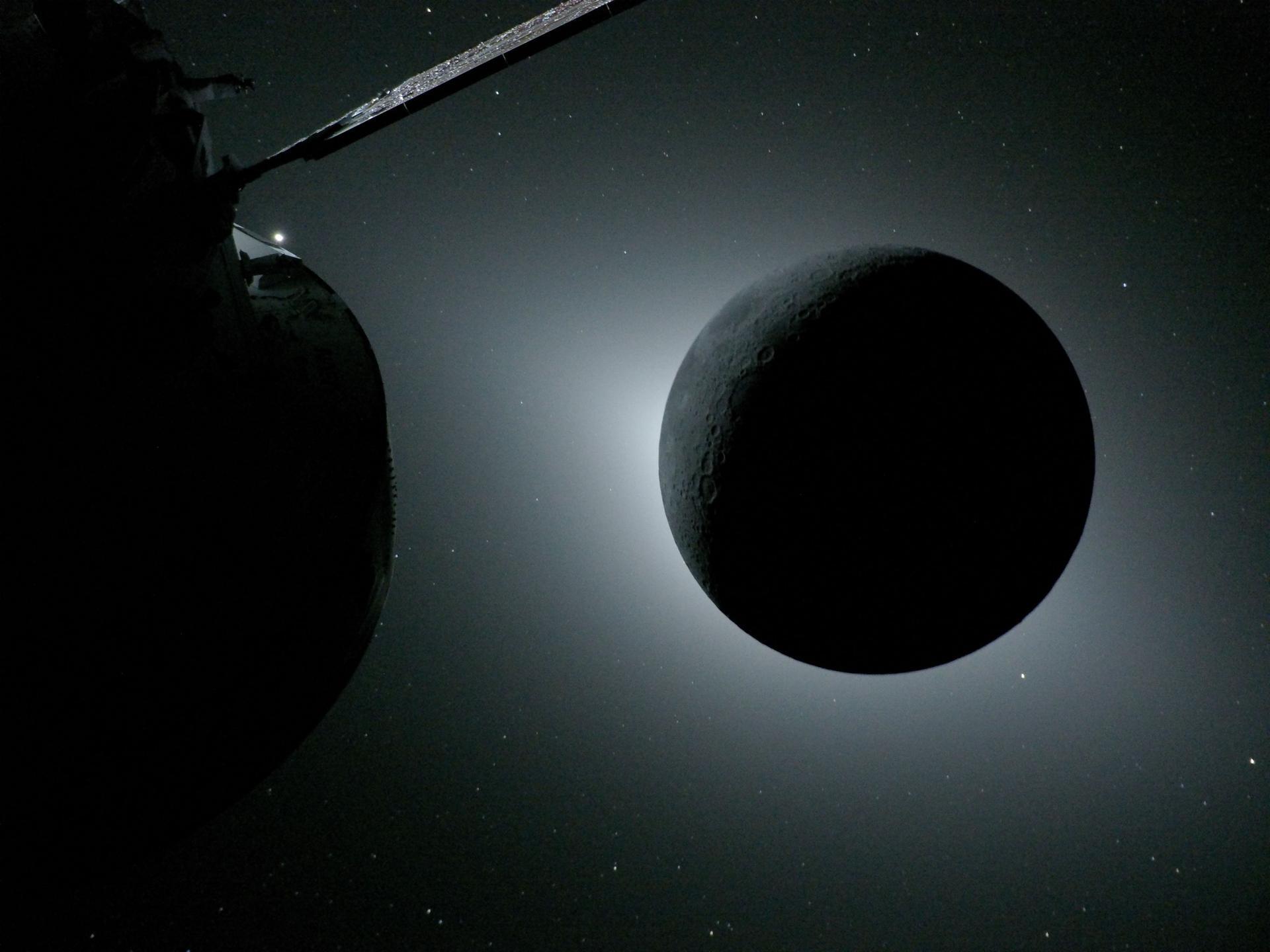
The Moon, backlit by the Sun during a solar eclipse, is photographed by NASA’s Orion spacecraft on April 6.  Orion is visible in the foreground on the left. The bright spot visible just below the Moon’s bottom right edge is Saturn. Beyond that, the bright spot at the right edge of the image is Mars.


Credit: NASA

HOUSTON—Following a record-setting, seven-hour pass beyond the far side of the Moon, NASA’s Artemis II astronauts returned into the gravitational sphere of Earth April 7 as they continued a free-return trajectory that will bring their nine-day mission to a close with a splashdown in the Pacific Ocean on April 10.

Prior to the crew waking up to begin their seventh day in space, the first images and recorded audio notes from their science observations during the lunar flyby were transmitted back to Earth for analysis.

The downlink, much of which was via an optical communications link, included pictures of the lunar terrain, showing color, brightness, surface textures and other features intended to give scientists a better understanding of the composition and evolutionary history of the Moon. Some of the far-side features were seen by human eyes for the first time, as the Artemis II Orion spacecraft soared 4,000-6,000 mi. beyond the lunar surface, a span that far exceeded the distance of the Apollo capsules’ orbits during the agency’s first forays to the Moon between 1968-72.

“What you did yesterday really made a difference scientifically,” Kelsey Young, the Artemis II lunar science lead, radioed to the astronauts April 7. “Our whole lunar science team and the broader science community have been pouring out positive feedback and gratitude.”

The observations by Orion astronauts Reid Wiseman, Victor Glover and Christina Koch, all with NASA, and Canadian Space Agency astronaut Jeremy Hansen included 4-6 bright flashes from micrometeorites that were visible during the final hour of the flyby when the Sun was eclipsed by the Moon.

“I don’t know if I expected to have the crew see any on this mission,” Young told reporters April 7. “I was not in the science evaluation room [at the time], but I heard there were audible screams of delight.”

With the  optical communications link, NASA was able to download 20 gigabytes of data in a little more than 45 min. “That’s orders of magnitude more than we get via our S-band telemetry system,”  flight director Rick Henfling told reporters. “Optical comm has been working really well, and hopefully we can take what we learned on Artemis II and expand its operational capability and implementation for future missions.”

The Orion capsule, named Integrity, left the Moon’s sphere of gravitational influence and fell back in the gravitational embrace of Earth at 1:23 p.m. EDT when Integrity was 41,072 mi. from the Moon. The transition was a seamless phase of the capsule’s “free return” trajectory provided by orbital mechanics, rather than chemical propulsion.

The Artemis II mission lifted off  April 1 from NASA’s Kennedy Space Center. Following a 25-hr. checkout in high-Earth orbit, Orion’s European Space Agency-provided service module performed a 5 min. 50 sec. engine burn to begin the eight-day loop around the Moon and return to Earth. Integrity’s splashdown off the coast of San Diego on April 10 is expected at 8:06 p.m. EDT.

Integrity’s closest approach to the Moon—4,067 mi. — occurred at 7:02 p.m. EDT April 6 with the ship flying 3,138 mph relative to the lunar surface,

The first of three planned thruster firings to tweak Orion’s return trajectory was expected about 9 p.m. on April 7.

Earlier in the day, Wiseman, Glover, Koch and Hansen participated in a ship-to-ship call with astronauts aboard the International Space Station (ISS) to discuss their lunar flyaround.

“We know how fortunate all of us are to come up here and look down at the Earth from above. Every astronaut who comes to space remarks on that. We really wanted to hear how different that felt now from your new perspective around the Moon,” astronaut Jessica Meir radioed to the Artemis II crew from aboard the ISS.

“The thing that changed for me looking back at Earth was that I found myself noticing not only the beauty of the Earth, but how much blackness there was around it. It just made it even more special,” Koch replied.

“It truly emphasized how alike we are, how the same thing keeps every single person on planet Earth alive. We evolved on the same planet. We have some shared things about how we love and live that are just universal, and the specialness and preciousness of that is really emphasized when you notice how much else there is around it,” she said.

On a lighter note, Koch told Meir, “Jessica, I always hoped we would be in space again together, but I never thought it would be like this.”

The women flew together on the ISS from September 2019-April 2020.

At the time of the ship-to-ship, the ISS was orbiting 267 mi. above Earth south of Africa, and Orion was 231,793 mi. away from Earth.

Mark Carreau

Mark is based in Houston, where he has written on aerospace for more than 25 years. While at the Houston Chronicle, he was recognized by the Rotary National Award for Space Achievement Foundation in 2006 for his professional contributions to the public understanding of America's space program through news reporting.

Irene Klotz

Irene Klotz is Senior Space Editor for Aviation Week, based in Cape Canaveral. Before joining Aviation Week in 2017, Irene spent 25 years as a wire service reporter covering human and robotic spaceflight, commercial space, astronomy, science and technology for Reuters and United Press International.