This article is published in Aerospace Daily & Defense Report part of Aviation Week Intelligence Network (AWIN), and is complimentary through Apr 01, 2026. For information on becoming an AWIN Member to access more content like this, click here.

NASA Shifts Artemis From Gateway Station To Moon Base

nasa

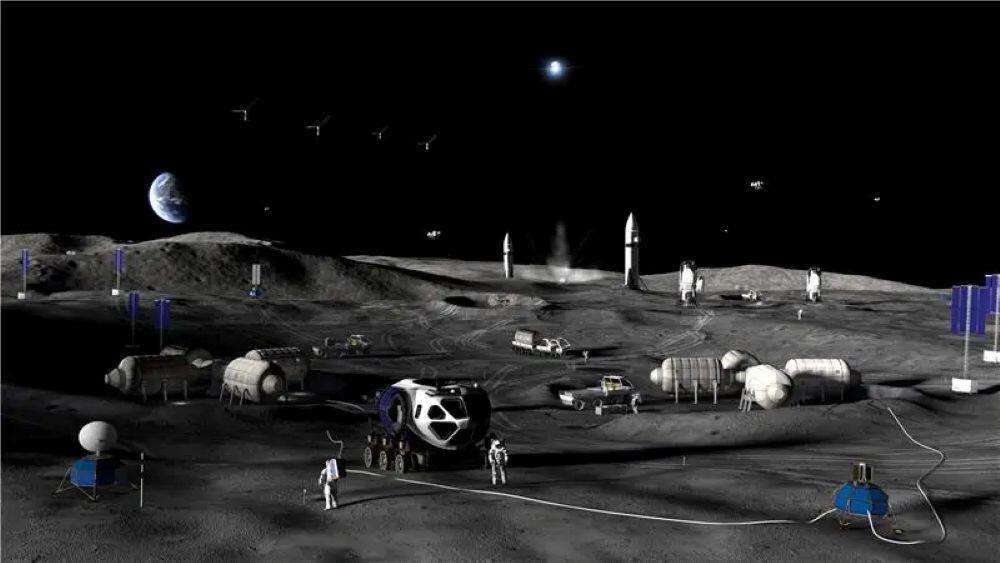
Rendering of NASA's planned Moon Base at the end of a planned 10-year development.

Credit: NASA

NASA has unveiled sweeping changes to its Artemis exploration initiative that repurposes hardware and partner contributions from the previously planned lunar-orbiting Gateway outpost to a base on the Moon.

The revamped architecture builds on the agency’s existing Commercial Lunar Payload Services (CLPS) and Human Landing System (HLS) programs to drastically increase the frequency and payload capacity of lunar missions. It also shifts crewed human flights from the Space Launch System (SLS) rocket to commercially provided flight services beyond Artemis V.

“We intend to work with no fewer than two launch providers with the aim of crewed landings every six months, with additional opportunities for new entrants in the years ahead,” NASA Administrator Jared Isaacman said March 24 at the beginning of a two-day series of briefings for Artemis industry and international partners at NASA Headquarters in Washington.

“The programs we left behind in this effort were not success stories,” Isaacman added.

NASA accompanied the briefings with a series of procurement notifications requesting information from industry on upgraded CLPS lunar landers and services,  a new planned solicitation for Artemis Commercial Lunar Transportation Solutions to fly crews to and from the Moon, and other initiatives.

Isaacman previously announced plans to add an HLS demonstration mission in low Earth orbit in 2027 ahead of landing the first Artemis crew on the Moon in early 2028. In an attempt to speed up the SLS flight rate, NASA also canceled planned upgrades, including the Boeing-built Exploration Upper Stage. Beginning with Artemis III in 2027 or Artemis IV in 2028, the rocket will use a Centaur V upper stage provided by United Launch Alliance.

Artemis II, the first crewed flight test of the Lockheed Martin-built Orion spacecraft, is being prepared for a launch attempt as early as April 1.

NASA envisions building the Moon base in three phases over the next 10 years, with each phase costing about $10 billion. The buildup includes increasingly more capable lunar surface and orbital assets requiring 24 launches between 2026-28; 26 launches between 2029-32; and 28 launches between 2033-36.

For surface power, the agency intends to start with solar and regenerative fuel cell technologies, then turn to nuclear power systems beginning with radioisotope heaters, followed by radioisotope thermoelectric generators and ultimately fission reactors, said Carlos Garcia-Galan, program executive for the new Moon Base program.

To demonstrate nuclear electric propulsion, NASA plans to launch an interplanetary mission in late 2028 that will fly to Mars. The mission, known as Space Reactor 1 (SR-1) Freedom, is intended to carry several Ingenuity-class helicopters to Mars while serving as a pathfinder for commercial fission-power providers, Isaacman added.

“SR-1 Freedom will establish flight heritage nuclear hardware, set regulatory and launch precedent, and activate the industrial base for future fission power systems across propulsion, surface and long-duration missions,” NASA added in a press release.

Irene Klotz

Irene Klotz is Senior Space Editor for Aviation Week, based in Cape Canaveral. Before joining Aviation Week in 2017, Irene spent 25 years as a wire service reporter covering human and robotic spaceflight, commercial space, astronomy, science and technology for Reuters and United Press International.

Comments

1 Comment
Finally NASA being NASA. I was a little tired and disappointed with NASA playing around with a weird architecture and an incomplete plan to explore the Moon.