This article is published in Aerospace Daily & Defense Report part of Aviation Week Intelligence Network (AWIN), and is complimentary through Jan 14, 2026. For information on becoming an AWIN Member to access more content like this, click here.
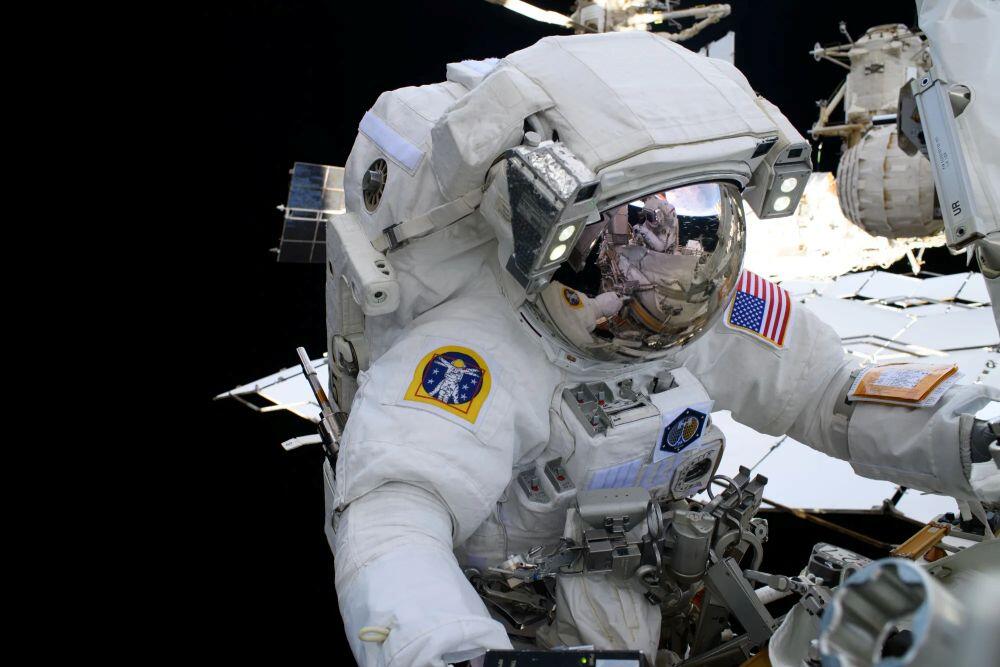
NASA astronaut Nichole Ayers during a spacewalk outside the International Space Station.
HOUSTON—NASA’s first International Space Station spacewalk of 2026 is planned for Jan. 8 to prep the orbital lab for the installation of its seventh ISS Roll-Out Solar Array (IROSA).
The 6- to 7-hr. excursion will be conducted by Mike Fincke, the ISS Expedition 74 commander, and astronaut Zena Cardman.
The ISS was equipped with an original four pairs of 240-ft.-long solar arrays during its initial assembly between December 2000 and March 2009 to generate about 160 kW of electricity over an anticipated 15-year lifespan. As ISS operations were extended, NASA and its prime space station contractor, Boeing, along with Redwire worked to augment six of the eight outstretched initial arrays with a 60-ft.-long IROSA, each of which was developed to generate an additional more than 20 kWs of solar power.
The initial six IROSAs were installed by spacewalkers between June 2021-June 2023. NASA decided to develop and install a fourth pair of IROSAs in June 2023. The final pair of IROSAs was delivered to NASA in January 2025 and now await launch together aboard a SpaceX Cargo Dragon mission for spacewalk installation later this year, Bill Spetch, NASA’s ISS operations integration manager, told a Jan. 6 news briefing. It was hosted by Johnson Space Center.
Fincke will be conducting a NASA career-record-tying 10th spacewalk. Cardman will be experiencing her first. They will transit to the 2A power channel on the port side of the ISS’s 356-ft.-long solar power truss to install brackets and fasteners as part of the support structure for the installation of the seventh IROSA.
Yet to be scheduled will be spacewalks for the actual installation of the 2A power channel IROSA and the hardware for and installation of the eighth, and final, IROSA at the 3B power channel on the starboard side of the long solar power truss.
The final pair of IROSAs will augment the solar power available for life support and scientific research activities aboard the ISS. They will also play a critical role in a planned controlled safe deorbit of the ISS in 2030 using a U.S. deorbit vehicle, which is being developed for NASA by SpaceX.
As the planned ISS deorbit unfolds, the altitude of the ISS will be gradually lowered, requiring the initially installed solar arrays to be secured and thereby reducing their power generation. The design and function of the IROSAs will be counted on to generate the electrical power considered critical for a safe, controlled deorbit of the about 1-million-lb. ISS, Spetch said.
The ISS has been continuously staffed by astronauts and cosmonauts for more than 25 years. NASA is currently working on plans to transition the scientific research and technology development activities on the ISS to multiple commercial space station operators and to become one of multiple tenants. The move is expected to create a rise in the low-Earth-orbit economy.