This article is published in Aerospace Daily & Defense Report part of Aviation Week Intelligence Network (AWIN), and is complimentary through Oct 07, 2026. For information on becoming an AWIN Member to access more content like this, click here.
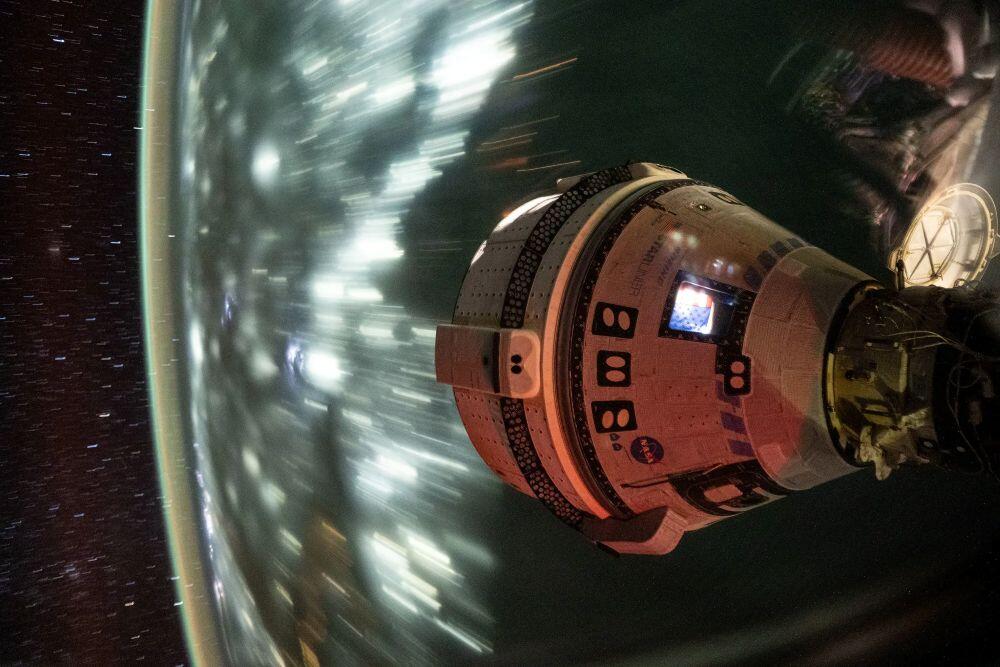
Starliner reached the International Space Station for a crewed flight test on June 6, 2024, but safety issues prompted NASA to return the capsule uncrewed.
CAPE CANAVERAL—More than two years after the troubled crewed flight test of Boeing’s CST-100 Starliner space taxi, NASA and Boeing aim to return the spacecraft to flight with an uncrewed cargo run to the International Space Station (ISS) in late December or January.
That flight test—the fourth in a series that began in December 2019—would be followed by what NASA hopes will be an operational ISS crew-rotation mission in 2028. Astronaut Warren “Woody” Hoburg, a veteran of one long-duration ISS mission, was assigned to command that flight, known as Starliner 2, NASA Administrator Jared Issacman told reporters on Sept. 28.
NASA also is looking to reinstate two Starliner missions suspended from Boeing’s 2014 Commercial Crew program contract following the June-September 2024 Crew Flight Test (CFT) with NASA astronauts Barry “Butch” Wilmore and Sunita Williams.
The CFT mission, originally slated to last one-two weeks, was repeatedly extended while NASA and Boeing assessed issues with the spacecraft’s propulsion system. Ultimately, NASA opted to bring Starliner back to Earth without Wilmore and Williams due to safety concerns. The astronauts were transferred to the resident ISS staff and served another six months in orbit.
In February 2026 NASA retroactively classified the Starliner CFT as a Type A mishap, a failure category for missions that typically result in loss of crew or vehicle.
A trio of technical issues surfaced during CFT, including corroded valves in the propulsion system, a problem that also arose ahead of Starliner’s second Orbital Flight Test in 2021.
“It took the team more extensive analysis on the root cause of why we saw the corrosion,” John Mulholland, vice president and program manager for Boeing’s Commercial Crew program, told Aviation Week. “It’s been a renewed focus for the company to make sure safety is first.”
During Starliner’s approach to the ISS on June 6, 2024, for the CFT flight, five of the spacecraft’s eight aft-facing reaction control system thrusters failed. Wilmore took manual control after the second shutdown and NASA decided to allow the docking despite the degraded conditions. Four more thrusters failed prior to docking, resulting in a loss of 6-deg.-of-freedom attitude control, later considered a very risky situation.
The spacecraft also experienced helium leaks and other issues.
Several fixes and operational changes are being implemented ahead of the uncrewed Starliner 1 mission, slated for December 2026-January 2027, and more remediations are planned before Starliner 2 is cleared for a launch targeted for 2028. The remediations include replacement of all the crew module propulsion system valves and new operating procedures to further mitigate against possible corrosion.
For the Starliner 1 mission, Boeing is implementing a system of thermal shunts and barriers to prevent the thrusters from overheating—another issue that contributed to problems during the CFT mission.
NASA said it is boosting Boeing’s Commercial Crew Program contract by $359 million to help offset additional expenses of preparing Starliner to return to flight and to begin certification for Starliner to fly on United Launch Alliance (ULA) Vulcan rockets. Boeing has contracts to fly Starliners on ULA’s final six Atlas V boosters and is looking to switch to Vulcan after those missions.
Mulholland declined to say how much more it will cost Boeing to evolve Starliner into an operational system. NASA selected Boeing and SpaceX in 2014 for contracts worth $6.8 billion at the time to develop commercial space taxis and provide flight services for six ISS crew-rotation missions. Since Starliner’s troubled December 2019 uncrewed debut, technical delays and fixed-price contract overruns have cost Boeing a reported $2 billion extra.
SpaceX is preparing to launch its 14th ISS crew on Oct. 1, and also has flown seven private orbital missions on its Dragon spacecraft.

Related Content