This article is published in Aerospace Daily & Defense Report part of Aviation Week Intelligence Network (AWIN), and is complimentary through Oct 20, 2026. For information on becoming an AWIN Member to access more content like this, click here.
U.S. Army Tests Amazon Leo Network Potential For Soldier Connectivity
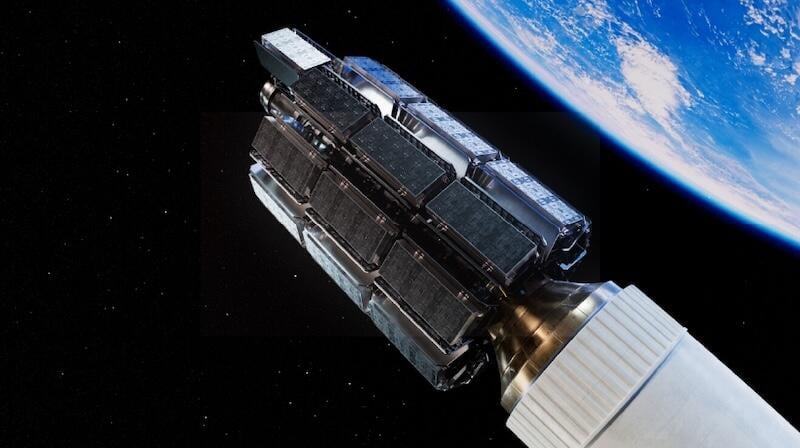
A rendering of Amazon Leo satellites.
The U.S. Army recently stress-tested the use of Amazon’s nascent proliferated communications network to provide high-speed connectivity to soldiers in the field, the company announced Oct. 13.
The service’s Combat Capabilities Development Command recently hosted a live demonstration of the company’s low-Earth-orbit (LEO) network, Amazon Leo, at Aberdeen Proving Ground, Maryland. Participants used a laptop to send and receive data as Amazon Leo satellites passed overhead, hitting peak download speeds exceeding 400 Mbps, per the release.
The company’s LEO-based network currently comprises nearly 400 active satellites, but it is expected to ultimately include more than 7,000 satellites. Amazon has manufactured more than 1,000 satellites as it looks to scale that constellation, and has satellites stacked and ready for two launches scheduled in the coming weeks: one via a United Launch Alliance Vulcan rocket from Cape Canaveral Space Force Station, and the other with an Arianespace Ariane 6 launch vehicle from the Guiana Space Center in Kourou, French Guiana, Amazon Leo said in an Oct. 8 company post.
More tests are in the works between Amazon and the Army, including higher-speed connections, mobile scenarios and integration with the service’s existing tactical networks.
Amazon Leo's government services subsidiary is also preparing to demonstrate how its satellites can connect to the U.S. Space Force’s new Space Data Network (SDN). Amazon was one of five vendors to secure a cumulative $60 million in August, to test how satellites built by multiple vendors can serve as orbital routers for the SDN “Backbone” constellation in development by SpaceX. The other vendors selected include Lockheed Martin, Northrop Grumman, Rocket Lab and York Space Systems.

Related Content