This article is published in Aviation Week & Space Technology and is free to read until Feb 07, 2026. If you want to read more articles from this publication, please click the link to subscribe.

Four Vendors Are Set To Build New LEO Missile-Tracking Constellation
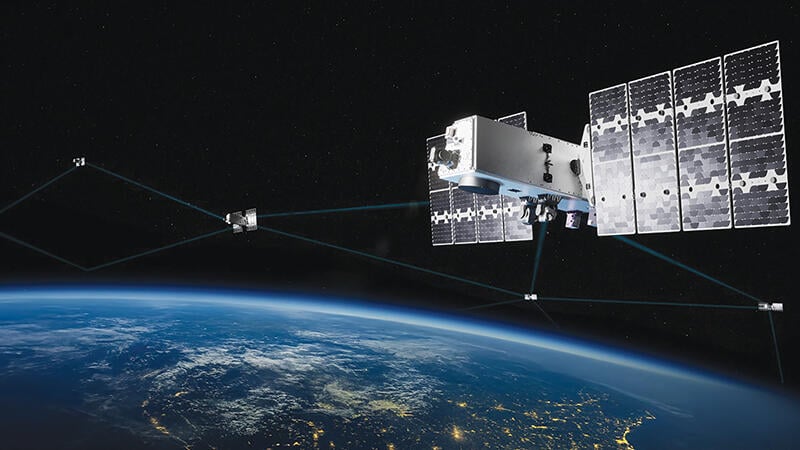
Illustration of Rocket Lab satellite in space

Rocket Lab is building satellites and supplying components to other vendors under the SDA Tranche 3 Tracking Layer contract.

Credit: Rocket Lab

The U.S. Space Development Agency is broadening its industrial base with recent contract awards that bring launch company Rocket Lab into missile defense while reinforcing commitments to established primes.

As it continues to build and field its nascent constellation, the Space Development Agency (SDA) has selected four companies—L3Harris Technologies, Lockheed Martin, Northrop Grumman and Rocket Lab—to build the next generation of missile-warning and tracking satellites. First launches are expected in fiscal 2029.

  • Sierra Space is bumped after the SDA received 15 bids for new contract
  • Tranche 3 Tracking satellites are slated to launch in fiscal 2029

Each vendor is set to produce 18 satellites for the Tranche 3 Tracking Layer within the SDA’s Proliferated Warfighter Space Architecture (PWSA) in low Earth orbit. That architecture is intended to provide global data connectivity through the Transport Layer as well as persistent missile warning, tracking and defense sensing via the Tracking Layer.

The awards, announced on Dec. 19, continue the SDA’s spiral development approach, which emphasizes rapid fielding, competition and regular technology refreshes. Each Tranche 3 Tracking Layer satellite is to carry an infrared mission payload, optical communications terminals and Ka-band communications payloads.

Rocket Lab debuts as a missile defense satellite prime with the award, which includes an $805 million base contract, according to the SDA. The company is already a satellite vendor for the Transport Layer under Tranche 2.

Better known for launch services and small satellite manufacturing, Rocket Lab has spent the past year repositioning itself as an end-to-end national security space technology provider. It acquired electro-optical and infrared payload supplier Geost last year from Lightridge Solutions for $275 million. The company also announced plans to acquire German optical communications company Mynaric a few months prior, although German authorities are still reviewing the proposed deal.

Rocket Lab made these moves with the Tracking Layer and the U.S. government’s proposed Golden Dome missile defense architecture in mind, CEO Peter Beck told Aviation Week. “We’ve made no kind of secret of the fact that we want to be the SDA supplier of choice, and we think we can be a better supplier to the government by integrating the sensor into our platform,” he said in June.

Other Tracking Layer primes, including Northrop Grumman and Sierra Space, previously picked Geost’s Starlite sensors to protect their own satellites against directed energy threats.

Under the Tranche 3 awards, Lockheed Martin and Rocket Lab plan to build satellites equipped with missile-warning,  tracking and missile defense payloads; Lockheed’s contract is valued at up to $1.1 billion. L3Harris and Northrop Grumman are to produce missile-warning and tracking satellites under contracts worth $843 million and $764 million, respectively.

The selection pushes out Sierra Space, which is building 18 satellites for the Tranche 2 Tracking Layer expected to launch in 2027. The company does not plan to protest the awards and continues to position itself for future tranches as prime contractor and supplier, Erik Daehler, senior vice president of defense at Sierra Space, says.

Daehler notes that the company has invested “hundreds of millions of dollars” in the past three years to establish high-rate satellite production in Centennial, Colorado, including facilities for integrated spacecraft, solar arrays and their subcomponents for proliferated constellations, such as the PWSA. “While we may not be on every single award as a satellite prime, we anticipate being in every single production system, building some part of the supply base,” he says.

Sierra Space remains focused on meeting its Tranche 2 commitments, Daehler says, adding that nine of 18 satellite structures were completed by the end of 2025, several months ahead of schedule.

Since its inception, the SDA has emphasized bringing new companies into each tranche while regularly returning to seasoned satellite integrators. Northrop Grumman entered the PWSA ecosystem in Tranche 1 and is building more than 150 satellites across Tracking and Transport Layer contracts. L3Harris has participated in every Tracking Layer tranche, building 56 satellites across Tranches 0-3. Lockheed joined the Tracking Layer in Tranche 2 and is under contract for 88 Transport Layer satellites.

The SDA received 15 bids for the Tranche 3 solicitation and selected the strongest proposals, agency spokesperson Jenn Elzea tells Aviation Week. The outcome “is not a reflection of the current performance of any one vendor but rather an indication of a strong industrial base,” she says.

Vivienne Machi

Vivienne Machi is the military space editor for Aviation Week based in Los Angeles.