This article is published in Aviation Week & Space Technology and is free to read until Sep 05, 2026. If you want to read more articles from this publication, please click the link to subscribe.
Launch Site Shortage Troubles Western Military Space Leaders

Sweden is upgrading Esrange to support orbital launches starting in 2028.
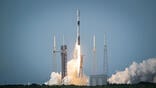
Launcher scarcity may be today’s capacity concern for space operators, but Western military leaders increasingly worry about the state of range infrastructure as they look to put spacecraft to orbit quickly in times of crises.
Germany is exploring whether to secure a space launch facility for its military, driven in part by Berlin’s growing interest in carrying out responsive space missions and concerns that commercial demand might delay access to launch pads, German Defense Minister Boris Pistorius said July 23. “We need space launch capacity,” he said during a visit to rocket startup Isar Aerospace.
- Sweden targets 2028 for Firefly Aerospace Alpha mission
- Rocket Lab heads to Kodiak, Alaska, for launch
Isar Aerospace currently launches from Andoya Spaceport in Norway, while German rival Rocket Factory Augsburg plans to use Scotland’s SaxaVord Spaceport. But those facilities “will not be sufficient,” Pistorius said. “We need more diversification.”
OHB, which last year established the European Spaceport Co., said it is working to provide Germany with sovereign launch capability. “Particularly for military requirements, we need significantly greater resilience in launch capacity, and we are fully prepared to get started quickly,” said Sabine von der Recke, OHB chief communications officer and managing director of the European Spaceport Co.
The theme resonates elsewhere. “We are lacking launch capability on a global level,” Rear Adm. Anders Sundeman, chief of space in the Swedish Armed Forces, said on the eve of the Farnborough Airshow.
U.S. Space Force Gen. Chance Saltzman, the Pentagon’s departing chief of space operations, voiced a similar sense days earlier that more needs to be done. “What we’re doing is trying to expand that infrastructure as rapidly as possible,” he said.
For 60 years, Sweden has used the Esrange Space Center for sounding rockets and high-altitude balloon flights, but it is upgrading the facility for orbital launches. State-owned SSC Space said on June 30 that it is targeting the first flight of a Firefly Aerospace Alpha rocket in 2028. The Swedish military is partly financing activities at Esrange, Sundeman said.
Canada is entering the spaceport business, too. The government detailed a roughly $146 million plan in March to establish a sovereign launch facility near Canso, Nova Scotia. Since then, Isar Aerospace signed a contract with site operator Maritime Launch Services to develop a launch complex for its Spectrum rocket, aiming to fly in 2028. Isar Aerospace CEO Daniel Metzler said during Pistorius’ visit that the company plans to expand to additional sites to build a global network of launch capabilities.
Even though the Pentagon can draw on the largest Western launch infrastructure, Saltzman said the increase in launch cadence is putting a strain on existing capacity, adding to the need for more. Since the creation of the Space Force, the operational launch tempo has increased by 1,100%.
The current pace of operations is starting “to put stress on that infrastructure that was designed for different operations,” Saltzman said. What is needed, he added, are more launchpads, additional agreements with commercial vendors to build their pads and infrastructure investments including secure facilities and ways to transport methane and liquid oxygen.
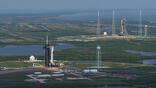
A recent Deloitte report notes that even though the number of spaceports in the U.S. has risen, activities remain largely centered around Cape Canaveral SFS in Florida and Vandenberg SFB in California.
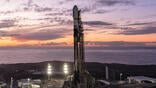
To help address concerns, the Space Force is opening an undeveloped site at its Western Range to support small- and medium-lift launch missions by developing Space Launch Complex-9 (SLC-9) at Vandenberg. The site would be used for rocket launches carrying up to 20,000 kg (44,092 lb.) to low Earth orbit, and the Space Force would like operations there to begin within three years.
Space Launch Delta 30 (SLD 30), which manages base operations at Vandenberg, had explored leasing SLC-9 to Blue Origin for its New Glenn launch vehicle. But a safety analysis concluded the site could not support heavy or super-heavy launch vehicles without affecting other operations significantly, SLD 30’s commander, Col. James Horne, told Aviation Week. Bringing smaller launch vehicles into the fold allows the service to support diverse payloads and maximize launch rates, he said.
The Space Force also is reactivating dormant squadrons at both Cape Canaveral and Vandenberg to manage space operations and oversee range improvement activities. Congress has earmarked about $1.3 billion for a bicoastal infrastructure program known as the Spaceport of the Future, due to run through 2028.
Bolstering the Space Force’s launch infrastructure was one of the top priorities in its record $71.1 billion fiscal 2027 budget request. Saltzman suggested that if funding does not materialize, drastic action might need to be taken. “We don’t want to put a cap on the number of launches that we can support from our ranges, but we have to consider that our existing resources will fail if we don’t consider a cap,” he told reporters July 15.
Rocket Lab, which operates out of Wallops, Virginia, and New Zealand, will begin suborbital launch operations from Kodiak, Alaska, as early as the end of this year under a $266 million contract with the Space Force supporting missile defense.
Since the company’s Hypersonic Accelerator Suborbital Test Electron (HASTE) rocket uses the same infrastructure as the Electron vehicle, operations in Alaska come with further options, including orbital launch, a Rocket Lab spokesperson said. The company has built its launch facilities based on a common framework that can be established in other locations, including allied nations seeking sovereign launch capability, the spokesperson noted.


Related Content