This article is published in Aerospace Daily & Defense Report part of Aviation Week Intelligence Network (AWIN), and is complimentary through May 17, 2026. For information on becoming an AWIN Member to access more content like this, click here.

Debrief: ‘City Killer’ Asteroid Numbers Set To Explode

debrief

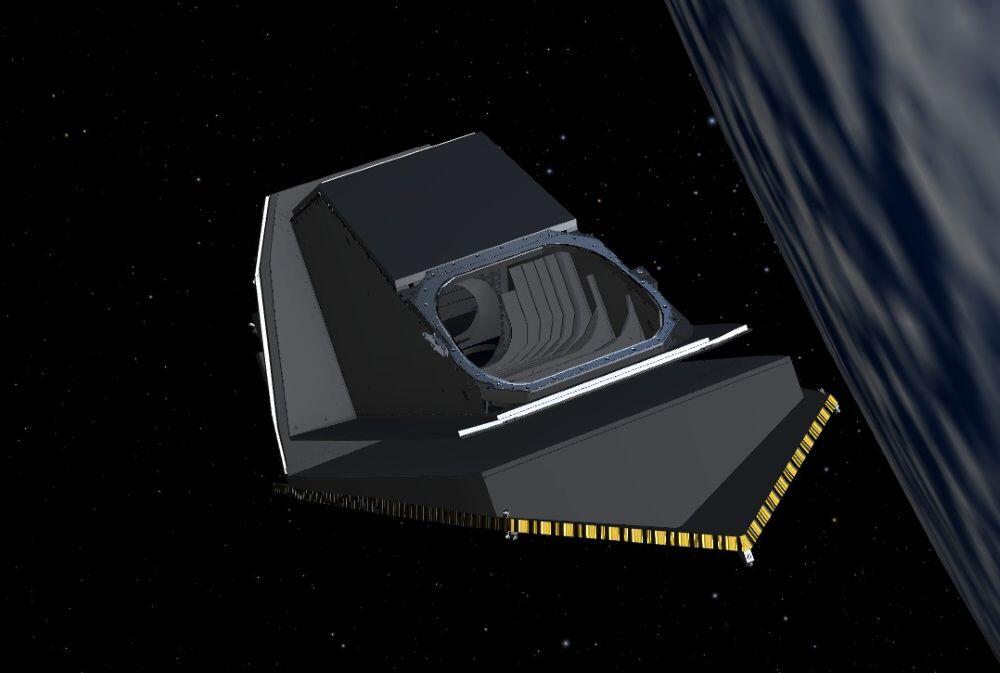
NASA aims to launch its NEO Surveyor asteroid-hunting space telescope in 2027.

Credit: NASA

COLORADO SPRINGS–Thirteen years ago a 20-m asteroid streaked without warning into Earth’s atmosphere before exploding over the Russian city of Chelyabinsk, injuring 1,500 people and causing widespread damage.

The sudden appearance of the object and its destructive power–15 times greater than the combined yield of the two atomic bombs dropped on Japan–sent shockwaves around the world’s scientific community.

Although by 2013 the search for “planet killer” asteroids bigger than 1 km was already well underway, the question after Chelyabinsk became “what about the ‘city killers?’” The Russian event, eerily similar to the 1908 Tunguska asteroid air burst over Siberia which flattened trees over an area of more than 800 mi.², injected new urgency into NASA’s search for 140-m and larger near-Earth objects (NEOs) that had been underway since 2005.

Fast-forward to today and, as of mid-April, NASA’s Planetary Defense Coordination Office says 40,155 NEOs of all sizes have now been discovered and tracked. Of these, 876 are larger than 1 km, with an estimated 50 still to be found. A further 11,493 asteroids larger than 140 m have been discovered with a staggering 14,000 estimated to still be found.

But beyond this there is an even greater population of smaller but potentially deadly city killer asteroids about which humanity knows next to nothing.

“The asteroid that hit Tunguska wiped out an area roughly the size of the Los Angeles Basin. That was only about 40 m across, so only about one-tenth the size of the 140-m asteroids. So if you ask really, how many of the asteroids have we tracked that are large enough to destroy a city, the answer is closer to about 1%,” says Ed Lu, head of the Asteroid Institute and founder of the B612 Foundation.

Speaking April 16 at the Space Symposium event here organized by California-startup ExLabs–a company planning a commercial rideshare mission to rendezvous with the asteroid Apophis before its 2029 Earth flyby–Lu says efforts to fill in the yawning gaps are about to bear fruit.

“Help is on the way. This is about to change in the very near future because of two particular telescopes,” Lu says, referring to the recently inaugurated Vera C Rubin Observatory in Chile and NASA’s Near-Earth Object (NEO) Surveyor–an infrared space telescope due to be launched in 2027 specifically to hunt for Earth-threatening asteroids.

NASA says NEO Surveyor “will seek out, measure, and characterize the hardest-to-find asteroids and comets that might pose a hazard to Earth. While many near-Earth objects don’t reflect much visible light, they glow brightly in infrared light due to heating by the Sun.”

In the meantime, in just more than a roughly six-week period during its first full year of operations, the Rubin Observatory has already discovered 11,000 new asteroids. These include 33 previously unknown NEOs, the biggest of which is around 500 m in diameter. Eventually the observatory is expected to find almost 90,000 new NEOs–some of which may be classified as potentially hazardous objects.

Addressing the audience at the Symposium, Lu adds “you get advanced knowledge of what most of the public is unaware of right now, which is that when our discovery rate goes up by a factor of 20 or 30 or 40, which is happening starting now, the rate of discovery of asteroids that have a chance of hitting the Earth in that range of a few percent or larger, also goes up by a factor of 20 or 30 or 40.”

So is this good news or bad news? The answer is a little of both. “It’s going to be a fairly common occurrence that we get these reports of ‘hey, we found an asteroid. It has a chance of hitting the Earth someday a decade or two from now. But we can’t be certain, because the uncertainty is large enough’,” Lu says.

But while the known threat will grow, so will the situational awareness to mitigate it, he adds. “So there’s both the threat and the opportunity for the space industry to deal with this,” Lu says.

Guy Norris

Guy is a Senior Editor for Aviation Week, covering technology and propulsion. He is based in Colorado Springs.