This article is published in Aerospace Daily & Defense Report part of Aviation Week Intelligence Network (AWIN), and is complimentary through May 31, 2026. For information on becoming an AWIN Member to access more content like this, click here.

Starship V3 Completes Full Duration Flight Despite Booster Loss
Credit: SpaceX

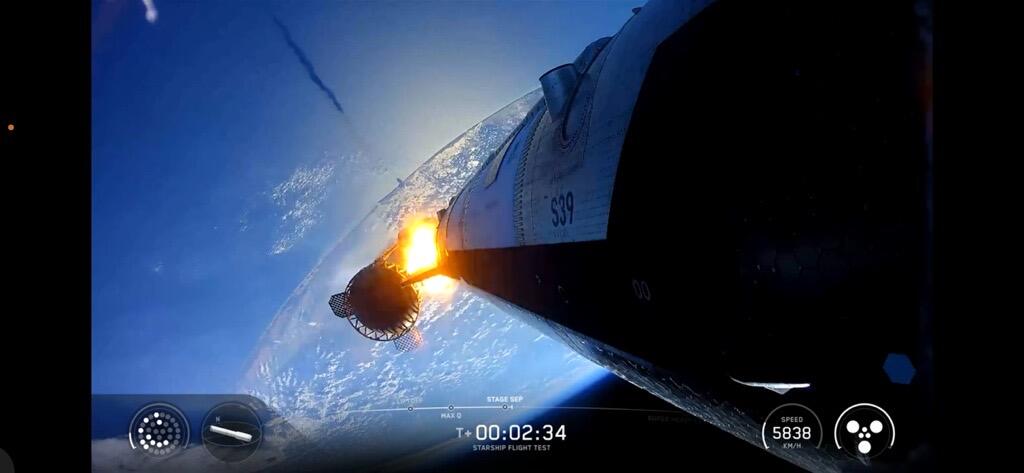
SpaceX's Super Heavy booster broke apart shortly after liftoff of the Starship Super-Heavy's 12th flight test on May 22, 2026.

Credit: SpaceX

SpaceX completed a full suborbital flight of the latest version of its Starship-Super Heavy launch vehicle on May 22, achieving several key milestones for "Version 3" even as it lost its first-stage booster shortly into the flight.

The 408-ft.-tall rocket lifted off on May 22 at 6:30 p.m. EDT from Pad 2, a newly designed complex at the company’s facility at Boca Chica Beach, Texas, less than one day after a technical issue scrubbed the initial launch attempt for Flight Test-12.

SpaceX’s hopes for the upgraded Super Heavy booster during this test flight included a successful launch, ascent, stage separation, boost-back burn and landing burn, with a splashdown in the Gulf of Mexico. The Super Heavy’s 33 Raptor engines ignited to lift the towering rocket off the launch pad. The new integrated hot-staging system worked as expected and the Super Heavy separated. But several engines failed to reignite as expected, cutting short the boost-back burn needed for a soft splashdown in the Gulf of Mexico. The booster broke apart a little more than two minutes after launch, with the debris falling into the ocean.

The Starship upper stage lost one of its six Raptors shortly after stage separation but successfully reached a suborbital trajectory and began payload deployment just under 20 min. after liftoff. SpaceX deployed 22 simulator Starlink satellites, two of which will scan and transmit images of Starship’s heat shield.

SpaceX also planned to relight a single Starship Raptor engine but opted to skip that demonstration due to the loss of the engine.

A little more than 1hr. following liftoff, Starship executed a banking maneuver meant to mimic the way it would approach SpaceX's Starbase when it returns on future missions, then achieved a targeted landing in the Indian Ocean at approximately 7:36 p.m. EDT.

With this latest flight, SpaceX aimed to demonstrate a variety of updates for the Super Heavy reusable first-stage booster, the Starship upper stage and the Raptor engines that power both stages. SpaceX has said it is saving approximately 1 ton of vehicle-level mass per engine by simplifying the engine, vehicle-side commodities and supporting hardware.

Considering the sizable redesign of the entire Starship stack on this test flight, SpaceX did not plan to return the booster to the launch site to be caught. The company has successfully caught the Starship booster twice to date, during the fifth flight test in October 2024 and the seventh in January 2025.

SpaceX began Starship test flights in April 2023. The last launch took place on Oct. 13, when the rocket completed a 65-min. suborbital flight test, marking the end of the “Version 2” configuration.

The company originally targeted V3’s first flight for January but pushed the date several times due to development setbacks. A May 21 launch attempt was scrubbed at T-minus 40 sec. before liftoff due to a technical issue that cropped up during the final seconds of the countdown.

The Starship production pipeline is full, and SpaceX expects to complete around 10 more ships and “about half that number of boosters this year,” CEO Elon Musk shared in a May 19 social media post.

Vivienne Machi

Vivienne Machi is the military space editor for Aviation Week based in Los Angeles.

Irene Klotz

Irene Klotz is Senior Space Editor for Aviation Week, based in Cape Canaveral. Before joining Aviation Week in 2017, Irene spent 25 years as a wire service reporter covering human and robotic spaceflight, commercial space, astronomy, science and technology for Reuters and United Press International.