This article is published in Aerospace Daily & Defense Report part of Aviation Week Intelligence Network (AWIN), and is complimentary through Dec 19, 2026. For information on becoming an AWIN Member to access more content like this, click here.
Space Cargo Unlimited Eyes 2030 For REV1 Reentry Spacecraft Operations
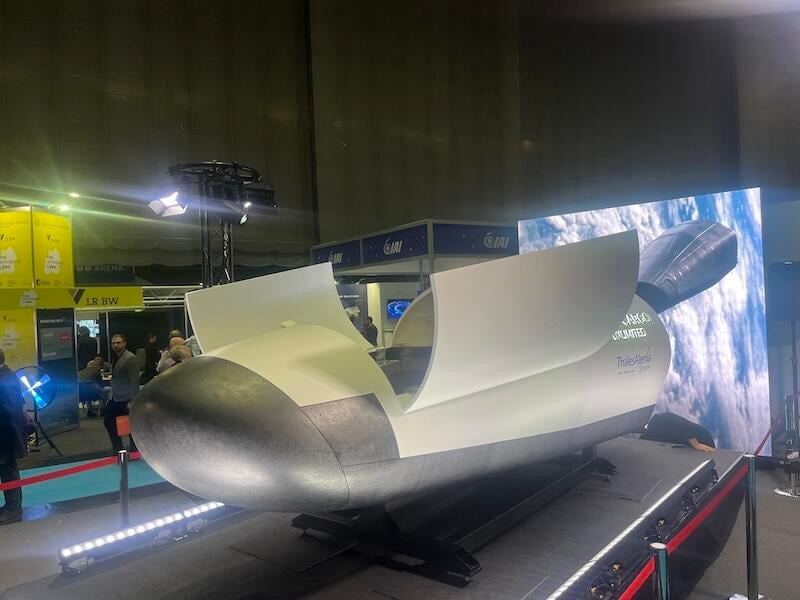
Space Cargo Unlimited's REV1 reusable reentry vehicle on display at Space Tech Expo in Bremen, Germany.
BREMEN, Germany—Space Cargo Unlimited plans to deploy its REV1 reentry space vehicle and associated elements in 2030.
The REV1, being codeveloped with Thales Alenia Space, is due to carry the company’s BentoBox in-space manufacturing platform. The 3.7-metric-ton vehicle is designed to fly around 20 times, with the company looking to secure launch capacity for the missions, Chief Technology Officer Achim Schwarzwälder said.
The system would provide slightly more than 1 metric ton of payload capacity, with 2.5 kW of continuous power.
Space Cargo Unlimited has opted for a two-section setup for the spacecraft, comprising the REV1 reentry vehicle and an orbital module to provide power. The split reduces launch demand by reducing weight, though it would require the company to master on-orbit docking. The company is working with several potential suppliers but has not yet selected the eventual vendor, Schwarzwälder said.
The orbital module, when not connected with the REV1, would operate as a node in a low-Earth-orbit communications constellation, he said. It would also provide high-bandwidth communications for REV1.
An initial version of the BentoBox for research or manufacturing in microgravity is due to fly next year with ATMOS Space Cargo’s Phoenix 2 vehicle. A 1-metric-ton version is due to fly on a SpaceX Starfall reentry vehicle sometime in 2028 or after.
The company says it is in talks with more than 150 potential customers, many in the life sciences and biotech sectors that have previously shown interest in microgravity work.
“With BentoBox, we are developing the space factory that can fly across a fleet of vehicles,” CEO Nicolas Gaume said.

Related Content