This article is published in Aerospace Daily & Defense Report part of Aviation Week Intelligence Network (AWIN), and is complimentary through Dec 19, 2026. For information on becoming an AWIN Member to access more content like this, click here.
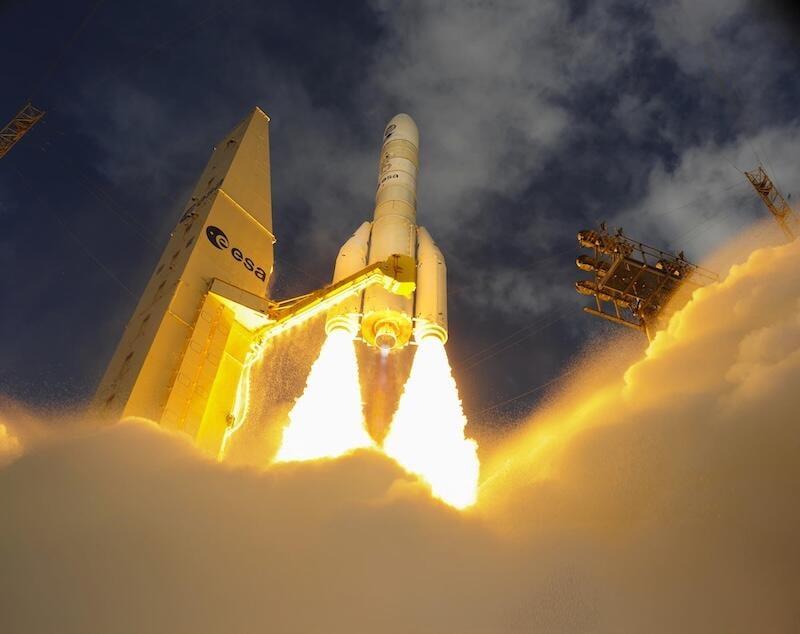
DLR Director General Walther Pelzer wants Europe to pursue heavy-lift capability beyond Ariane 6 (shown).
BREMEN, Germany—Europe should augment its efforts to foster a new generation of launchers by developing a new heavy-lift rocket, the head of the German aerospace center DLR said.
The European Space Agency (ESA) has funded several companies to develop their microlaunchers with a view to evolving them so that they are capable of putting heavier payloads into orbit. But DLR boss Walther Pelzer, speaking at Space Tech Expo Europe, said that is not enough. He wants Europe to move more quickly in supporting heavy-lift rocket development.
Europe currently relies only on the Ariane 6 for heavy-lift launch.
Pelzer also said Germany wants Europe to foster launch infrastructure. As part of that, the German government could deploy a sea-launch capability next year.
A trial would use a sounding rocket launched from a vessel, Pelzer said.
Having a sea-launch capability would help meet the urgent need for launch capacity, and it being positioned offshore would provide a degree of resilience, he said. Germany could, for instance, place sea-launch infrastructure in the equatorial region and then ship rockets out to it.
The effort is part of a wider German push to help Europe expand launch options. Pelzer said the European Union (EU) should consider UK and Norwegian launch sites as European, even though neither country is a member of the EU. Germany is also working with Canada and Spain to support launch infrastructure there.
Pelzer used his keynote at the Space Tech Expo Europe gathering to try to allay European fears about the pace at which Germany is pursuing some security space efforts. It has prompted some European companies to worry the country is turning away from cooperation. Pelzer said Germany has invited the EU and ESA to join Germany’s new Protocol Stack for Space—an effort to ensure interoperability also known as the European Architecture for Space Interoperability.

Related Content