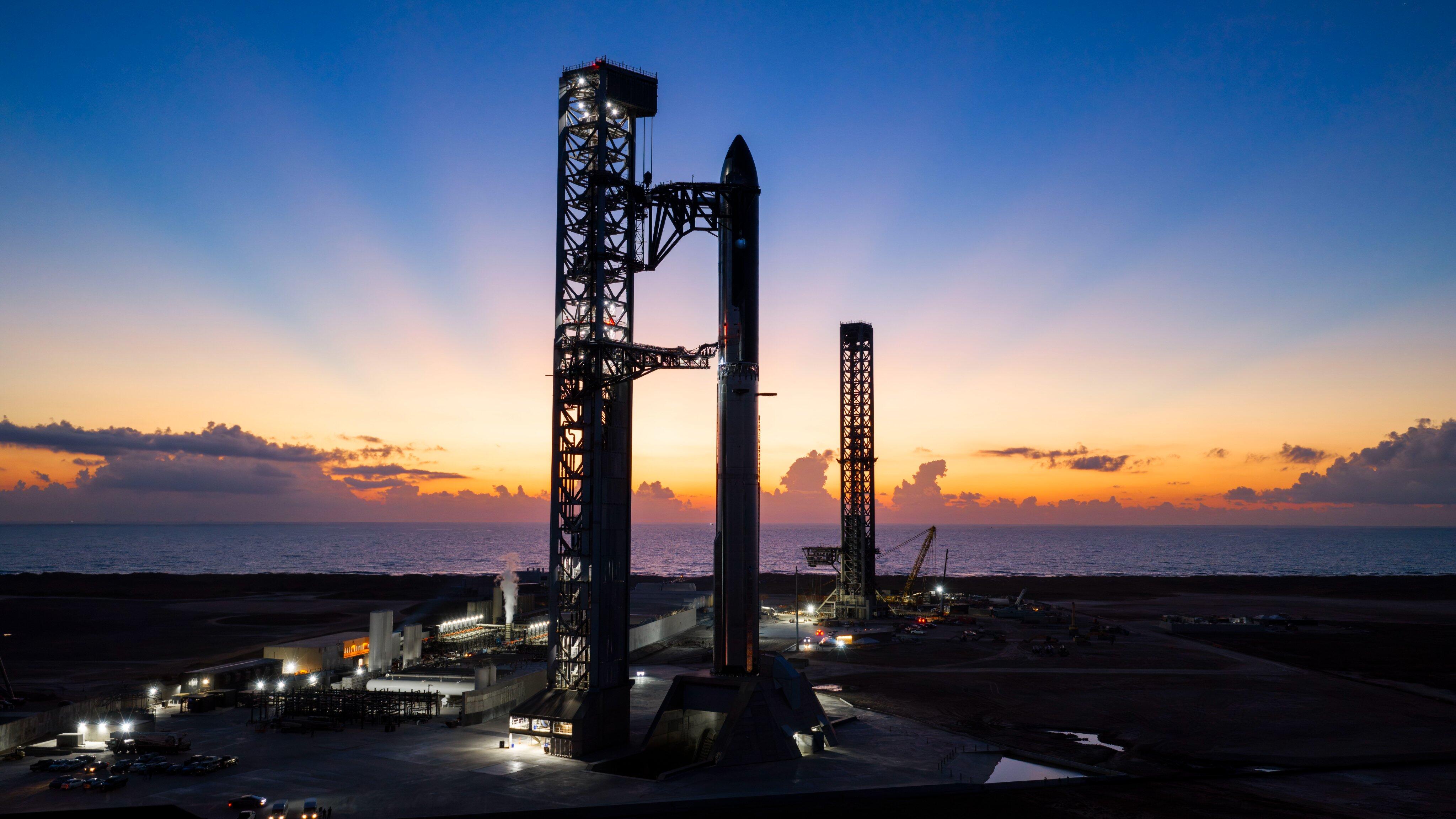
The FAA has licensed SpaceX for the orbital debut of the Starship-Super Heavy launch system, which remains in development after 13 suborbital flights and which will attempt deployment of 26 next-generation Starlink broadband satellites.
SpaceX targets the launch from Starbase, Texas, between 8:15 and 9:30 a.m. EDT Sept. 28.
“On Sept. 26, the FAA issued license authorization for the SpaceX Starship – Super Heavy Flight 14 launch and reentry operations,” the FAA said in a Sept. 27 statement.
Although the Starship system is intended to be fully reusable—eventually surpassing flight rates of SpaceX’s Falcon 9 fleet—the upcoming mission will end with both the Super Heavy first stage and the Starship upper splashing down in the ocean.
The mission follows the July 24 flight test, known as Flight 13, that ended with Starship’s unexpectedly soft impact in the Indian Ocean, prompting CEO Elon Musk to consider a Starship landing in the launch gantry on the upcoming Flight 14. That proved too much of a stretch, with a return-to-pad goal retargeted for Flight 15, depending on the outcome of Flight 14.
Instead, SpaceX is focused on getting Starship into orbit for the first time. “After the initial ascent burn, Starship will be on the same passively safe suborbital trajectory to the Indian Ocean as its initial flight tests,” SpaceX wrote in a mission profile. “This will enable flight controllers to assess the health of the vehicle during a coast phase and make the determination to either proceed to orbit or let Starship reenter and splash down in the Indian Ocean.
“Assuming the vehicle is healthy, Starship will execute a circularization burn using a single Raptor sea level engine that will place the vehicle in orbit around Earth,” SpaceX said.
The 19-sec. orbital insertion burn is expected to begin 25 min., 17 sec. after liftoff. The nominal plan is for Starship to orbit Earth six times at an altitude of about 171 mi.
About 10 min. after reaching orbit, Starship is to begin deployment of 26 Starlink Version 3 (V3) satellites slated to join SpaceX’s broadband constellation in low Earth orbit. The deployment is expected to last 30 min.
SpaceX flew 20 short-lived V3 Starlinks on the suborbital Flight 13 to demonstrate operations and connectivity.
For the next eight hours of Flight 14, flight controllers hope to gather data on Starship’s performance in orbit. Engineers also will continue tests of a remote-sensing system to inspect the ship’s heat shield during flight. Three of the Starlink V3 satellites include cameras to relay heat shield imagery during flight.
Eight hours, 52 min., 37 sec. after launch, SpaceX plans for Starship to ignite a single Raptor engine for an 11-sec. burn to leave orbit and set up a trajectory to re-enter the atmosphere and splash down in the Pacific Ocean—another first. The mission is expected to last 9 hrs., 50 min.
Among those keenly watching Starship development is NASA, which hired SpaceX in 2021 to fly astronauts to and from the surface of the Moon. The first crewed mission under the Artemis program is slated for early 2028, some 55 years after the final lunar sortie under the 1969-72 Apollo program.
NASA in 2023 added Blue Origin’s crewed lunar lander services for follow-on Artemis Moon expeditions. Both companies plan to provide vehicles for a lunar lander demonstration and checkout mission next year.