This article is published in Aviation Week & Space Technology and is free to read until Mar 21, 2026. If you want to read more articles from this publication, please click the link to subscribe.

Europe Turns A Corner With Ariane 64 First Flight For Amazon
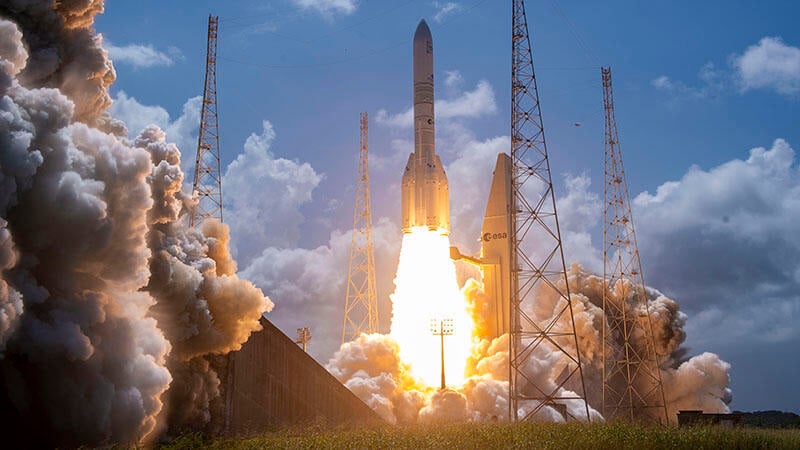
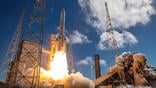
Ariane 6 rocket launching

Arianespace launched its first Ariane 6 heavy with four P120C boosters on Feb. 12, taking 32 Amazon Leo satellites to low Earth orbit.

Credit: P.Pron/ESA/CNES/Arianespace/ArianeGroup

Europe had to do some heavy lifting to revitalize its space launch operations, but the first flight of the Ariane 64 rocket for marquee customer Amazon shifts the region fully from rebound into growth mode.

The Ariane 6 took off—sporting four rather than only two P120C boosters—from the European spaceport in Kourou, French Guiana, at 11:45 a.m. EST on Feb. 12. It began deploying the 32 Amazon Leo satellites from the Beyond Gravity dispenser over a 20-min. period about 90 min. later. The satellites are due to operate in low Earth orbit (LEO) at around 465 km (289 mi.).

  • Second Amazon Ariane 64 flight due soon
  • E-commerce giant seeks waiver on deployment milestone

The VA267 mission marked the sixth overall flight for an Ariane 6 and the first for the roughly 21.6-metric-ton payload capacity configuration that is more than double that of the two-booster Ariane 62. The rocket featured a larger 20-m-tall (65-ft.) fairing to accommodate the satellites.

“It was a highly complex mission—the first constellation, the first Ariane 64, the first commercial flight,” Arianespace CEO David Cavaillolès told reporters. It was also the first nongovernmental Ariane 6 launch and one of seven or eight planned for 2026.

The flight also had special significance for Europe, which was in a launcher crisis a few years ago after a Vega C failed, the Ariane 5 program had ended and the Ariane 6 was not yet ready. The flight of the Ariane 64 marks the capstone of a turnaround that began two years ago. The European Space Agency (ESA) has since set the bar higher as it tries to foster a new cadre of startup launchers through the European Launcher Challenge.

However, the challenge is off to a slow start. Some test failures occurred in 2024 and 2025, and UK newcomer Orbex filed for insolvency in February, ending its involvement in the program. Still, ESA’s departing director of space transportation, Toni Tolker-Nielsen, said he is optimistic that some challenge participants will demonstrate success before year-end.

The Ariane 6 flight from the Amazonian region, designated Leo Europe 1 by the customer, was the first of 18 Ariane 6 launches Amazon booked to build out its broadband satellite constellation, which it intends to rival SpaceX’s Starlink. Leo Europe 1 was Amazon’s eighth constellation deployment launch and the first using a heavy rocket.

Amazon plans to have satellites on four or five Ariane 64 launches this year and on about 20 overall, depending on launch cadence. The next launch should come soon, Cavaillolès said. “Starting today, we’ll prepare the next launch” due before the summer, he noted.

With the Feb. 12 launch, Amazon now has more than 200 satellites in orbit. To achieve the goal of deploying 3,232 spacecraft, Amazon has spent over $10 billion on the system and has launch commitments through early 2029, it has said.

If launches in the coming months run at pace, Amazon is looking to begin offering some service in the first half of the year.

Still, the company asked the U.S. Federal Communication Commission (FCC) in late January for schedule relief from a deadline to deploy about 1,618 satellites, or half of the original constellation size, before August because it projects that only 700 satellites will be deployed by that point.

The e-commerce giant argued that delays with launch vehicles—including the Ariane 6, United Launch Alliance’s Atlas V and Blue Origin’s New Glenn—have contributed to delays in deploying Amazon Leo. Amazon added that it completed only seven of 20 planned launches last year. It has asked for a 24-month extension of the interim deadline.

“Amazon Leo’s scaled-up manufacturing capacity of up to 30 satellites per week and secured launch manifest of 102 launches from four providers demonstrate a confirmed ability to meet the required 1,618 satellites well before the proposed July 30, 2028, deadline,” the company said. It plans more than 30 launches in 2027 and beyond.

Despite the slower-than-expected initial rollout of Amazon Leo, the FCC approved the company’s plan to expand the current system and deploy its second-generation satellites. The FCC is allowing the company to increase the constellation size above 7,000 spacecraft and add spectrum options. The approval also enables Amazon to add polar coverage to Leo, the company said Feb. 10.

That constellation expansion will drive demand for more launches. Cavaillolès would not be drawn on any talks with Amazon on further Ariane 6 orders. The customer feedback from the first mission was “highly positive,” he said, adding: “This is very positive for the next steps.”

Over the course of 2026 and into 2027, Arianespace intends to launch an Ariane 64 powered with P160C boosters fueled by 157 metric tons of propellant, up from the P120C’s 142 metric tons. The Ariane 64 also will have an upgraded upper-stage Vinci engine that, with some launcher optimization, will represent the Block 2 configuration capable of placing 24 metric tons of payload into LEO. The design was driven in part by Amazon Leo needs.

As Arianespace picks up the launch pace, rocket-maker ArianeGroup is accelerating the production of strap-on boosters to support the higher launch cadence, especially since the Ariane 64 version is likely to dominate the business. The need for higher output is amplified by Avio’s plans to increase the Vega C launch cadence to five this year. The Ariane 6’s boosters also serve as the Vega C’s main stage.

To address the combined requirement, ArianeGroup and Avio aim to produce about 30 boosters per year. The two companies are targeting an annual launch cadence of nine or 10 Ariane 6 flights starting next year and half a dozen Vega C launches.

Arianespace says it has considered increasing the cadence further to meet expected demand, but such a decision might involve significant expenditures. “We can ramp up to 12-13 per year without any major investment,” Philippe Clar, ArianeGroup’s executive vice president and space transportation programs director, said. “Beyond that, we would have to duplicate our solid propellant production and casting facility for boosters in Kourou.”

Robert Wall

Robert Wall is Executive Editor for Defense and Space. Based in London, he directs a team of military and space journalists across the U.S., Europe and Asia-Pacific.

Thierry Dubois

Thierry Dubois has specialized in aerospace journalism since 1997. An engineer in fluid dynamics from Toulouse-based Enseeiht, he covers the French commercial aviation, defense and space industries. His expertise extends to all things technology in Europe.