This article is published in Aerospace Daily & Defense Report part of Aviation Week Intelligence Network (AWIN), and is complimentary through Dec 11, 2025. For information on becoming an AWIN Member to access more content like this, click here.
Rocket Lab is filing in as Japan's space needs outrun its launch capacity.
Japan has big ambitions for its space industry. But before the country can realize those dreams, it needs rides to space to test its technologies.
That’s a problem because production and launch of the IHI Corp.-made Epsilon small launch vehicle has been on hold for years, after a launch failure in 2022 and two second-stage engine explosions during tests in 2023 and 2024. It is uncertain when the Epsilon will return to service.
Japan’s only other proven orbital-class rocket is Mitsubishi Heavy Industries’ H3 medium-launch vehicle. But that workhorse has a long backlog of Japan Aerospace Exploration Agency (JAXA) science missions—as well as Japanese civil government and military payloads—to launch before it can offer additional rides to space.
And so, the nation is facing a launch vehicle bottleneck. To keep space research and development moving, JAXA has recently turned to Rocket Lab of the U.S. and New Zealand to pick up the slack and support its Innovative Satellite Technology Demonstration program, which provides rides to space for Japanese organizations to test their technologies.
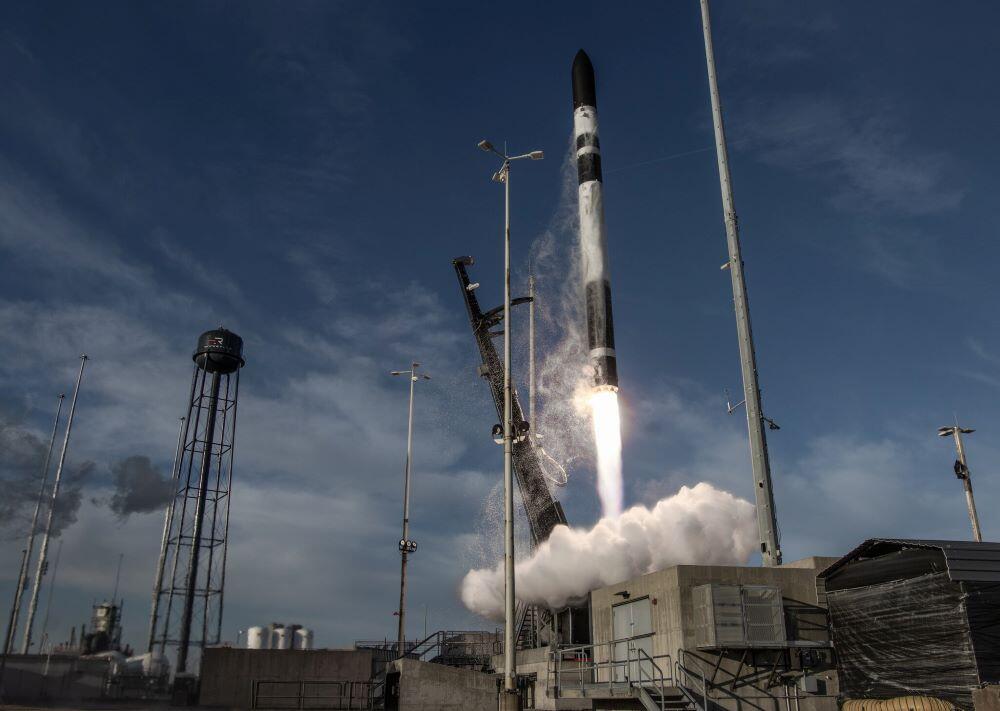
JAXA’s RApid Innovative payload demonstration SatellitE-4 (RAISE-4), carrying eight technology demonstration payloads, is expected to lift off on a dedicated Rocket Lab Electron launch vehicle on Dec. 5 from New Zealand, Rocket Lab announced on Nov. 24. A second dedicated Electron launch for the demonstration program carrying eight cubesats is scheduled for the first quarter of 2026.
The prior three Innovative Satellite Technology Demonstration missions flew on the Epsilon rocket starting in 2019.
Payloads on RAISE-4 come from a range of startups and large space manufacturers, including:
• NTT: A demonstration of Multiple Input Multiple Output (MIMO) equipment for Internet of Things (IoT) applications. MIMO is wireless communication technology that uses multiple antennas at both the transmitter and receiver to increase data throughput and reliability
• Mitsubishi Electric: An in-orbit evaluation of commercial graphics processing units to test whether the electronics can handle high-speed signal processing, including for artificial intelligence (AI) and synthetic aperture radar playback applications.
• Pale Blue: A demonstration of two types of water-based propulsion systems, an ion thruster that uses water as a propellant and a resistojet thruster that uses heat to generate steam from water.
• Takahashi Electric Works: A demonstration of a pulsed plasma thruster, an electric propulsion device intended for ultrasmall and small satellites that is low-power, compact and inexpensive.
• Axelspace: A demonstration of a membrane-deployable sail to deorbit microsatellites at the end of their operation.
• Sakase AdTech: A demonstration of a deployable lightweight membrane structure that can be used to generate power or serve as an antenna.
• Mach Corp.: A demonstration of a radiation-resistant color camera for Earth observation missions.
• Mitsubishi Heavy Industries: A demonstration of using onboard AI to detect space objects more accurately.
Those payloads and JAXA’s launch support are indicative of the Japanese government’s wider push to seed a new space industry. In 2024, the government launched its ¥1 trillion ($6.8 billion) Space Strategy Fund, a decade-long effort to transform the local space sector.
Tokyo wants to double the size of the Japanese domestic space market to ¥8 trillion (about $54 billion) from ¥4 trillion in 2020 by the early 2030s. By then, Japan wants to launch some 30 rockets into space each year and have more than 30 new satellite services on offer—everything from communications constellations to robotic spacecraft.
Aware that the H3 and Epsilon won’t be sufficient to meet those goals, the Space Strategy Fund announced efforts on Nov. 21 to study and develop high-frequency launch sites and higher production-rate rocket components. Several companies are aiming to fulfill local launch demands, including Interstellar Technologies and Honda, which are both working to develop reusable launch vehicles.