This article is published in Aerospace Daily & Defense Report part of Aviation Week Intelligence Network (AWIN), and is complimentary through May 17, 2026. For information on becoming an AWIN Member to access more content like this, click here.
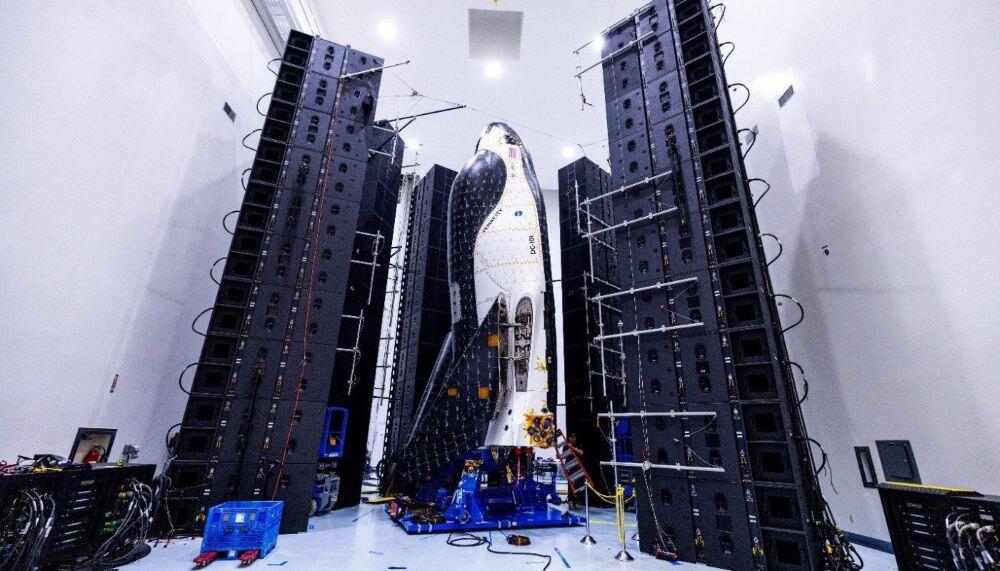
COLORADO SPRINGS—Sierra Space is attaching the last batch of thermal protection tiles to its Dream Chaser “Tenacity” vehicle prior to a final integrated fight software load test this summer that is designed to clear the spaceplane for its long-awaited orbital debut around year’s end.
The work, which is taking place at the company’s Louisville, Colorado, site, follows the return of the Dream Chaser from NASA’s Kennedy Space Center in Florida, where it completed an extensive series of prelaunch qualification checks and tests over an almost two-year period.
The final phase of the evaluation campaign, which began with the arrival of Tenacity in NASA’s Space Systems Processing Facility in May 2024, was a recently completed acoustic test. “That was the final piece for the launch certification requirement for United Launch (ULA) Alliance,” says Dan Polis, vice president of Engineering Solutions and Propulsion Systems and Dream Chaser program manager.
Acoustic testing validated that Sierra’s modeling for the internal loads on Dream Chaser were as predicted. “We can now close out the vehicle, so we have about 200 tiles remaining, out of a total of about 2,200,” says Polis, who spoke to Aviation Week at last week’s Space Symposium here.
“We also just finished our flight quality software qualification. So, our next major milestone is bringing the vehicle and the software together in a test that’s called ‘Day in the Life’ testing,” Polis says. The integrated evaluation will emulate the complete operations of the vehicle and is expected to take place over the summer. “Then we will be prepping for final mission specific payload integration for December, so we’ll be ready by the end of the year,” he adds.
The debut launch, on a ULA Vulcan rocket, will be a free-flying demonstration mission, rather than a cargo resupply flight to the International Space Station (ISS) as originally planned. The decision to revise the Dream Chaser’s debut mission to a test flight was announced by NASA last September following repeated delays to the development of both the spaceplane and the launch vehicle.
“The realignment was best for us and NASA to get to first flight, and we’re seeing that, and also to making it a multimission platform,” Polis says. The mission will now include commercial payloads. “Hopefully in the coming months we’ll be able to announce the payloads that are on there. NASA is supporting us, but we’re also trying to unlock other uses for this multimission platform.”
Before the realignment, Sierra had been on contract for at least six ISS resupply flights, the first of which was originally targeted for as far back as 2021. But Polis says under the revised plan with NASA “this was a mutual decision to get us to first flight as quickly as we could, and then to go back to station.
“We still have to finish all the certification deltas [to dock with ISS], but we don’t think that’s insurmountable. We know where those targets are, and we’re still having discussions with NASA regularly. They really care about our down mass capability, and with the extension of the ISS we’re optimistic that this vehicle will be valuable to the nation on multiple fronts,” Polis says.
At the time of the contract revision in September, the agency said, “following a successful orbital demonstration mission and certification, NASA may order flights from Sierra Space as part of the agency’s Commercial Resupply Services-2 contract based on the agency’s needs.”