This article is published in Aviation Week & Space Technology and is free to read until Dec 21, 2025. If you want to read more articles from this publication, please click the link to subscribe.

UAE Shifts Space Focus To Economy And Security

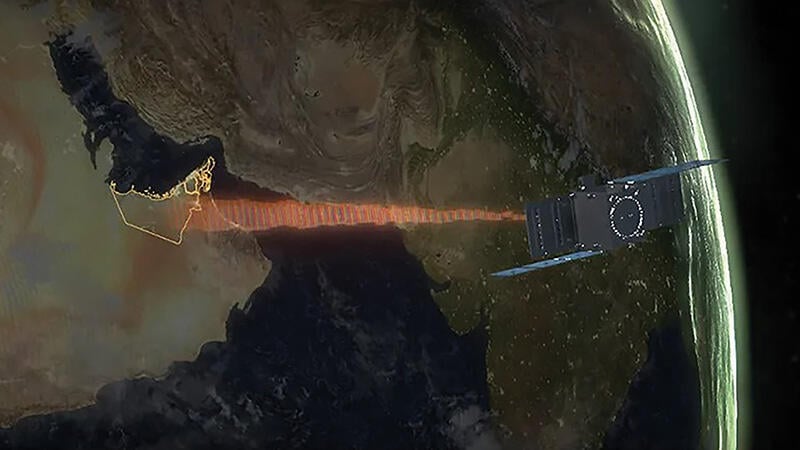
drawing of synthetic aperture radar satellite capability

FADA is ramping up work to develop a homegrown synthetic aperture radar satellite capability.

Credit: Edge Group

The United Arab Emirates is adjusting the trajectory of its space program, increasing focus on economic opportunities and security issues that echo shifts elsewhere.

The country’s effort to give more attention to securing economic gains from space and achieving national autonomy comes at a time when Canada, countries in Europe and several in Asia are similarly moving those issues up on their space agendas. The Emirates also is blending civil and military space endeavors that are playing out elsewhere.

  • FADA plans 2028 launch for first Sirb synthetic aperture radar satellite
  • UAE has eye on spaceport capacity

“I think that gray line is getting thinner and thinner between defense and civil,” Ahmad Belhoul Al Falasi, chairman of the UAE Space Agency, told Aviation Week at the Dubai Airshow. One clear example of that, he noted, is that the country’s defense minister also chairs the Supreme Space Council established only a year ago.

Last year’s establishment of space company FADA as a part of state-owned Edge Group also underpins that push, Al Falasi said. One of the ambitions is to build up the country’s technology expertise in key fields needed for national security space.

One of the first projects in which that is unfolding is in synthetic aperture radar (SAR) satellites. FADA selected Singapore-based ST Engineering and Italy’s MetaSensing as foreign industrial partners this year to develop the SAR system. ST Engineering is to provide hardware and transfer technical expertise on the satellite bus, while MetaSensing would do the same for the sensor for the system—known as Sirb, the Arabic word for a flock of birds.

The first phase of Sirb is to include the launch of the first satellite, with a focus on knowledge transfer so the second and third satellites can be built locally in the second phase.

FADA staff plan to travel to Italy in the first quarter of 2026 to start acquiring the SAR knowledge and participate in the design and development of the payload. By the end of the first phase, that expertise gained can be brought in-house, says Waleid Al Mesmari, president of Edge’s Space and Cyber Technologies division.

Edge also has local industrial partners, including Space42 for the ground station. The UAE space company has been deploying its own SAR constellation working with Iceye.

A similar plan is unfolding for other elements of the Earth observation business. FADA is trying to identify the right partners to help work on systems that can deliver electro-optical, infrared, hyperspectral and thermal data, for instance, Al Mesmari says.

“Within the next five years, we will be able to have our own different payloads when it comes to such capability,” he says.

FADA has launched an image portal called Zenith as part of its growing Earth observation portfolio. It integrates various image types from different providers to give users one place to review and analyze data. The terminal also can process satellite tasking requests using different application programming interfaces to connect with vendor systems.

The company also is looking to develop protected modems to secure satellite communications, with the initial focus on ground or airborne terminals and then on the space payload. Edge, via its Katim secure communications unit, and Space42 also used the Dubai Airshow to announce a partnership around satellite communications manufacturing.

The UAE Space Agency’s new agenda goes beyond security issues. “We are developing our own space strategy where our primary focus is on the space economy,” Al Falasi said. The ambition is to be active across the entire value chain of space with a target of around 2031 to have the broad set of capabilities up and running.

“The main goal is to make the UAE the destination for space economy in the region,” Al Falasi added.

Space companies initially focused on upstream services such as data provision, but they are increasingly moving into space manufacturing and similar activities. Launch is among the issues next on the agenda, Al Falasi said, with the UAE looking to establish a spaceport to gain some level of autonomy.

The spaceport plan is not without challenges. Airspace in the UAE is tight given the scale of commercial air traffic because of major carriers such as Emirates Airline. The UAE’s geographic location also is not optimal for launch, which could challenge the commercial prospects for such a business, so the government is considering a state-owned-and-operated model with opportunities for some commercial returns. The agency is still scouting for the right location for the spaceport, but Al Falasi said suitable sites for such an operation should exist in the country.

The UAE also wants to get into the launcher business. That would be a step-by-step process, Al Falasi added. “Having the ability to reach to space, either through a reliable partner or in the country, is paramount for your sovereignty,” Edge’s Al Mesmari noted, though that technology is not currently on the company’s agenda. “In the end, we don’t rule out us being a technology developer under the right governance model that the country will put in place.”

Even with its new focus, the UAE Space Agency has not parked its space exploration enthusiasm. The Rashid 2 Rover to explore the lunar surface is due to launch next year after the country’s first rover mission was cut short in 2023 by a lander failure.

Also on the UAE’s agenda is the Emirates Mission to the Asteroid Belt using the Mohammed Bin Rashid (MBR) Explorer. The mission, due for launch in early 2028, is an eight-year sojourn to the main asteroid belt beyond Mars that involves close flybys of seven asteroids. It also is slated to involve deployment of an experimental lander to the Justitia asteroid.

This mission also has a lot of local private sector involvement on the lander, part of the agency’s mission to grow that industry. But the relationshp also represents a challenge. The MBR Explorer must launch within a three-week window, or the mission will essentially be scrapped. Al Falasi is satisfied with the progress to date and said managing that relationship with businesses beyond this mission is essential.

“The only way to bring about innovation is to bring in the private sector,” he said.

Robert Wall

Robert Wall is Executive Editor for Defense and Space. Based in London, he directs a team of military and space journalists across the U.S., Europe and Asia-Pacific.