This article is published in Aviation Week & Space Technology and is free to read until Oct 14, 2026. If you want to read more articles from this publication, please click the link to subscribe.

Opinion: MRO Sector 3D Printing Needs Collaborative Ecosystem To Scale
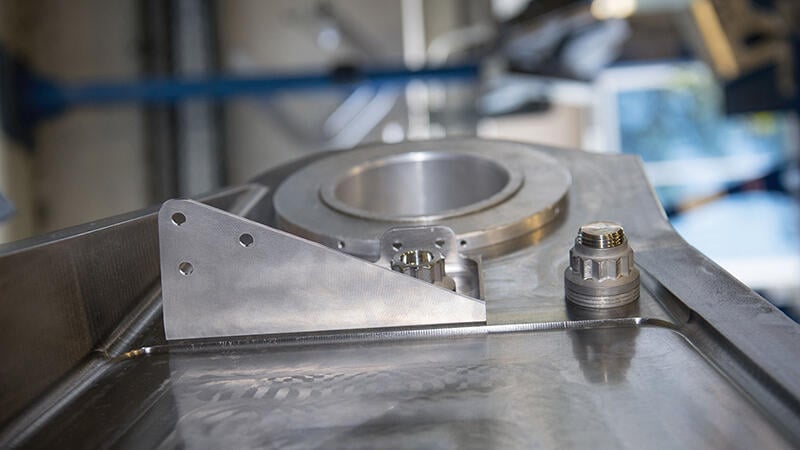
3D-printed bracket installed onto an Airbus A350 XWB aircraft pylon

The Civil Aviation Authority of Singapore and the Singapore Standards Council have established national regulatory frameworks for AM part quality and supplier vetting.

Credit: F. Lancelot/Airbus

Aerospace MRO is navigating a complex global business environment, with tighter supply chains, longer airframe life cycles and unrelenting pressure to keep aircraft flying. Against this backdrop, additive manufacturing—commonly known as 3D printing—has emerged as a transformative solution.

Additive manufacturing (AM) is more than a tool for outright cost savings; it is a catalyst for supply chain agility. By decentralizing production and moving from physical stocks to digital inventories, MRO providers can reduce lead times and guarantee part availability. AM could even consolidate complex, multipart assemblies into single, lightweight components, improving fuel efficiency and lowering operational costs.

One example is the CFM International Leap’s GE fuel nozzle, which consolidated 20 separate parts into a single printed component. The redesigned nozzle is 25% lighter and five times more durable, and its intricate cooling-channel design contributes to a 15% improvement in fuel efficiency compared with its predecessor.

For years, the aerospace industry has focused on proving that AM works. Today, industry is moving beyond prototyping; the technology is no longer the bottleneck. The real challenge is building the ecosystem required to scale adoption.

Moving beyond pilot programs to real, large-scale applications requires overcoming systemic hurdles, particularly in aviation safety standards. Qualification pathways for AM components are rigorous, lengthy and expensive. Every new material, process and hardware combination demands exhaustive validation. The industry is also fragmented, as OEMs, suppliers, MRO providers and regulators operate with diverse capabilities and frameworks that inflate costs and prevent progress.

The challenge is the absence of an operating model that allows OEMs, MROs, regulators and researchers to share data, validate processes and industrialize innovation efficiently. Industrial-scale AM requires an integrated, data-driven supply chain<\/p>

in which technology, materials and processes are standardized.

Achieving this demands a collective effort. The ecosystem relies on a delicate balance: OEMs control design authority, MROs drive operational execution, regulators enforce airworthiness, and researchers advance material science. Without an interlocutor synchronizing and connecting these pillars, AM risks remaining confined to isolated applications rather than becoming a scalable industrial capability.

What, then, would an ecosystem capable of scaling AM look like in practice? Singapore offers a blueprint for how coordinated development can accelerate industrial adoption. The country’s aerospace industry accounts for 10% of global MRO output and is supported by a combination of public-sector support, regulatory engagement, R&D capabilities and advanced manufacturing expertise drawn from adjacent sectors.

With technology often outpacing regulation, proactive governance and guidance are essential. National bodies like the Singapore Standards Council and the Civil Aviation Authority of Singapore (CAAS) directly address the certification bottleneck. By partnering closely with industry, they have established national regulatory frameworks for AM part quality and supplier vetting, culminating in CAAS Advisory Circular AC 21-7 and<\/p>

Singapore Standard SS 708:2024. These offer steppingstones for broader international collaboration.

Industrial adoption also requires collaborative innovation mechanisms that allow researchers, OEMs and MRO providers to validate and industrialize new processes jointly. An example is Singapore’s Smart Manufacturing Joint Lab, which brings together the Agency for Science, Technology and Research (A*STAR), Rolls-Royce and Singapore Aero Engine Services Private Ltd. This partnership allows for the codevelopment and deployment of new AM processes, helping drive efficiencies and increasing component reliability.

Collaboration alone is insufficient. Innovation must be translated into deployable industrial capability through design, qualification, certification and production. In Singapore, supported by the National Additive Manufacturing Innovation Cluster (NAMIC) and A*STAR, ST Engineering has developed an end-to-end AM workflow spanning design optimization, production and certification. Having delivered more than 2,000 flight-
approved AM parts spanning more than 120 part numbers, ST Engineering’s experience demonstrates how localized capabilities can shorten the path from innovation to deployment.

As AM technologies mature, competitive advantage will increasingly shift from technology ownership to ecosystem orchestration. The winners of the next phase of aerospace manufacturing will not be those with the most advanced AM technologies but those capable of building ecosystems that can transform innovation into certified, scalable industrial capability.

Kelvin Loke is a deputy director at NAMIC Singapore. He specializes in additive manufacturing technologies and applications in aerospace and defense.