
IAI AVIATION GROUP Builds For The Next Generation Of Engines MRO
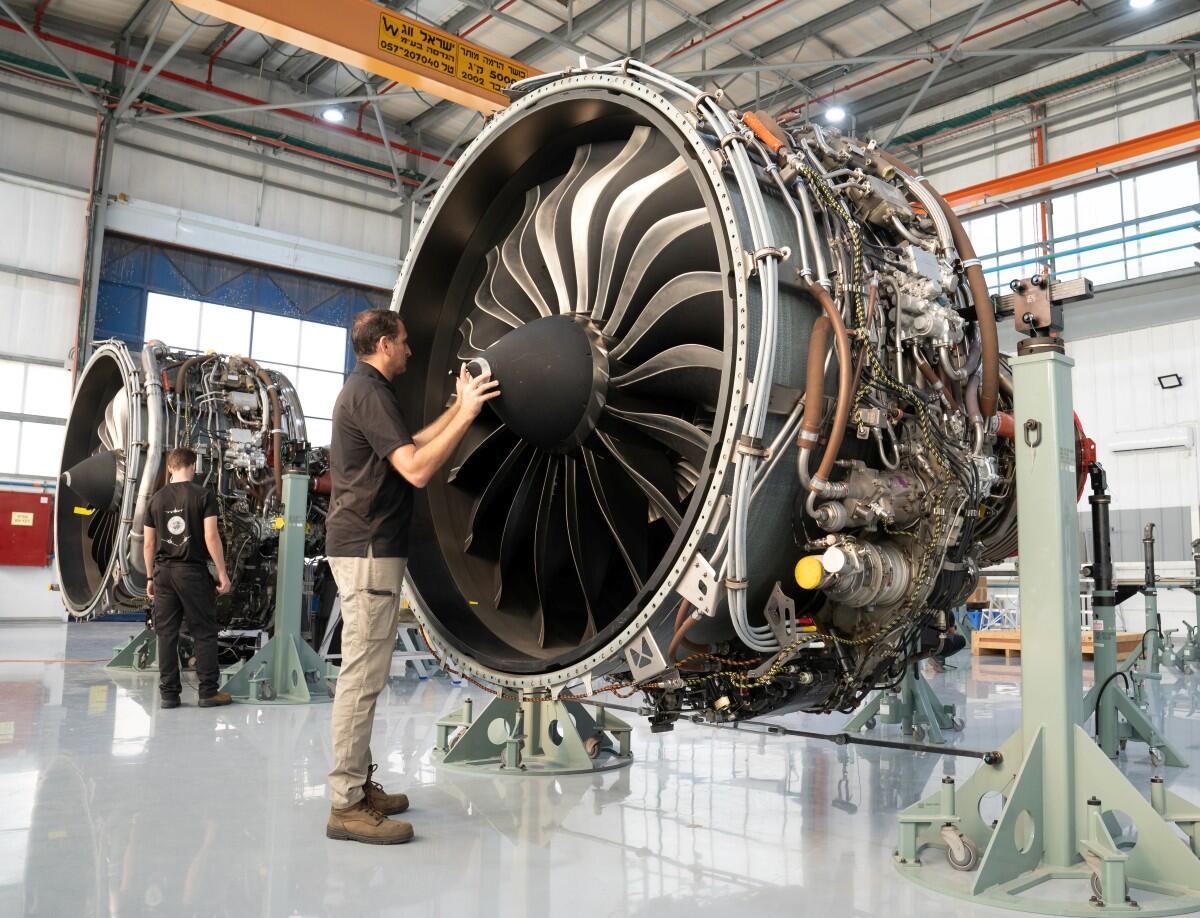
Photo credit: IAI
IAI (Israel Aerospace Industries) Aviation Group is expanding its engines MRO capabilities to meet rising global demand - increasing LEAP capacity, expanding repairs in-house, and giving operators greater flexibility.
Engine shop visits are increasing. Supply chains remain stretched. Airlines, still recovering after years of disrupted operations, are valuing predictable turnaround times more than ever.
These pressures are reshaping the MRO landscape, and IAI Aviation Group is responding with focused investments in its aviation MRO, engine, and component maintenance arm, emphasizing expanding capacity, internalizing critical processes, and supporting the next generation of commercial turbofans.
Aviation never stops. For the global airline industry, a grounded aircraft is lost revenue, and a delayed engine redelivery is a broken schedule. The Aviation Group operates as the company’s designated Center of Excellence for engine, APU, landing gear, and component MRO - a structure that consolidates capabilities under a single engineering organization rather than distributing them across separate business units.
“By combining advanced technology, engineering expertise, and decades of experience, we deliver reliability and quality to our customers while developing tailored solutions and new partnerships with operators worldwide. We continuously strive to strengthen our professional excellence and deepen long-term collaborations with both existing and new customers.”
David Kalda, VP & General Manager, IAI Aviation Group, MRO Division
Expanding Engine Support
The most important near-term development for the division is its entry into the CFM LEAP engine market. As LEAP-1A and LEAP-1B-powered fleets expand worldwide, increased maintenance capacity has become one of the industry’s most urgent needs.
The Division has introduced Quick Turn Shop Visit (QTSV) capability for LEAP engines, with full overhaul capability expected before the end of 2026. Contracts with international customers are already in place, providing the company an early foothold in what will be a high-volume market for years to come.
The LEAP program builds on an existing engine portfolio that has long included the V2500-A5, PW4000-94, CFM56-5B, and CFM56-7B - now expanding to include the LEAP-1A and LEAP-1B - engines that power a large share of today’s single-aisle and widebody fleets. It’s MRO experience with CFM56 variants provides a strong technical basis for the transition to LEAP.
In-House Capabilities Improving Turnaround Time
Across its engine programs, the division has actively worked to cut dependence on external suppliers by developing in‑house repair capabilities for components that would otherwise need to be outsourced - saving both time and cost.
Independent low-pressure turbine blade repair now occurs within its own facilities, a capability that directly speeds up turnaround time. The company has also introduced ultrasonic inspection (USI) for the V2500, expanding its diagnostic tools for one of the industry’s most widely used commercial engines.
Other in-house processes include chemical cleaning, non-destructive testing, precision machining, grinding, and specialized component restoration - supported by dedicated engineering teams working alongside technicians throughout the overhaul process. When complex technical issues arise, in-house expertise accelerates resolution instead of waiting for external support.
Testing infrastructure strengthens this self-reliance. Six dedicated engine test cells allow IAI to conduct comprehensive performance testing on-site. These facilities also provide testing services to third-party MRO providers.
Operational Support Beyond the Shop Floor
Technical capability alone does not keep fleets flying. IAI Aviation Division’s trading unit offers engine leasing during the overhaul period, module exchange programs, and the purchase and sale of engines and components - A service that help operators maintain operational continuity while their engines are in the shop.
Components maintenance includes avionics, mechanical, and pneumatic systems across major platforms such as the Boeing 737NG, 737 MAX, A320 and Airbus A330.
APU maintenance is handled within the same integrated structure, serving several operators. Landing gear overhaul programs are supported by advanced exchange arrangements, Access-to-Pool (ATP) services, and Home-Base Stock Kit (HBK) solutions that reduce aircraft-on-ground exposure. Landing gear leasing is also available during the overhaul period.
Contractual flexibility is also part of the offering. IAI works with airlines under cost per hour (MCPH), fixed-price, and Time & Material models - recognizing that different operators have different financial priorities and risk tolerances.
“The Aviation Group continues to serve as a trusted partner for airlines, cargo operators, and lessors around the world. Our unique combination of aircraft passenger-to-cargo conversions, aircraft maintenance, and the overhaul of engines and components together with supporting trade arm, enables us to support the full lifecycle of the aircraft platform - ensuring that our customers receive a comprehensive, end-to-end solution under one roof.”
Yaacov Berkovitz, Executive Vice President & General Manager, IAI Aviation Group
A Broader MRO Ecosystem
What IAI Aviation Group has built over decades is not simply a collection of maintenance shops, but an integrated service ecosystem. Engine overhaul, APU, landing gear, and component maintenance services all operate within a single organization — reducing the coordination burden on operators who would otherwise have to manage multiple vendors.
In a market where capacity is limited and operators need to plan further ahead, that combination of breadth and depth is becoming an increasingly important differentiator.
Meet IAI’s global MRO experts at MRO Americas Booth 955, or connect directly at [email protected]