This article is published in Aviation Week & Space Technology and is free to read until Dec 12, 2025. If you want to read more articles from this publication, please click the link to subscribe.

How Stability, Slots And Strategy Are Reshaping Base Maintenance
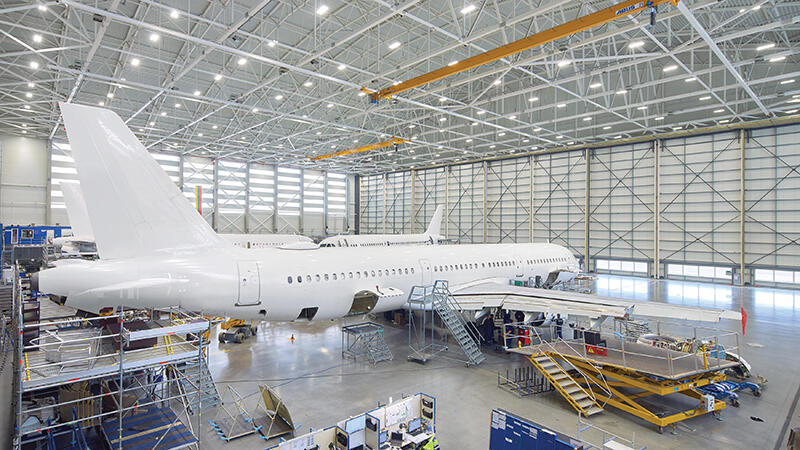
aircraft at MRO facility

FL Technics says customers are asking for five- or 10-year contracts to try to increase certainty in uncertain times.

Credit: Norbert Tukaj /FL Technics

Airframe base maintenance has undergone marked changes the past two years as airlines and MROs have sought stability amid demand swings, supply chain pressures, labor shortages and evolving fleet strategies. As MROs and airline maintenance shops are forced to find solutions for aircraft and parts shortages, both have set about creating efficiencies in their operations. Particularly in the past 18 months, several sources have identified important changes: extended slot contracts, derisking business through adding or altering strategic infrastructure and/or extending capabilities, and adopting technologies.

Planning and Scheduling

A big shift in airframe heavy maintenance strategy is driven by slot availability. Ongoing constraints in hangar space and workforce sometimes prevent airlines from completing checks when they want to, and access to capacity is reshaping how airlines and MROs plan their heavy maintenance.

Even a few years ago, “long-term contracts” could be 1-2 years, and many maintenance checks were sold “on the spot,” or one check at a time.

“That time has passed,” says Holger Beck, president and CEO of Lufthansa Technik Philippines, a joint venture with MacroAsia Corp. located in a special economic zone near Manila. The heavy maintenance provider emphasizes building long-term customer relationships, which have translated into contracts that typically extend 3-5 years. Beck notes that one even lasts 10 years.

maintenance technician working on aircraft
AAR’s base maintenance slots are sold out until 2027 or 2028. Credit: AAR Corp.

Although Lufthansa Technik Philippines provides some narrowbody maintenance for Airbus A320 aircraft, the majority is for widebodies such as A330, A340, A380 and Boeing 777 aircraft.

Some widebody repair providers have identified specific slot challenges related to the widebody market segment. Building customer relationships remains important, but “the reality is that there is a relative shortage for widebody heavy maintenance slots . . . at MROs that cover the full spectrum, all the way up to first-class cabins,” says Marc Szepan, general manager at China-based Guangzhou Aircraft Maintenance Engineering Co. Ltd. (Gameco). That shortage is prompting airlines “to lock in slots, not just for a year or two, but three, four, five, six years or longer” to provide planning stability and slot security, he adds.

Gameco, a joint venture between China Southern Airlines and Hutchison Whampoa in Guangzhou, runs 31 lines of heavy maintenance for narrowbody and widebody aircraft and releases a heavy check every 1.2 days on average, Szepan says.

Lithuania-headquartered MRO provider FL Technics operates six base maintenance facilities in Europe and the Asia-Pacific region and expects to complete 2 million labor hours annually. The majority of its base maintenance activity is focused on narrowbody aircraft, and FL Technics is seeing clear shifts to longer-term contracts. “In many cases,” they are “looking for commitments of five or even 10 years,” says Juozas Lapeika, FL Technics deputy CEO for base maintenance. “Everyone is seeking more certainty, and longer contracts provide that security on both sides.”

That includes the traditionally quieter summer season in the Western fleet, when airlines’ flying hours peak. To keep up with the busier year-round demand, Caerdav, an independent maintenance provider in Wales that focuses on Boeing 737 and Airbus A320 aircraft, remodeled its facility in St. Athan “to open a dedicated fourth line of maintenance, which effectively means we have doubled capacity in the past 18 months,” says Phil Swanson, Caerdav business development director.

U.S.-based AAR’s base maintenance slots are sold out for the next two years, with the exception of what it calls “onesies and twosies” that move around. It will not have a large number of slot openings in its network until 2027 or 2028, says Tom Hoferer, AAR senior vice president of repair and engineering. He confirms that contract lengths with large airline customers have expanded recently to an average of 3-5 years.

Some airlines, such as Philippines-based low-cost carrier Cebu Pacific, have opted for different planning strategies. “We lock in slots approximately 12 months in advance through a competitive [request for quote] process,” says Shevantha Weerasekera, vice president for engineering and fleet management. The carrier’s strong relationships with MROs “allow us to secure optimal slot availability and maintain flexibility where we need it,” he says.

Qatar Airways is planning to make big fleet shifts that in turn will influence its base maintenance and slot planning. It operates 221 aircraft, according to the Aviation Week Network’s Fleet Discovery database, but it expects to grow considerably, based on its aircraft orders. The carrier ordered up to 210 widebody aircraft from Boeing in May—including 130 787s and 30 777-9s. It also has orders for 40 Airbus A321neos, 10 A321LRs and 18 A350-1000s.

Qatar Airways’ goal is to insource all C checks again—it recently had to outsource 40% due to supply chain hurdles. Two factors in particular influenced that decision. One was that its first 787 C4 checks consumed more labor hours and turnaround time than planned. The other was that line maintenance was challenging in 2023 and 2024 due to an aggressive flight schedule, so staff usually dedicated to heavy maintenance were assisting line maintenance teams, says Elmar Lutter, Qatar Airways senior vice president for maintenance.

The airline is back to performing almost all C checks in-house for its Airbus A330s, A350s, A380s, Boeing 777s and 787s. It is not doing C checks on Boeing 737s, which the airline is in the process of phasing out, or A380s, which the Qatar is also considering phasing out. The first 12-year check for A380s is due in June, so the airline will decide that aircraft’s fate before then. Lutter expects Qatar Airways to be performing all of its C checks again by March, with the exception of those two aircraft.

Qatar operates 11 widebody maintenance bays at its facilities in Doha, where it is optimizing hangar space, Lutter says. But even with the optimized space, “at one point in time, we will outgrow that,” he says, especially if it decides to perform more third-party work. “We would like to establish a full line of C check maintenance for third parties and possibly extend that to two lines at the end of next year,” he adds.

To accommodate its growing fleet and this potential third-party maintenance, Qatar will consider expanding its hangars, but that move is 5-10 years out. “We are making the first steps,” Lutter says.

Qatar Airways announced in June that it will build two widebody paint hangars at Dukhan air base in Qatar in partnership with Barzan Holdings and Satys Aerospace. The paint facility would accommodate commercial, VIP and military aircraft, as well as light maintenance. Lutter says the hangars should provide “better service and shorter turnaround times” by keeping the work close to home.

Like Qatar Airways, Cebu Pacific is expanding maintenance resources. “We are planning to build additional capacity locally” to keep up with the expanding fleet, Weerasekera says. It operates a single-bay hangar at Clark International Airport.

In addition, its wholly owned MRO, Aviation Partnership Philippines (known as Aplus), has been expanding its base maintenance capabilities to include light maintenance to C checks, and it is in the process of adding heavy maintenance visits. The expanded workscopes “allow us to retain a portion of the work locally, helping us manage costs more effectively,” Weerasekera adds.

With cost in mind, airlines halted cabin upgrades during the height of the COVID-19 pandemic and as they recovered. Now the demand for cabin modifications and connectivity has surged. Gameco sees strong demand for cabin modifications for both narrowbody and widebody aircraft.

A key part of cabin upgrades is improved connectivity. “Having high-speed, high-reliability, high-fidelity inflight connectivity is not a positive differentiator anymore,” Szepan says. “Not having it is a negative differentiator.”

He notes that the connectivity upgrades “feed into a much higher proportion of cabin modifications and cabin refreshes” than was traditional in heavy maintenance checks.

Supply Chain

Aircraft base maintenance requires many parts, and missing just one can increase downtime and cause delays.

FL Technics sees a large amount of buyer-furnished equipment that has long lead times. “When customer airlines do not maintain sufficient stock of frequently required components, even relatively simple repairs can become resource-intensive,” Lapeika says.

Will the supply chain ever return to its 2019 level, or is this the new normal?

“I hate to keep using ‘pre-pandemic’ and ‘post-pandemic,’ ” AAR’s Hoferer says. “The reality is that we are all waiting for a return to the pre-pandemic supply chain, but the reality is that it’s not coming back. What we have now is the new norm.” AAR has adapted its processes and business expectations to that, he says.

Cebu Pacific aircraft at A+ facility
Cebu Pacific seeks base maintenance slots about 12 months in advance. Credit: Cebu Pacific

AAR’s supply chain strategy benefited from its $725 million March 2024 acquisition of Triumph Parts Support, which is now part of AAR’s Component Services business. “So when our hangars need an aerostructure repair or flight control repair, we’re working with our Hot Springs [Arkansas] facility” to mitigate or alleviate some supply chain issues,” Hoferer says. Similarly, base maintenance teams reach out to AAR’s trading and parts distribution businesses when necessary.

In addition to developing new capabilities or leveraging a company’s broader portfolio, another key seems to be simply using longer-term planning.

Cebu Pacific signed a consumables and expendables contract with Satair in September under which the Airbus subsidiary will oversee expendable material supply for the airline’s A320 and A330 fleets.

The consignment-model contract is slated to run for 10 years and “reduces risk and provides cost advantages,” Weerasekera says.

Because airlines are short of aircraft due to OEM delivery issues, they are also short of parts due to supply chain issues, and “turnaround time has always been the name of the game,” Szepan says. “[When] you put that all together, you see a significantly higher willingness to use non-OEM parts in the interest of maximizing aircraft availability.”

Demand for parts is even increasing the use of parts manufacturer approval (PMA) in China, which previously used it sparingly, and boosting acceptance of used serviceable material in that country.

Derisking parts availability is one reason Gameco has invested continually in its in-house part and design manufacturing capabilities. The company is set to manufacture “just more than 20,000 part numbers,” Sze-pan says.

Paperless, AI and Predictive

Several MROs and airlines are changing maintenance planning systems for base maintenance or are going paperless as they look to capitalize on the emergence of artificial intelligence (AI) to gain efficiencies.

AAR’s base maintenance facilities in Rockford, Illinois, and Miami are now 100% paperless. The company also “launched the parallel digital process in Oklahoma City to get our customers there on paperless,” Hoferer says. He expects the Oklahoma City facility to achieve that goal by year-end.

GAEMCO MRO with China Southern Cargo Boeing 777F
Gameco runs 31 lines of heavy maintenance. Credit: Gameco

AAR’s facilities in Trois-Rivieres, Quebec, and Windsor, Ontario, use some of the company’s digital tools, such as milestone planning, but not all. Those facilities are planned to go fully digital later.

The transition away from paper is “one step on the road to employing AI,” Hoferer says. “Because without data, there is no AI.”

The many processes and the data assurance required to go paperless lays the foundation for using AI.

For instance, the digital benefits are very site-specific now, and a business intelligence report on defect trends might take days to produce, Hoferer says. AAR aims to use AI to generate that same report immediately so it can see defect trends on particular aircraft. “And are we seeing those same defects in Rockford, in Miami, but not Oklahoma City?” he says. “Why or why not? And then getting into the task card detail—that’s the kind of details that we’re excited to get to with AI.”

AAR has been building its maintenance software arsenal over the past few years through the acquisition of enterprise resource planning system provider Trax in 2023 and of Aerostrat, a long-range maintenance software company, in August.

While AAR and its customers who use Aerostrat are in the early stages of discussions, Hoferer says they are examining “how we tie their Aerostrat planning into our [maintenance] capacity scheduling” to reserve slots.

A common industry trend in recent years is for airlines either to fully replace or to modify their software management systems to incorporate AI-driven tools, which they use to organize datasets and plan their operations. Cebu Pacific uses Swiss-AS’ AMOS software for maintenance planning and is “trialing several AI-based tools to enhance planning efficiency and predictive capabilities,” Weerasekera says. The trials have not progressed far, but he is optimistic about their potential.

Qatar Airways plans to switch its base maintenance planning software to AMOS from Trax. Lutter says he hopes the new system will help it further optimize heavy maintenance and become the “one single source of truth in a fully paperless system, where all the data is connected, available and recorded accurately” and algorithms can continually optimize it.

For instance, heavy maintenance planning could go from task level to subtask level and eventually sequence hour by hour to decrease turnaround times, Lutter notes. “That efficiency can translate into additional capacity, additional business, and the more controlled the work happens, in my experience, it’s also safer—although that’s a bit counterintuitive,” he says. “If you achieve dense workflow, not by sheer pressure but by intelligent planning, it can reduce the possibility for errors.”

Qatar’s tech ops digital transformation is in the early stages. “We really need that single source of truth and that very disciplined data input and data handling to use the data in a more productive way,” Lutter says. Having integrated systems that use disciplined data should lead to higher productivity and efficiency, which includes predictive maintenance. Qatar uses Airbus Skywise, but it also announced a partnership with Accenture in August that intends to use AI to optimize various parts of its operation, such as predictive maintenance.

FL Technics has been investing heavily in statistical analysis to support predictive maintenance, says FL Technics’ Lapeika. One of the core objectives is “to ensure that 95% of nonroutine consumable materials are available in stock,” he says. “This proactive approach is designed to mitigate the risk of delays caused by global material supply chain challenges” that could affect turnaround times and service reliability.

Gameco has been working on developing an in-house MRO enterprise resource planning system to gain efficiencies and data fidelity. Part of that project is to control its data and “to make sure we have the quality of data that then allows us to train AI,” Sze-pan says. Having trustworthy data is “where it all starts,” he notes. If quality of the data is not good, “you’re training AI to do exactly the wrong thing.”

See related sidebar on tariff effects: https://aviationweek.com/mro/supply-chain/shifts-tariffs-economic-facto…

Lee Ann Shay

As executive editor of MRO and business aviation, Lee Ann Shay directs Aviation Week's coverage of maintenance, repair and overhaul (MRO), including Inside MRO, and business aviation, including BCA.

James Pozzi

As Aviation Week's MRO Editor EMEA, James Pozzi covers the latest industry news from the European region and beyond. He also writes in-depth features on the commercial aftermarket for Inside MRO.

Related Articles
graphic, map, U.S. Flag, Tariffs Scabble tiles
Article
Shifts In Tariffs And Economic Factors Are Affecting MRO