This article is published in Aviation Week & Space Technology and is free to read until Jun 25, 2026. If you want to read more articles from this publication, please click the link to subscribe.

Anticipated Growth Heats Up China’s Aftermarket

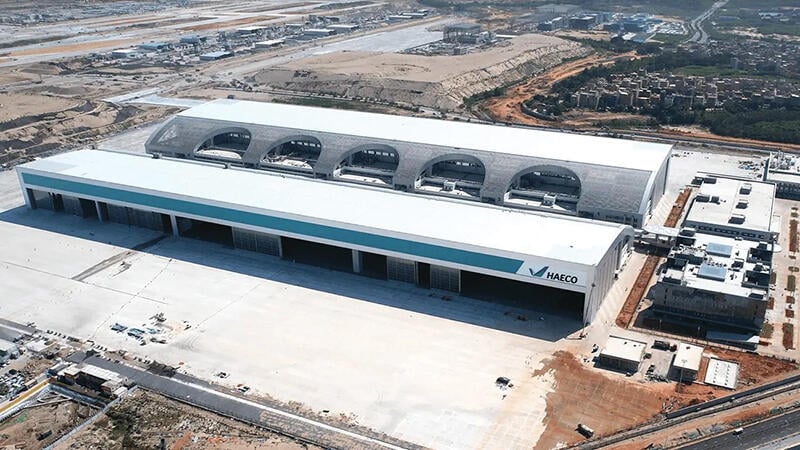
HAECO facility in Xiamen

HAECO’s new Xiamen hangar is on track to open by year-end.

Credit: HAECO

Aftermarket stakeholders are betting on significant growth in China over the next couple of decades, and maintenance, repair and overhaul providers are growing regional capacity and facilities in anticipation.

Aviation Week’s 2026 Commercial Fleet & MRO Forecast predicts China’s commercial fleet will increase to 5,800 aircraft from 4,760 in the coming 10 years. This is expected to translate to an annual maintenance, repair and overhaul (MRO) market of $22.9 billion by 2035—roughly 12% of global MRO demand.

  • The country’s MRO sector is likely to generate $30 billion in demand by 2035
  • New facilities and joint ventures are being launched

China operates the world’s largest Airbus fleet, and the manufacturer expects the country to become its largest services market by 2043, generating $61 billion in demand then. Boeing’s most recent Pilot and Technician Outlook projects that China will need 131,000 new maintenance technicians by 2044—a number that exceeds demand for technicians in all other regions except for Eurasia.

Airlines, OEMs and MRO service providers have been adding more facilities, joint ventures and maintenance capabilities in China over the past couple of years. Boeing Shanghai began operations at a new 48,000-m2 (516,000-ft.2) hangar near Shanghai Pudong International Airport in April. China Southern Airlines began construction that month of a base maintenance and cargo hangar at Urumqi Tianshan International Airport, which is scheduled to open in 2028.

China Eastern Airlines will also soon open a 110,000-m2 hangar at Shanghai Pudong; construction is expected to be complete by the end of June. The carrier also recently acquired ST Engineering’s 49% stake in Shanghai Technologies Aerospace Co., the companies’ airframe MRO joint venture that operates from Shanghai’s Hongqiao and Pudong airports.

In December, Rolls-Royce and Air China opened Beijing Aero Engine Services (BAESL), a joint venture focused on Trent 700, Trent XWB-84 and Trent 1000 engines. The facility is Rolls’ first on the Chinese mainland and one of only four authorized joint venture overhaul facilities within the engine manufacturer’s global services network. BAESL is expected to ramp up to 250 overhauls annually by 2034.

MTU Aero Engines and China Southern Airlines opened their MTU Maintenance Zhuhai Jinwan joint venture in March 2025, focused on Pratt & Whitney PW1100G geared turbofan engines. This complements the well-established MTU Maintenance Zhuhai, which overhauls IAE V2500-A5, PW1100G and CFM International CFM56-5B/-7B and Leap engines.

Last August, Chinese cargo carrier SF Airlines and ST Engineering opened their ST Engineering Aerospace (Hubei) Aviation Services joint venture at Ezhou Huahu International Airport. The facility will provide MRO services to the airline and third-party customers, and a second hangar is under construction and expected to open in the second half of 2027.

HAECO plans to open two new facilities in Xiamen in the fourth quarter of this year. The first is what it says will be the world’s largest single-span aircraft maintenance hangar. Located at Xiamen Xiang’an International Airport, the 292,300-m2 hangar will have 12 widebody and six narrowbody maintenance bays, as well as two separate painting bays.

The HAECO Engine Services (Xiamen) subsidiary is opening a new facility to support overhaul, testing and repair of a variety of engines, including the GE Aerospace GE90, GE9X, CF34-10A and Engine Alliance GP7200. The company plans to scale to 200 GE90 engines annually once it completes Phase 3 of expansion by the fourth quarter.

HAECO’s new facility additions are to support growth in customer agreements, according to HAECO Group Chief Commercial Officer Gerald Steinhoff.

“We recently secured our first long-term GE90 contract in the Chinese mainland with a major operator for their widebody fleet,” Steinhoff says. “On the CF34-10A—where we are the Sole [GE Branded Service Agreement] License Holder for Greater China—we received FAA and [Civil Aviation Administration of China] approvals between late 2025 and January 2026 and on April 30 completed our first quick-turn shop visit, positioning HAECO as the first independent MRO able to support CF34-10A operators.”

Steinhoff adds that HAECO is “progressing long-term widebody airframe agreements through 2031” and partnering with OEMs to industrialize component repair across its Chinese mainland and Hong Kong facilities.

The “defining trend” in China’s MRO market is capacity expansion, he notes, including “significant investment in new infrastructure to meet both airline in-house and third-party demand. . . . Regional competition is intensifying as domestic capability develops, particularly in component and engine repair, with new engine [joint ventures] and airline-owned shops emerging alongside established foreign joint ventures.”

While Aviation Week forecasts that China will have a 16% share of the world’s engine MRO events (including overhauls and life-limited parts events) through 2035, similar to the rest of the Asia-Pacific region, these are projected to grow at a 4% compound annual growth rate (CAGR) compared with a flat-to-declining CAGR in the Asia-Pacific region.

Beyond support for domestic fleets, MROs in the region are securing work from other regional customers. “China has been a big beneficiary of the outsourcing trend, with customers from North America, Europe, the Middle East and elsewhere sending their aircraft to China for maintenance,” Alton Aviation Consultancy Director Joshua Ng says.

Guangzhou Aircraft Maintenance Engineering Co. (Gameco), for instance, signed new multiyear agreements in December with Emirates, covering heavy maintenance support for the airline’s Airbus A380 and Boeing 777 fleets through 2029.

“China still retains a strong advantage, although we have started to see increasing competition for this work in Southeast Asia with new locations being set up in Malaysia, Philippines, Thailand and Vietnam,” Ng says.

He notes that other key areas in China’s aftermarket that should see growth include component MRO as well as alternative parts such as used serviceable material (USM) and parts manufacturer approval (PMA).

Hainan Airlines—which operates a fleet of more than 220 Airbus, Boeing and Comac aircraft—has adapted some of its spare parts strategies to mitigate rising costs in recent years. Wilson Liu, vice president of procurement for the carrier, sees a step change happening in China, which has long resisted USM and PMA adoption. “More airlines see PMA as a way to control costs,” he says. “This is just the beginning of China PMA.”

Ng cites the Chinese airframer’s supply chain as “by far the most interesting development, and should Comac be successful with selling its aircraft abroad, MRO work will naturally flow back into the Chinese aftermarket.”

Airbus technicians
The Airbus Lifecycle Services Center aims to increase its staff to 300 by 2030. Credit: Airbus

Airbus clearly sees USM as a growth area for China’s aftermarket. The company in 2024 opened its Chengdu-based Airbus Lifecycle Services Center joint venture with Tarmac Aerosave, which is expected to grow to 300 employees by 2030. Airbus’ 2024-43 Global Services Forecast predicts that the dismantling and recycling market will see a 7.5% CAGR during this period, as USM stakeholders are eager to gain access to the Chinese parts market.

In 2024, the Aircraft Fleet Recycling Association (AFRA) and blockchain specialist Block Aero Technologies launched a parts registry program in partnership with the Civil Aviation Administration of China (CAAC) to simplify Chinese buyers’ ability to source USM from Western companies. Aircraft disassemblers from outside the country have had difficulty accessing its parts market because the CAAC required parts to be removed and overhauled by a Chinese-certificated repair station (CCAR 145) and entered into a Civil Aviation Maintenance Association of China database.

The AFRA-CAAC Parts Registry Program creates a special limited-scope certification for dismantling activities that Block Aero says is simpler and cheaper to obtain than a CCAR 145 certification. Western disassemblers like Ecube and Ascent Aviation Services have joined the program.

Paul Ashcroft, senior vice president for Asia-Pacific at AerFin, discusses China’s USM sector growth in a recent column published by the company. He notes that international partnerships would be essential to help the country address maintenance challenges.

“Access to global USM supply is already helping Chinese operators smooth over the gaps created by supply chain volatility,” he writes. “It also provides the quality, documentation and reliability needed to build long-term confidence. The airlines that succeed will be those that combine strong in-country capacity with relationships that open up the best of the worldwide aftermarket.”

Ashcroft notes that he heard several discussions during a recent USM conference in Jinan about China’s ambition to reuse or recycle more than 90% of materials from retired aircraft. This echoes Airbus’ goals: The airframer has stated that aircraft at its facility in Chengdu will be dismantled with Tarmac Aerosave’s process, which recovers approximately 90% of their weight.

On the alternative parts front, Ng says China-based suppliers could see opportunities to develop and manufacture PMA parts. For instance, Gameco has invested significantly in its PMA capabilities and now produces more than 17,000 different part numbers.

Despite a boom in China’s aftermarket investments, Ng cautions that geopolitical factors could cause uncertainty.

“The key question is not growth—growth is clearly there—but whether China can maintain and expand its role as a global MRO exporter amidst the backdrop of geopolitical tensions, tariff and supply chain disruptions and India aviation ambitions,” Ng says. “The critical watchpoint will be whether this capacity build-out can keep pace with demand, achieve global competitiveness and navigate an increasingly fragmented geopolitical environment.”

Lindsay Bjerregaard

Lindsay Bjerregaard is managing editor for Aviation Week’s MRO portfolio. Her coverage focuses on MRO technology, workforce, and product and service news for MRO Digest, Inside MRO and Aviation Week Marketplace.