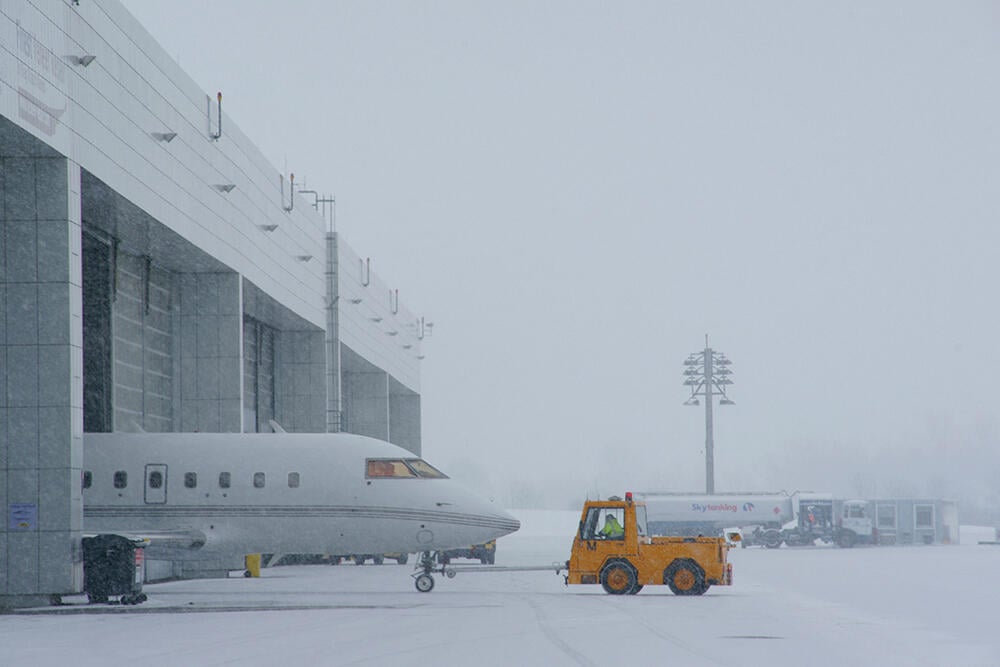
Recent winter storms in the U.S. have disrupted airline operations across the Midwest and Northeast, putting additional pressure on aircraft hangars to maintain safe, stable working conditions.
Stephen Levy, founder and CEO of Shadow Infrared Heating, has seen some MROs rethink their heating strategies in response to recent severe weather. “This winter has really exposed the limits of traditional heating in aircraft hangars,” he tells Aviation Week. “Many MROs are realizing that systems designed to heat the entire air volume of such large spaces perform poorly during extreme cold, particularly when energy costs are high, and hangar doors are opening and closing frequently throughout the day.”
Levy adds that operators are increasingly scrutinizing the efficiency of heating strategies as utility costs rise and sustainability pressures mount. “There’s also a noticeable shift toward solutions that reduce energy waste, lower carbon impact and provide more consistent comfort for technicians on the hangar floor, not just theoretical temperature targets.”
The most common challenge, he notes, is thermal stratification, where hot air naturally rises. “In high-ceiling hangars, warm-air systems push hot air upwards and accumulate well above the occupied zone, leaving technicians working in cold conditions while energy is wasted heating unused space,” Levy explains.
In hangars with ceilings higher than 50 ft., the temperature difference between the roof and the floor can be large, reducing both worker comfort and overall energy efficiency.
Frequent aircraft movements further complicate performance. “When large doors open for aircraft movements, air is rapidly lost and the heating system is forced to work harder to recover,” says Levy. This often results in temperature fluctuations, discomfort and excessive energy consumption, he adds.
Cold floors, condensation on aircraft surfaces and uneven temperatures across different work zones are also persistent problems in these environments.
Radiant infrared systems, Levy argues, address these issues by shifting the heating paradigm by operating on a fundamentally different principle from warm-air heating. “Rather than heating the air, they directly warm people, surfaces and the hangar structure itself, similar to how the sun provides warmth on a cold day,” he says.
Levy explains that when hangar doors open and air is exchanged, most of the effective heat remains in place. As a result, the space stays warm and temperatures return to normal quickly, without the system needing to heat the area from scratch again.
“This approach creates far greater temperature stability, reduces recovery times after door openings and maintains consistent working conditions even in high air change environments,” he adds.
For operators considering retrofits, installation constraints remain a factor, but Levy suggests the transition to radiant systems is often less disruptive than anticipated. “Key considerations include perimeter area, mounting height, structural load capacity and ensuring clear line-of-sight to occupied zones,” he says.
Zoning flexibility is another driver: “Because radiant systems can be zoned and independently controlled, operators can target heat precisely where it is needed rather than heating the entire building,” says Levy.
Electrical capacity may also need to be assessed, depending on the system type. “Many operators also value the ability to phase installations, allowing heating upgrades to align with operational schedules and minimize downtime,” Levy says.

Related Content