MROs Prioritize Turnaround Time As Operators Seek More Predictability
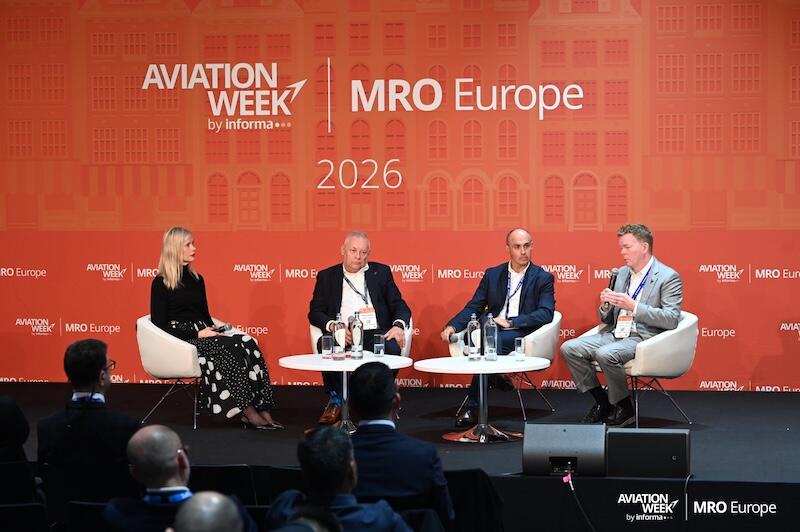
From left, Lee Ann Shay, Paul Kinch, Oscar Pérez and Frank Stevens at MRO Europe 2026 in Amsterdam.
AMSTERDAM—Turnaround time outweighs price for MRO customers, while longer-term agreements and closer operator relationships are becoming increasingly important amid capacity constraints, according to experts gathered at Aviation Week’s MRO Europe to discuss the needs of business, leisure and defense operators.
Turnaround time is taking precedence over price for maintenance customers, with MRO providers highlighting the importance of predictable delivery schedules as operators compete for limited maintenance capacity.
An audience poll during the MRO Europe panel, “Lessons for all: Navigating the MRO Landscape Across Business, LCC, Leisure and ACMI Aviation,” found that 74% of respondents prioritized turnaround time over price, which received 26% of the vote.
Frank Stevens, Embraer's global MRO services vice president, said delivering aircraft on time was fundamental to maintaining customer relationships, while competitive pricing remained important for securing repeat business.
Oscar Pérez, Globalia Maintenance's managing director, said the cost of maintenance must be considered alongside the consequences of poor turnaround times, particularly for operators dependent on aircraft availability.
The discussion also highlighted a shift toward longer-term maintenance agreements, driven partly by a shortage of available slots, particularly in Europe. Pérez said customers were increasingly seeking predictable access to future maintenance capacity rather than simply negotiating individual slots or the best price.
Paul Kinch, Gama Aviation's MRO services managing director, said some smaller business aviation operators may approach several MROs for the same maintenance requirement, sometimes repeatedly within a week, making it difficult for providers to decide whether to commit to the work. He called for closer cooperation between operators and MROs, arguing that greater certainty over future demand would help providers plan investments in spares and training.
For Embraer, longer-term agreements also support better planning and operational efficiency. Stevens said: “If we don't, then we are always fishing for the next meal. And that's what we don't want to do.”
Parts availability and labor remain important constraints on turnaround times. Stevens said an aircraft might arrive with 98% of the required parts available, but the remaining 2% could keep it grounded. Short-notice maintenance can also leave providers without sufficient labor, even when parts are available.
He emphasized the importance of communicating delays and requirements to customers as early as possible, noting that transparency can help manage expectations when an aircraft cannot be returned on schedule. Embraer is developing software to improve customer communication, including through an application that allows operators to review discrepancies and approve parts purchases.
Seasonal demand presents another challenge, particularly for providers serving leisure airlines and business aviation. Pérez said Globalia Maintenance was adjusting workforce availability during peak summer periods while diversifying its customer base to balance demand across the year. Gama Aviation also shifts maintenance activity between customer segments to make better use of its facilities.
The panel agreed that strong technical expertise and customer relationships remain essential as MRO providers navigate differing requirements across commercial, business, leisure and defense aviation.
Component repair emerged unanimously as an area of potential for the aftermarket over the next five years. Panelists highlighted opportunities to address localized shortages and keep more component work within Europe, reducing reliance on shipping parts over longer distances.

Related Content