This article is published in Aviation Week & Space Technology and is free to read until Jan 08, 2026. If you want to read more articles from this publication, please click the link to subscribe.

Eurowings Uses Predictive Tech To Operate Older Aircraft Efficiently

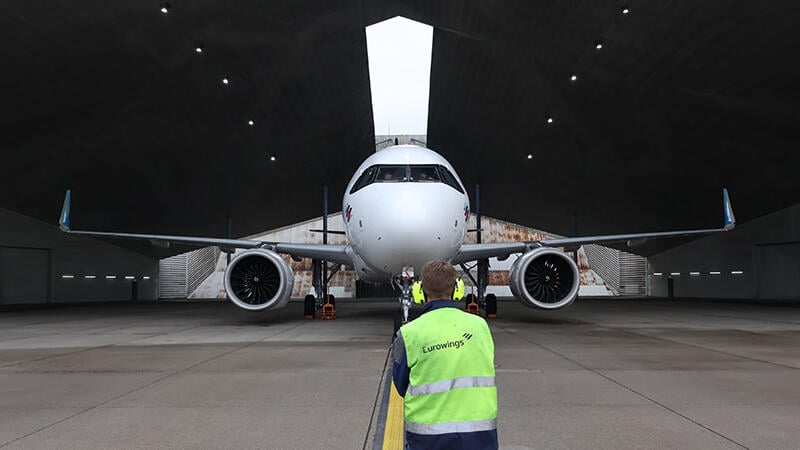
person in hi-vis vest in front of aircraft

Eurowings Technik uses a centralized approach to line maintenance, conducting all checks in Dusseldorf.

Credit: Eurowings Technik

Eurowings operates a fleet that is older than those of its ultra-low-cost rivals, such as Ryanair or Wizz Air, so maintenance plays a crucial role in its competitiveness. In particular, the airline relies on predictive maintenance and technical management to keep even older aircraft operating efficiently.

Eurowings’ fleet consists of 100 Airbus aircraft (A319s, A320s, A320neos and A321neos) that are from 1.3 years to almost 24 years old.

Eurowings Technik (EWT) observes that the balance between reliability and maintenance costs shifts considerably around the second IL check or D check (about 18-20 years). “From this point on, maintenance costs increase noticeably while technical reliability decreases,” Matthias Gruber, vice president of technical fleet management and managing director at EWT, tells Inside MRO. This balance proves difficult, especially compared with airlines in the low-cost segment, which regularly retire older aircraft and adjust their fleet structure accordingly.

Matthias Gruber, Eurowings Technik vice president, technical fleet management and managing director
Matthias Gruber, vice president<\/p>of technical fleet management and managing director, says EWT uses historical data to plan maintenance. Credit: Eurowings Technik

In addition to managing a diverse fleet, Eurowings operates from 13 bases. “From a technical perspective, this is a complex challenge,” Gruber says. He credits the technical operations in Dusseldorf, Germany, and its “close collaboration with our partners at other locations.” At selected locations, Eurowings works strategically with partners such as Nayak, supplemented by other service providers. But to simplify this system, a clear approach is necessary.

Line maintenance checks take place exclusively in Dusseldorf. “This ensures that every aircraft in our fleet comes from a network station to Dusseldorf on average every 52 days and undergoes a so-called module check that usually takes 80-100 labor hours and is performed overnight,” Gruber says. The checks, performed by EWT or Nayak technicians, involve inspection of flight controls, hydraulics, landing gear, cabin, cockpit and more.

The major advantage of this centralized approach is that Eurowings can efficiently pool in Dusseldorf resources including tools, mechanic qualifications or materials. Once the aircraft has been returned to a station in the network after the check, it can operate without major scheduled work until the next module check. All minor maintenance can be completed easily at the network stations. “We have around 120 employees at EWT in Dusseldorf and around 185 in Cologne, including the planning department,” he says.

About 35 Eurowings aircraft are stationed in Dusseldorf and are regularly serviced there, Gruber says.

Lufthansa Technik’s (LHT) Aviatar tool is central to efficient and proactive management of the EWT fleet’s technical condition. A key element is the Electronic Technical Logbook, which enables paperless documentation and simplifies processes. Another important procedure is condition monitoring, in which systems are observed in real time to identify problems or recurring errors at an early stage. Components also can be specifically analyzed—for example, with regard to wear and tear or potential failures—so EWT can react before an aircraft-on-ground situation occurs.

“We also use [artificial intelligence]-supported analyses of documented complaints,” Gruber says. “Extensive historical data allows us to identify patterns and develop solutions more quickly.” The heart of Aviatar is the Control Center—the central interface for all technicians and colleagues in the maintenance control center. All reports, including from the crews, come together there and serve as the basis for further planning.

“Our vision is to make all of today’s unplannable ad hoc complaints plannable step-by-step and thus contribute increasingly to punctual flight operations at Eurowings,” Gruber says.

Base Maintenance

Given the age of Eurowings’ fleet, 61 aircraft will undergo base maintenance this winter. According to the summer flight schedule, four D checks, 12 IL checks and 35 C1 and C2 checks will be conducted in the next several months. The C1 checks typically take about 2.5 weeks, and the C2 checks just under three weeks. The first base check began on Oct. 27, and the final check is expected to be completed by the week of March 14. “We have booked 10 MRO lines in parallel for this, including LHT in Sofia, [Bulgaria], and Budapest, [Hungary], Sabena [Technics] in Perpignan, [France], and Heavytech [MRO] in Madrid. On average, each aircraft spends about 2-6 weeks at each location for a check,” Gruber says.

Eurowings’ fleet
Boeing 737 MAX 8 aircraft are planned to enter Eurowings’ fleet in 2027. Credit: Eurowings Technik

While operating older aircraft is possible, it can also be costly. “We fly point-to-point with high frequency and many flight hours per day,” he notes. “This places a heavy strain on the landing gear, structure and systems. Our aircraft are in operation almost around the clock, so you have to closely monitor when the economic ‘sweet spot’ is reached.”

In contrast, long-haul flights involve considerably fewer takeoffs and landings, which reduces the strain on certain components. “Nevertheless, one thing is clear: The older an aircraft becomes, the higher the maintenance costs, and the more critical the question of economic viability in the respective operational profile becomes,” Gruber says.

In terms of the supply chain, EWT says it and LHT are positioned well, especially in materials management. “Of course, there are challenges, especially with older aircraft models where certain components are no longer readily available,” Gruber says. “But overall, we have very few problems and a strong, forward-looking materials management system.” A key success factor is EWT’s analytical strength: It uses extensive historical data to plan precisely. “And when things do get tight, we benefit from the close cooperation within the Luft­hansa Group,” he says.

737 MAX Prep

Eurowings plans to renew its fleet with the introduction of 40 Boeing 737 MAX 8s, the first of which should enter service in 2027. This will be the largest fleet renovation in its history.

For EWT, the introduction of the 737-8 marks the beginning of a very intensive preparation phase. “As soon as the decision was made, we began preparing our entire organization for the new model,” Gruber says. This means training technical departments, obtaining new information technology systems, procuring spare parts and choosing suitable partners for line and base maintenance.

EWT also is monitoring aircraft construction at Boeing to ensure that the carrier receives exactly the aircraft it ordered. “When the aircraft finally arrive, this effort pays off,” Gruber notes. “New aircraft mean one thing above all technology: less maintenance, greater reliability and thus lower costs.” He adds that this has a direct impact on the airline’s operational performance. “Overall, we are taking a major step forward with the 737-8 MAX—for our technology, our crews and our guests,” he says. “The effort is high, but we are convinced it is worth it.”

Of course, all of this would not be possible without employees. Even though the market for aircraft mechanics, especially in Europe, is becoming increasingly tight, “we at Eurowings Technik can say we continue to receive a sufficient number of qualified applicants for maintenance,” Gruber says. Eurowings trains five junior employees each year. “After theoretical and basic training, they join us directly for practical work and are gradually introduced to the processes,” he says. “Of course, we have fluctuation—that’s normal in the industry. However, fluctuation is very healthy and easily manageable.”

Kurt Hofmann

Kurt Hofmann has been writing on the airline industry for 25 years. He appears frequently on Austrian, Swiss and German television and broadcasting…