This article is published in Aviation Week & Space Technology and is free to read until Nov 01, 2026. If you want to read more articles from this publication, please click the link to subscribe.
ADS-B 'In' Developments Advance Ahead Of Potential Mandates
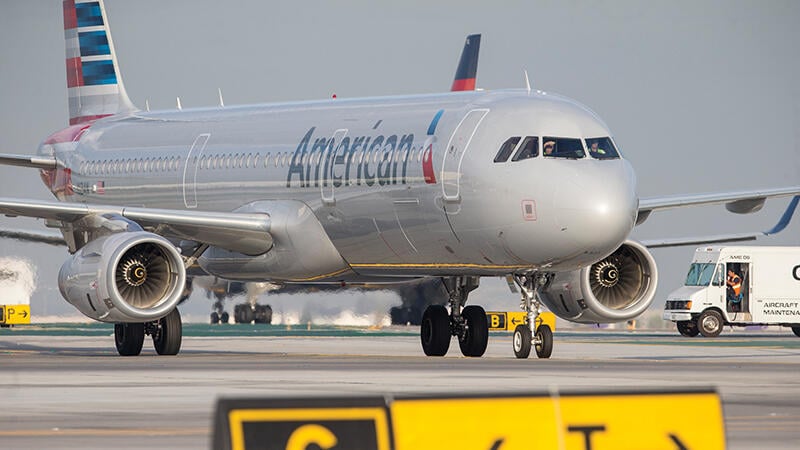
American Airlines is undergoing ACSS’ largest installation to date of its SafeRoute+ ADS-B In system.
The fatal midair collision between a U.S. Army Sikorsky UH-60 Black Hawk helicopter on a nighttime training mission and a Bombardier CRJ700 regional jet on final approach to Ronald Reagan Washington National Airport nearly two years ago has generated urgent calls for mandatory Automatic Dependent Surveillance-Broadcast “In” equipment on most commercial fixed- and rotary-wing aircraft. Competing bills in both houses of Congress to mandate the technology were still under debate in mid-August.
Unlike the already-mandated Automatic Dependent Surveillance-Broadcast (ADS-B) “Out,” which simply broadcasts an aircraft’s position and is used primarily by air traffic control (ATC), ADS-B “In” displays the presence of nearby aircraft to pilots. ADS-B In enables active precision spacing behind lead aircraft, as airlines transition away from reliance on ATC voice communications and toward interval management software. Among the potential benefits are fuel savings, runway capacity maximization and lower carbon emissions, since more aircraft can land or take off at more frequent intervals.
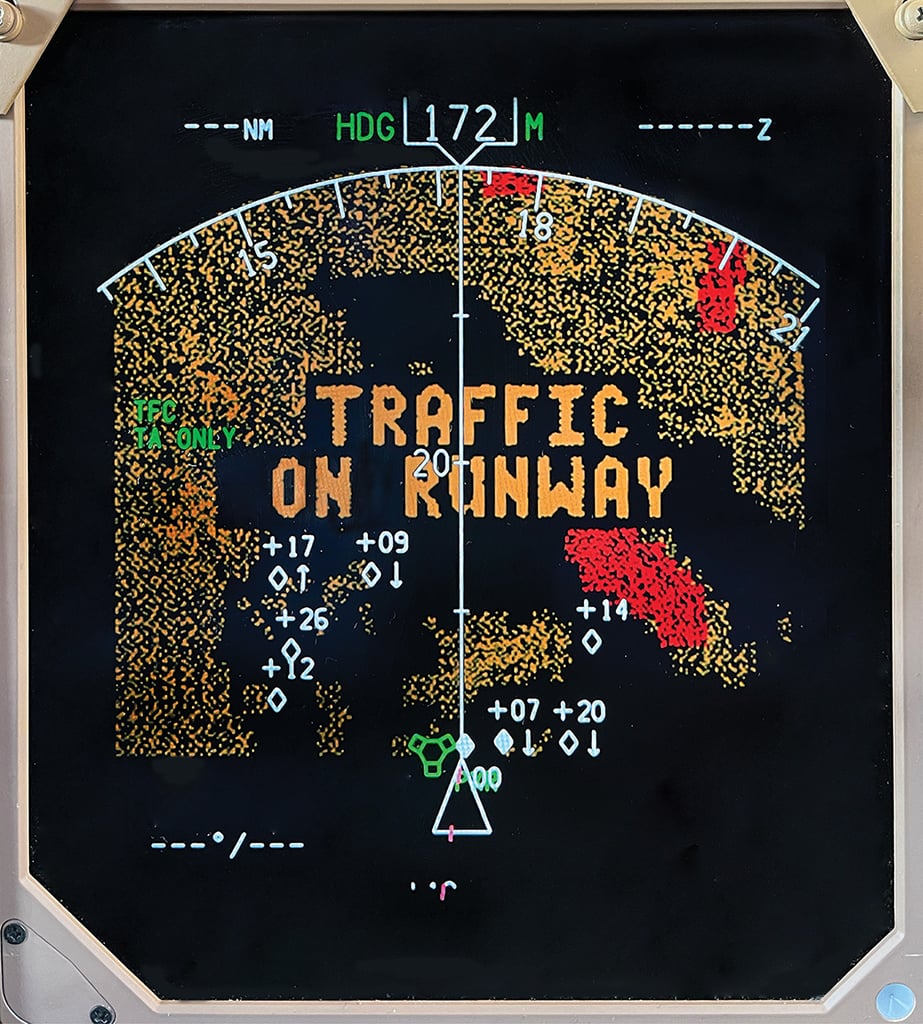
Most important, it gives pilots greater awareness of nearby traffic—and potential collision threats. Requiring commercial aircraft to integrate ADS-B In into aircraft collision avoidance systems that use cockpit displays would provide another layer of safety beyond the most common traffic collision and avoidance systems and radar-based ATC tools.
“It seems likely that there will be an ADS-B In mandate of some sort by the early-2030s,” says Cam Morast, product manager at Aviation Communication and Surveillance Systems (ACSS). He cites a survey ACSS carried out earlier this year that indicates that U.S. airlines are already moving ahead with ADS-B In without waiting for legislation.
“Of the 100 U.S. airline leaders polled, almost half had already equipped some of their fleets with ADS-B In, and 86% said they could comply with a mandate within three years,” Morast notes.
A spokesperson for United Airlines says that every new widebody aircraft delivered to the carrier arrives with ADS-B In.
“We continue to monitor developments related to ADS-B In technology as part of our broader fleet investment and modernization planning,” says Blake Johnston, director of brand strategy and communications for CommuteAir, a United Express regional carrier. “CommuteAir will remain prepared to comply with any future applicable requirements.”
EXPANDING SAFETY FEATURES
ACSS, a joint venture of Thales and Acron Aviation, develops and manufactures the TCAS 3000SP and T3CAS traffic alert and collision avoidance system (TCAS) product lines, which are the host platforms for Safe-Route+, ACSS’ ADS-B In software certified in 2020.
As Morast notes, SafeRoute+ is an evolution of the original SafeRoute ADS-B In product. “The underlying ADS-B In processing remains; however, SafeRoute+ removes the need for costly Class 3 Electronic Flight Bag displays by utilizing the existing Multifunction Control and Display Units, the existing Navigation Displays and the new Acron Aviation ADS-B Guidance Display,” he says. “This offers a retrofit ADS-B In solution with lower cost and reduced installation impact. The cost can be as low as $50,000 per aircraft, with 1-2 days of downtime.”
Morast adds that SafeRoute+ offers five ADS-B In applications covering all phases of flight: Enhanced Airborne Traffic Situational Awareness (AIRB), Cockpit Display of Traffic Information Assisted Visual Separation, Interval Management, In-Trail Procedures (ITP) and Surface Alert (SURF-A).
“SURF-A brings runway and taxiway safety alerting to the system, and was the most significant addition in capabilities,” Morast says. “Operators can choose the applications which best align with their specific needs, helping them reduce go-arounds, increase runway throughput, optimize spacing buffers and reduce fuel burn and carbon emissions.”
SafeRoute+ gives pilots a real-time picture of surrounding traffic using ADS-B In data, with coverage out to 180 nm, he notes. “This creates a shared traffic situational awareness between pilots and air traffic controllers, including each aircraft’s direction, identification and intent, displayed on the ADS-B Guidance Display.”
“The ADS-B In processing, traffic applications and operational functions are consistent across all installations,” Morast says, explaining that the system uses standard 1090ES ADS-B messages and interfaces with standard avionics. “SafeRoute+ installation is tailored for targeted aircraft type and certified via supplemental type certificate [(STC)].”
ACSS is offering a complete, certified SafeRoute+ package, which includes the SafeRoute+ ADS-B In applications—for either ACSS TCAS 3000SP or T3CAS Surveillance platforms—and the low-cost retrofit ADS-B Guidance Display. This enables operators to avoid having to source and integrate components separately, Morast says.
As for retrofit options using different platforms, he reports that while SafeRoute+ can only be hosted on the ACSS TCAS 3000SP or T3CAS, retrofitting the existing TCAS system is possible with the ACSS TCAS platform for most mainline and regional aircraft. “For ACSS TCAS-equipped aircraft, all that’s required is a software update to the existing ACSS TCAS unit and retrofit installation of the ADS-B Guidance Display,” he says.
ACSS has already completed large-scale retrofits, Morast says. Under STCs covering SafeRoute+ and TCAS upgrades, he cites American Airlines, which has the system on all 310 of its Airbus A321s. The first 302 installations were retrofits. All new American A321neos now come off the assembly line with the system.
Early this year, ACSS announced additional retrofit programs for Boeing 757 and 767 aircraft using the TCAS 3000SP platform. Morast adds that although the full SafeRoute+ suite of ADS-B In applications is not yet available for line fit, Airbus offers two applications—AIRB and ITP—on new aircraft with the T3CAS selected. This includes the A320, A321 and A330.
In a further development, ACSS is investigating the use of ADS-B In to support more complex interval management operations, such as closely spaced parallel runway operations and merging of multiple arrival streams. FAA-sponsored trials using American’s A321s have demonstrated the concepts.
Honeywell Aerospace expects to add SURF-A as an application to its ADS-B In product, with certification on the first platforms expected by year-end. Aeromexico is the product’s launch customer, announcing in July its plan to equip more than 100 737NG and MAX-family aircraft.
Honeywell Aerospace Distinguished Technical Fellow Thea Feyereisen notes the new SURF-A-equipped system builds on Honeywell Aerospace’s Enhanced Ground Proximity Warning System (EGPWS) and its already-installed precision runway database that is used for EGPWS and Smart X runway safety portfolio functions.
“SURF-A will enhance the runway safety portfolio to include aural warnings and text alerts of a potential runway collision,” Feyereisen says. “This is along with current runway safety alerts, which reduce the risk of runway excursions and wrong surface operations.” The SURF-A application will be hosted on the EGPWS box, she notes.
Additional ADS-B In applications certified and flying today from Honeywell Aerospace include AIRB Cockpit display of airborne traffic; visual separation on approach (VSA), cockpit display of surface traffic (SURF) and oceanic ITP. SURF-A collision detection algorithms and runway database are aircraft-agnostic. Pilot interface may vary slightly between aircraft to align with differences in OEM cockpit alerting and color philosophy.
“These ADS-B In functions are facilitated by Honeywell Aerospace’s TPA SmartTraffic family of traffic computers,” Feyereisen says. “SmartTraffic collectively refers to AIRB, VSA and SURF functions that display airborne ADS-B In traffic to the pilot.”
She adds that the ADS-B In functions do not have to be hosted on the SmartTraffic computer. “They may take a third-party traffic computer that follows industry standards for the digital traffic information file and the functionality may be hosted elsewhere, such as on an integrated display module,” she says.
Honeywell Aerospace anticipates certification of SURF-A on the Boeing 737 and 757 later this year or in early 2027, Feyereisen says. “We look forward to providing the runway collision functionality to other platforms along with other safety and efficiency enhancements that can be afforded with ADS-B In in the coming years,” she adds.
INTEGRATED SYSTEMS
For Collins Aerospace, ADS-B In is a “continued evolution of its established surveillance architectures” rather than a replacement of a stand-alone product, according to Nazeif Habboub, senior director of product strategy for Collins Aerospace’s avionics division. “Our newer surveillance architectures build on existing traffic surveillance and collision avoidance technologies while providing the evolved processing and integration flexibility needed to accommodate more congested airspace,” he says.
He cites Collins’ ISS-2100, which combines ADS-B and traffic processing with weather detection, collision avoidance and terrain awareness tools to enhance flight safety and situational awareness. Collins integrates all of these into the cockpit display system on the Boeing 777X and 787. “We are working on adding similar ADS-B In capabilities to other fleets for both retrofit and new-production aircraft,” Habboub says, adding that Collins is in conversations with aircraft OEMs and operators to define the technical path for integrating ADS-B In traffic applications with the display systems and other avionics on those aircraft.
He notes that the industry is moving away from stand-alone ADS-B In applications. By integrating the technology with existing surveillance systems such as Mode S and TCAS, operators gain a more comprehensive and unified view of traffic conditions.
“For Collins, another key trend is systems configuration to deliver the most impactful, relevant data to operators at the right time,” he says. “The objective is not to provide pilots with more data. It’s building situational intelligence into our tools to ensure pilots are fully supported and aware during the most critical phases of flight.”


Related Content