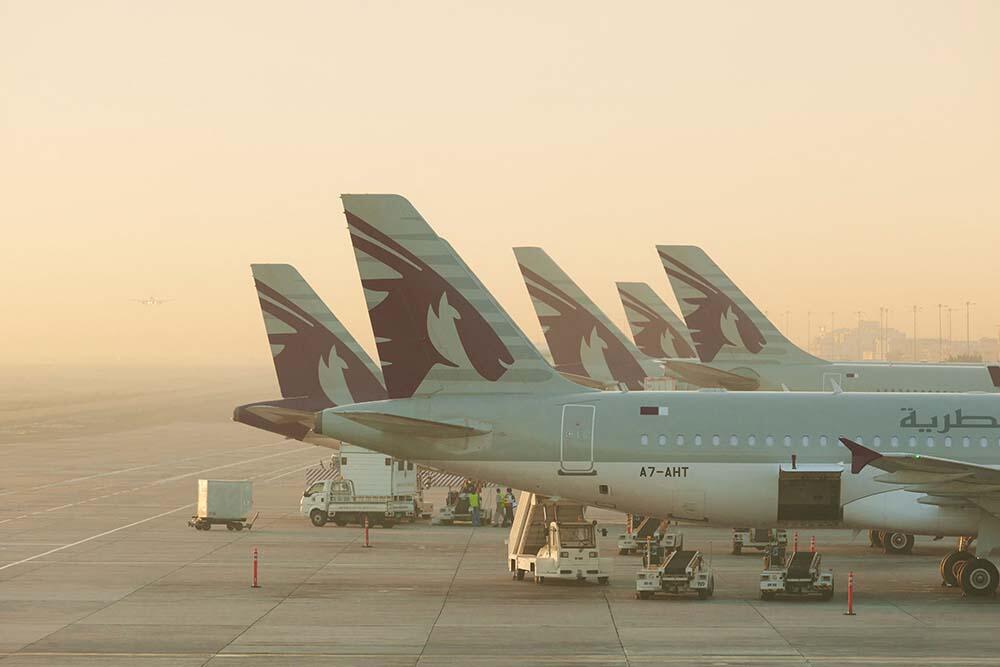
Harsh operating conditions and persistent supply chain constraints are accelerating a shift in how Middle East airlines source and manage aircraft parts, according to insights shared with Aviation Week by parts supplier Aventure Aviation during MRO Middle East in Dubai.
Amyr Qureshi, Aventure Aviation’s senior vice president, says airlines operating in the region are experiencing above-average component failure rates driven primarily by environmental extremes rather than fleet age. Wide temperature swings between day and night operations, combined with heat, humidity and airborne dust, are placing sustained stress on critical aircraft systems, forcing operators and MROs to reassess parts planning assumptions.
“The harsh environment mainly affects pneumatics, hydraulics, electromechanical actuators and, to some extent, avionics,” Qureshi says. The most exposed high-failure components include air cycle machines, heat exchangers, and outflow valves that see elevated removal rates. High wear is also recorded on wheels and brakes, auxiliary power units and engine quick-engine-change components, including starters, generators, fuel control units and pumps.
According to Qureshi, the impact extends beyond traditionally high-value rotable components. “Even wiper motors, wiper blades, angle-of-attack sensors and lavatory systems are prone to a higher-than-normal rate of snags,” he says. Typically, such component failures increase both the volume and unpredictability of maintenance events across fleets.
These reliability challenges are colliding with ongoing supply chain constraints, despite the Middle East’s strong OEM presence. Qureshi notes that airlines and MROs are increasingly adapting their sourcing strategies as parts manufacturers prioritize commitments to aircraft production programs.
He describes a structural imbalance in which parts manufacturers allocate a disproportionate share of their production capacity to support new aircraft manufacturing, leaving fewer components available for the aftermarket. Ultimately, this places additional pressure on maintenance control centers, aircraft-on-ground (AOG) desks and production planning teams. The result has been longer procurement cycles, rising acquisition costs and growing dependence on non-OEM supply channels to keep aircraft operational.
Qureshi suggests the shift toward alternative sourcing is accelerating. “It’s seen as an exponential trend rather than a declining trend,” he says, pointing to increased aftermarket activity to offset limited OEM availability. Airlines are seeking faster access to ready-to-use parts to avoid prolonged aircraft groundings, especially for components that fail more often under the region’s harsh conditions.
Getting parts quickly during AOG events now depends less on being physically close and more on smart inventory management and efficient logistics. Qureshi says operators are prioritizing suppliers that are capable of anticipating demand rather than reacting to failures. “We constantly keep track of the end users’ buying habits and their fleet parts reliability cognizance,” he says. He also notes that predictive analysis is central to reducing AOG exposure.
Airlines are relying more on logistics networks, with Middle East hubs now linked to global express freight systems, which speeds up the delivery of critical parts. Dubai now serves as a major hub for FedEx and UPS, while Bahrain is DHL’s regional hub, enabling direct connections from North America and Europe.
“These countries have evolved to be major hubs,” Qureshi says, “so the parts transit and trans-shipment times have been considerably shortened.” This allows airlines to better utilize worldwide parts stocks when their operations are disrupted.

Related Content